
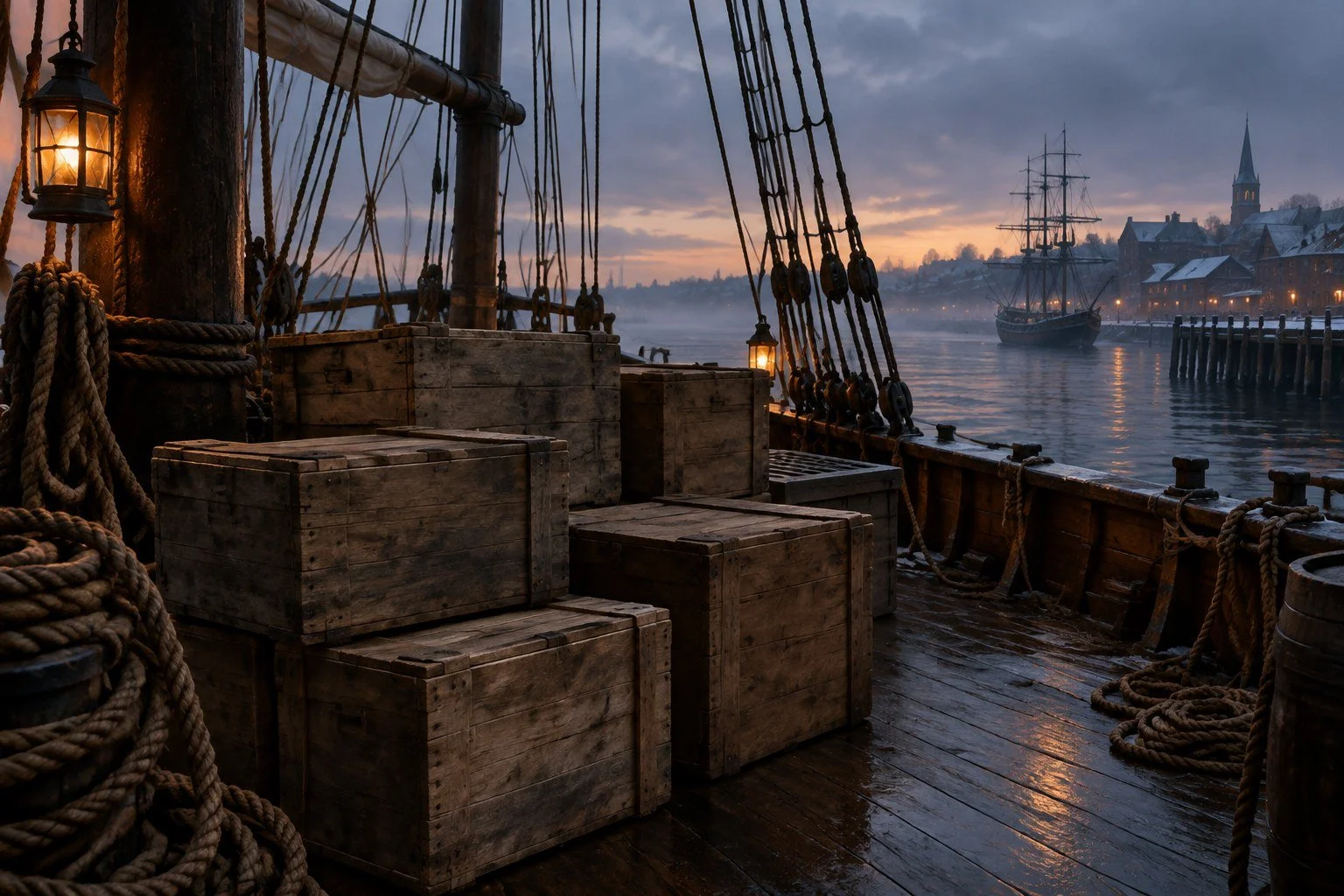
Here in "Beantown," it's hard to go far without bumping into the Boston Tea Party. Most of us learned that on December 16, 1773, colonists threw chests of East India Company tea into Boston Harbor. Few of us learned what was actually in those chests, or whether a tea drinker today would recognize it.
As tea enthusiasts, we couldn't resist digging in. It turns out the shipping paperwork still exists, and it tells a surprisingly detailed tea story.
The Tea Act and three ships at Griffin's Wharf
According to the Library of Congress, Parliament passed the Tea Act in 1773 to shore up the financially troubled East India Company. The act didn't add a new tax. The tea duty from the earlier Townshend Acts was already on the books, at three pence per pound. Instead, the act gave the Company a virtual monopoly on selling tea in the colonies. As the John F. Kennedy Presidential Library explains, letting the Company ship straight to colonial ports made its tea cheap enough to undercut the smuggled Dutch tea many colonists were drinking, even with the duty included.
Instead of welcoming cheaper tea, many colonists saw paying the duty as accepting Parliament's right to tax them without representation. According to Britain's National Archives, tea ships sent to Philadelphia and New York were turned back, and in Charleston the tea was left unopened on the docks.
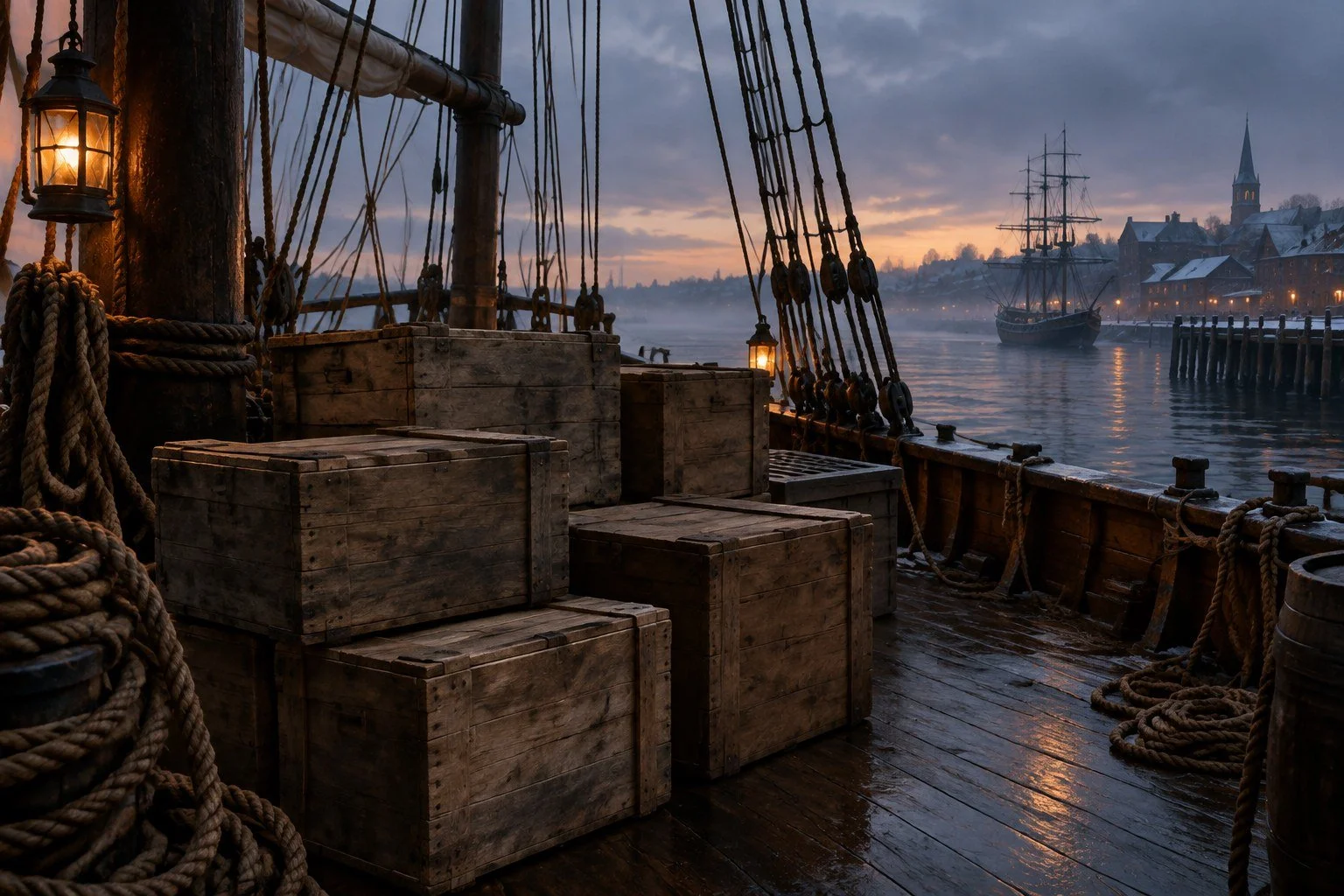
In Boston, the ships Dartmouth, Eleanor and Beaver tied up at Griffin's Wharf. The Massachusetts Historical Society describes weeks of mass meetings at Old South Meeting House and a hard deadline: if the duty on the Dartmouth's tea wasn't paid by December 17, customs officers could seize the cargo. On the evening of December 16, after Governor Thomas Hutchinson refused to let the ships leave without unloading, a group of men disguised as Native Americans boarded the three ships and dumped the tea into the harbor.
How much tea, really?
You'll see different numbers depending on where you look. The Massachusetts Historical Society has used both 342 and 340 chests in different places, and many accounts say "about 92,000 pounds." The most precise record we found is the East India Company's own invoice, sent to the British government in February 1774 with a request for compensation and now held by the National Archives. It lists 340 chests, valued at £9,659, 6 shillings and 4 pence.
Adding up the weights on that invoice gives roughly 92,600 pounds of tea.
The five teas in the chests
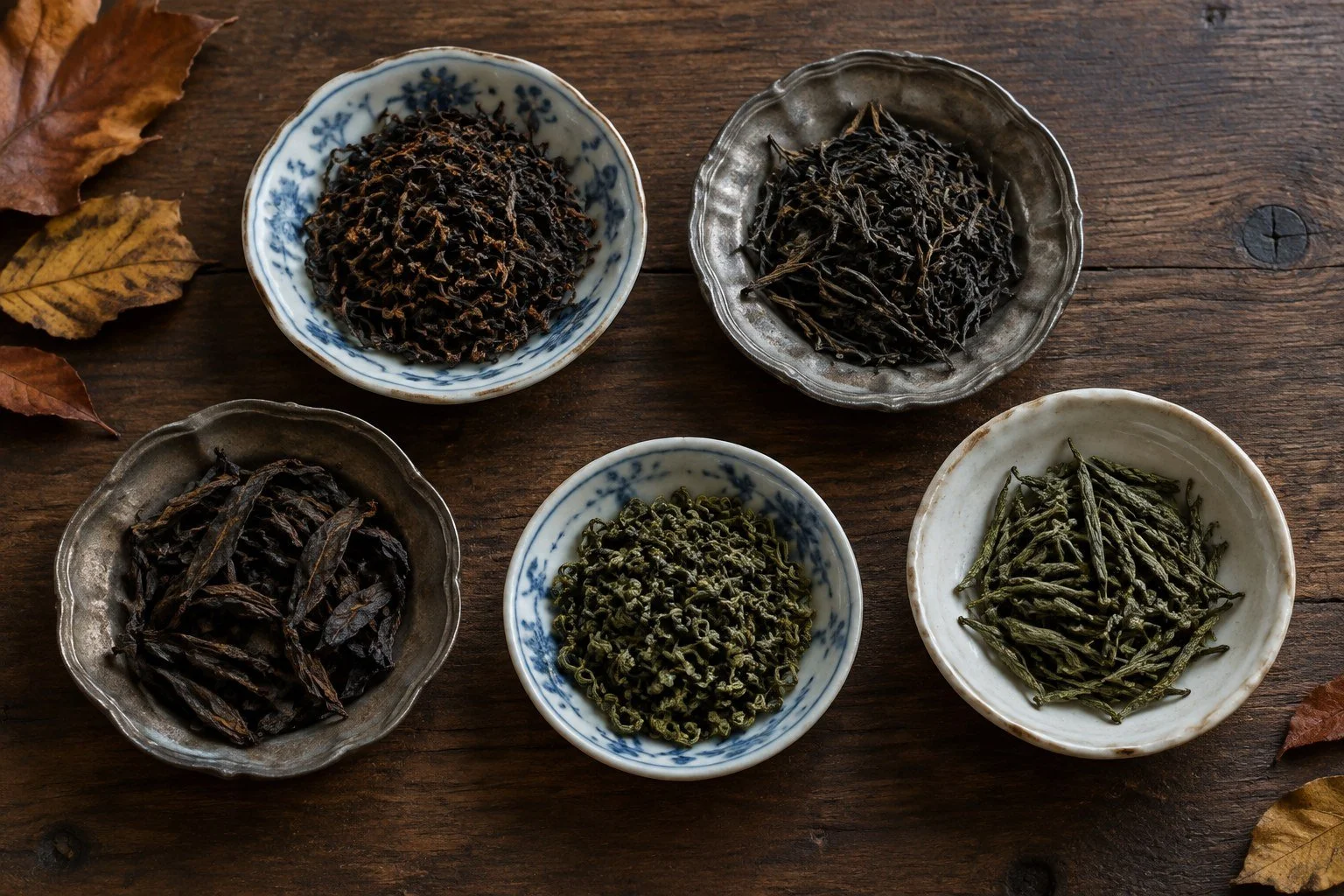
Here's the part we love. The same invoice breaks the cargo down by tea type, chest by chest and ship by ship. There were five teas, and every one of them came from China. As the Boston Tea Party Ships & Museum points out, none of it was from India, because tea wasn't cultivated in India or Sri Lanka until the 19th century.
Bohea (240 chests). This was the everyday black tea of the 18th century, and it filled the great majority of the chests: by the invoice weights, more than nine pounds out of every ten. According to Merriam-Webster, the name comes from the Fujianese pronunciation of the Wuyi hills in Fujian Province, where it was grown. In the tea trade, "Bohea" became shorthand for black tea in general, and even John Adams wrote in his diary the next morning that "3 Cargoes of Bohea Tea were emptied into the Sea." It was also the cheapest tea on board, invoiced at 2 shillings a pound.
Congou (15 chests). A step up from Bohea. Merriam-Webster traces the name to a Chinese (Xiamen) phrase meaning "pains taken," a nod to the extra care in making it. The museum describes Congou as a well-made black tea that brewed a deep, clear red cup.
Souchong (10 chests). Another black tea from the Wuyi Mountains. The museum explains that souchong (xiaozhong) means "small leaf variety," and that the souchong of the colonial era likely carried only a slight smoky note picked up during drying. Today's intentionally pine-smoked version is what we know as Lapsang Souchong.
Singlo (60 chests). A green tea whose name, according to the museum, is an Anglicization of the Songluo (Sunglo) mountains in today's Anhui Province. It was picked later in the season than Hyson, with somewhat larger leaves. The museum says the Company included it partly because it had a lot of stock to sell before it lost its quality.
Hyson (15 chests). The prize of the cargo. The Collins English Dictionary traces "hyson" to a Chinese name meaning "bright spring," and the early-season grade was sold as "young hyson." On the invoice, Hyson cost 5 shillings a pound, more than twice the price of Bohea. The museum notes it was a favorite of both George Washington and Thomas Jefferson.
Was it any good?
Honestly, probably not by today's standards. The black teas, especially Bohea, were the bulk commodity teas of their day. The museum suggests that much of the shipment had already spent a long time in transit and in London warehouses before it ever sailed for Boston, and green tea in particular loses freshness quickly. One old London description quoted by the museum calls Bohea dark, dull and frequently smoky. Historians and tea writers don't fully agree on exactly how each of these 18th-century teas was processed, so it's best to think of them as ancestors of today's teas rather than exact matches.
Some of the leaves did survive, in a way. The Massachusetts Historical Society keeps a small glass bottle of tea leaves said to have been gathered on the shore of Dorchester Neck the morning after the protest. The American Antiquarian Society has a similar bottle, and its curators note that the story of exactly who collected the tea is part lore. And according to the Boston Tea Party Ships & Museum, one wooden half chest, the Robinson Half Chest, is the only known chest from that night still in existence.
Tasting the Boston Tea Party today
You don't need a time machine to taste these teas' descendants. Here's how we'd build a "Tea Party" tasting from our shelves:
For Bohea: Our Wuyi Oolong comes from the very same Wuyi Mountains in Fujian that gave Bohea its name. It's toasty, earthy and honeyed. The Boston Tea Party Ships & Museum itself compares the flavor of Bohea to a contemporary oolong.
For Congou and Souchong: Our China Black Tea is a classic Chinese black tea, medium to full-bodied, slightly malty and sweet. For something more refined, try Keemun Mao Feng. Keemun came along later, in 1875, when Qimen County in Anhui began making black tea using Fujian methods. Its tightly rolled leaves brew a reddish, winey cup that captures the spirit of a carefully made China black tea.
For Singlo and Hyson: Our Chun Mee Green Tea is a traditional pan-fired Chinese green tea whose roots tea historians trace to the green teas of Anhui, the same region as Singlo and Hyson. It's full-bodied, nutty and lightly smoky, with curved "eyebrow" leaves.
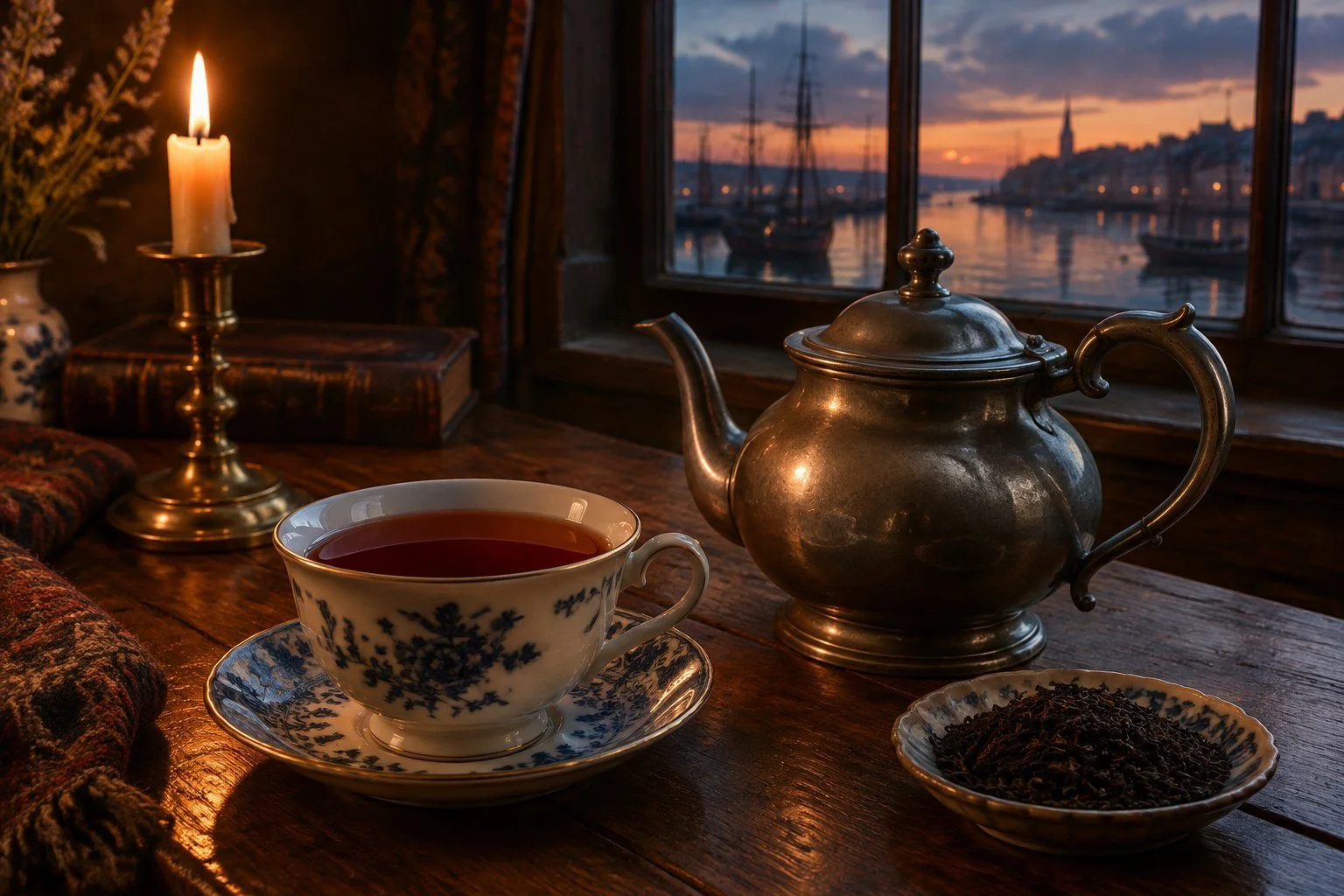
Brew the black teas with freshly boiled water (205 to 212°F) for 3 to 5 minutes, and the Wuyi Oolong at 185 to 205°F for 3 to 5 minutes. Keep the Chun Mee cooler, at 175 to 185°F for 2 to 3 minutes. Then taste them side by side and imagine choosing between 2-shilling Bohea and 5-shilling Hyson in 1773. It's a fun way to spend a chilly evening this Halloween week, with or without a bowl of candy nearby.
A Boston story worth steeping
The Boston Tea Party is remembered as a political protest, and it was. But it was also about real teas from real mountains in Fujian and Anhui that people on both sides of the Atlantic loved to drink. Explore our Black Tea collection and Green Tea collection, brew a cup, and raise it to Boston's most famous tea night. We promise not to throw any of it in the harbor.