
Chamomile and Sleep: What the Research Really Says
When the November evenings close in before dinner, a warm cup of chamomile is one of the oldest wind-down rituals around. Chamomile has a big reputation as a "sleepy tea," but what does the research actually say? We dug into the published studies, read the abstracts and reviews ourselves, and pulled together an honest, plain-English look at what's known, what isn't, and how to enjoy a calming caffeine-free cup at the end of the day.
Why Chamomile Has a Reputation for Sleep
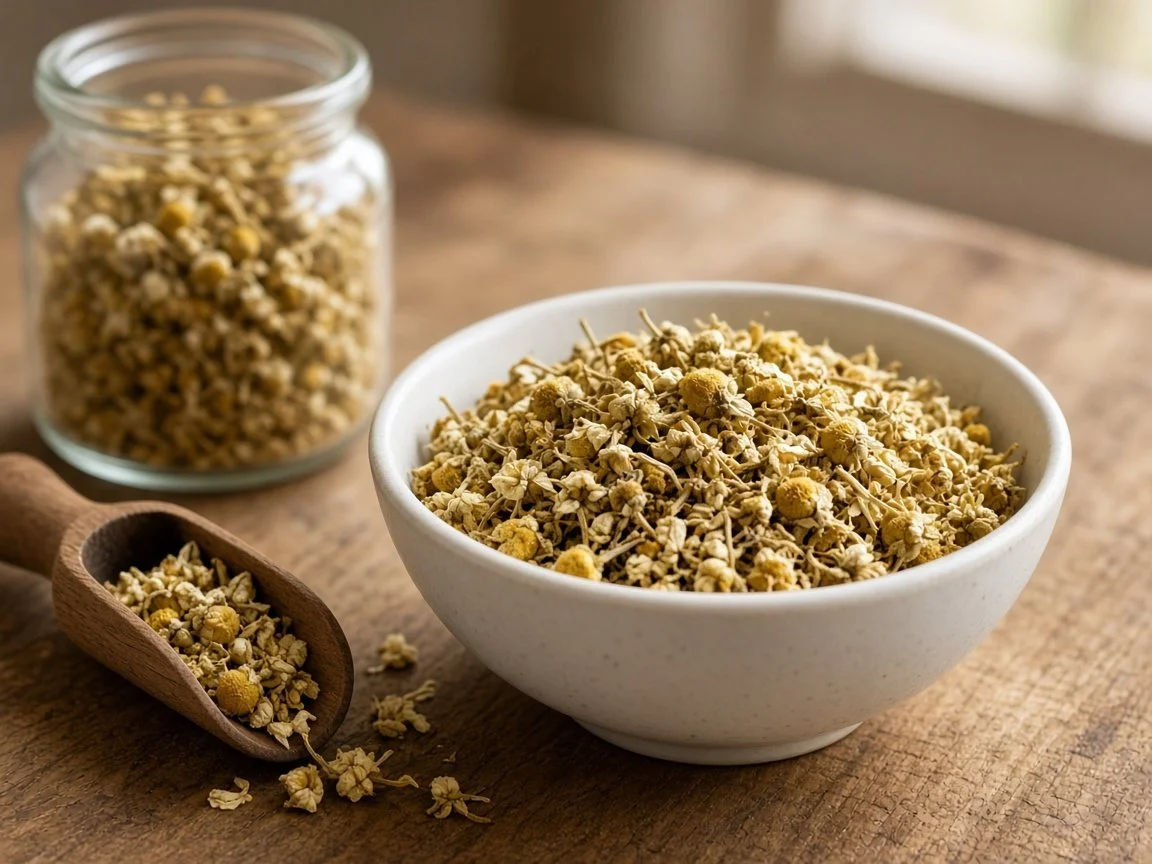
Chamomile is a daisy-like flower from the Asteraceae (Compositae) family, and people have been brewing it for a very long time. There are two common types, German chamomile and Roman chamomile.
A widely cited review from researchers at Case Western Reserve University describes chamomile as one of the most ancient medicinal herbs known, with chamomile tea consumed at a rate of more than one million cups per day. Traditionally, chamomile tea has been used to help with sleeplessness and to calm nerves (Srivastava et al., 2010).
Why might it work? The same review explains that chamomile's calming effect may come from apigenin, a flavonoid in the flowers that binds to benzodiazepine receptors in the brain. That's an interesting lead, but most of that evidence comes from lab and animal studies. At the time of that review, the authors noted that clinical trials in people were "notable for their absence." Since then, a handful of human studies have been published, and they are where things get more interesting.
What the Human Studies Found
A chamomile tea study in new mothers. In a randomized controlled trial from Taiwan, 80 postnatal women with poor sleep quality were split into two groups of 40. One group drank chamomile tea for two weeks, and the other received regular postpartum care only. After two weeks, the tea group had lower scores for physical symptoms linked to poor sleep and fewer symptoms of depression. But by the four-week check, two weeks after the tea stopped, the groups looked similar again, so the benefit seemed to last only while the women were drinking it (Chang & Chen, 2016). This one is notable because it used actual brewed tea, not a capsule. It wasn't blinded or placebo-controlled, though, since the comparison group drank no tea at all.
Chamomile extract in older adults. In a single-blind trial in Iran, 60 adults aged 60 or older living at a day care nursing home took either 200 mg chamomile extract capsules or placebo capsules (made with wheat flour) twice a day for 28 days. Sleep quality, measured with the Pittsburgh Sleep Quality Index, was significantly better in the chamomile group after the intervention (Adib-Hajbaghery & Mousavi, 2017).
Chamomile extract for chronic insomnia. A small pilot study at the University of Michigan tested 270 mg of chamomile extract twice a day against a placebo for 28 days in 34 adults with chronic primary insomnia. This time the results were mixed. There were no significant differences between the groups in sleep diary measures such as total sleep time, time to fall asleep, night awakenings or sleep quality. Chamomile showed a modest advantage on daytime functioning, but that didn't reach statistical significance either (Zick et al., 2011).
Putting the studies together. A 2019 systematic review and meta-analysis gathered 12 randomized trials of chamomile for anxiety and sleep. Pooling the sleep-quality studies, the authors found a significant improvement in sleep quality with chamomile. For insomnia itself, they found only one trial, and it showed no significant change in insomnia severity. They concluded that larger trials are needed (Hieu et al., 2019).
The Honest Bottom Line
Put simply, small studies suggest chamomile is linked with better sleep quality, especially for people who already sleep poorly, like new mothers and older adults. It hasn't been shown to treat insomnia, the medical sleep disorder.
A few limitations are worth keeping in mind:
The studies are small. We're talking about 34 to 80 people per trial.
Most used extracts, not tea. Two of the three trials above used concentrated capsules, so it's hard to know how much chamomile is in an ordinary home-brewed cup by comparison.
Benefits may be short-lived. In the tea study, the improvement faded once people stopped drinking it.
Some studies weren't fully blinded, and people often feel better simply from a relaxing routine.
Our take: chamomile isn't a sleeping pill, and it doesn't need to be. A warm, caffeine-free cup is a lovely signal to your body and mind that the day is winding down, and the research suggests it may help a little too.
A Few Safety Notes
The U.S. National Center for Complementary and Integrative Health (NCCIH) says chamomile is likely safe in the amounts commonly found in teas. Allergic reactions are uncommon but can happen, and they're more likely if you're allergic to related plants like ragweed, chrysanthemums, marigolds or daisies. NCCIH also notes reported interactions with warfarin (a blood thinner) and some drugs processed by the liver, possible interactions with sedatives, and that chamomile might reduce the effect of birth control pills. Little is known about its safety during pregnancy or breastfeeding (NCCIH).
If you're pregnant or breastfeeding, take medications, or are managing a health condition, please talk with your doctor before making chamomile a nightly habit. And if poor sleep is sticking around, that's worth a conversation with your doctor too.

Making Chamomile Part of Your Evening
If you'd like to give chamomile a try, our Sleep Well herbal blend is a gentle place to start. It's our own caffeine-free blend of chamomile, peppermint, lemongrass and green rooibos: soft, floral and lightly minty, with a lemony lift. (Since it's a blend, keep in mind that the studies above looked at chamomile alone, not this exact recipe.)
A few tips for a calming cup:
Brew it fully. Use 1 to 2 teaspoons per 8 oz of freshly boiled water and steep 5 to 7 minutes. Cover your cup while it steeps to keep the aroma in.
Make it a ritual. Brew your cup about an hour before bed, dim the lights, and put the phone down while you sip.
Watch the afternoon caffeine. Green, black and oolong teas all contain caffeine. Our post on L-theanine and caffeine in tea explains how that works, and switching to herbal tea later in the day is an easy swap.
Rotate your caffeine-free favorites. If chamomile isn't your thing, our Peppermint, Organic Rooibos and Vanilla Rooibos are all naturally caffeine free. For more ideas, see our list of caffeine-free teas for cozy nights.
You'll find all of these in our Herbal Tea collection. Like everything at Beantown Tea & Spices, they're quality loose-leaf teas at affordable prices, with sample sizes that make it easy to find your favorite evening cup. Sweet dreams!
Sources
Srivastava JK, Shankar E, Gupta S. Chamomile: A herbal medicine of the past with bright future. Molecular Medicine Reports. 2010;3(6):895-901. doi:10.3892/mmr.2010.377 (PubMed 21132119)
Chang SM, Chen CH. Effects of an intervention with drinking chamomile tea on sleep quality and depression in sleep disturbed postnatal women: a randomized controlled trial. Journal of Advanced Nursing. 2016;72(2):306-315. doi:10.1111/jan.12836 (PubMed 26483209)
Adib-Hajbaghery M, Mousavi SN. The effects of chamomile extract on sleep quality among elderly people: A clinical trial. Complementary Therapies in Medicine. 2017;35:109-114. doi:10.1016/j.ctim.2017.09.010 (PubMed 29154054)
Zick SM, Wright BD, Sen A, Arnedt JT. Preliminary examination of the efficacy and safety of a standardized chamomile extract for chronic primary insomnia: a randomized placebo-controlled pilot study. BMC Complementary and Alternative Medicine. 2011;11:78. doi:10.1186/1472-6882-11-78 (PubMed 21939549)
Hieu TH, Dibas M, Surya Dila KA, et al. Therapeutic efficacy and safety of chamomile for state anxiety, generalized anxiety disorder, insomnia, and sleep quality: A systematic review and meta-analysis of randomized trials and quasi-randomized trials. Phytotherapy Research. 2019;33(6):1604-1615. doi:10.1002/ptr.6349 (PubMed 31006899)
National Center for Complementary and Integrative Health. Chamomile. nccih.nih.gov/health/chamomile