

On a cold November night, a mug of rooibos is about as cozy as it gets: deep red, naturally sweet, and caffeine free, so you can enjoy a second cup right before bed. But that humble "red bush" has a surprisingly dramatic backstory. It involves mountain harvesters and donkeys, a tea merchant who borrowed a Chinese black tea method, a country doctor who cracked the secret of a stubborn seed, and a name that's now protected like champagne.

A plant that grows in one small corner of the world
Rooibos (say "ROY-boss") is Afrikaans for "red bush." Botanically it's Aspalathus linearis, a needle-leaved shrub in the legume family. It isn't related to the tea plant, Camellia sinensis, at all, which is why rooibos has no caffeine.
What makes rooibos special is how picky it is about where it lives. It grows in the fynbos, the unique scrubland of South Africa's Western Cape, and it's farmed almost entirely in the Cederberg mountain region, roughly 155 miles north of Cape Town. Even today, virtually all the world's rooibos comes from this one small area.
Mountain harvests, done by hand
According to botanists Ben-Erik van Wyk and Boris Gorelik, who studied the history of Cape herbal teas, the earliest written records of rooibos as a drink date to the late 1800s. It was a traditional drink of the Khoi-descended people of the Cederberg. Archaeological evidence suggests people knew the plant much earlier, but historians are careful to say that doesn't prove it was brewed as tea in precolonial times.
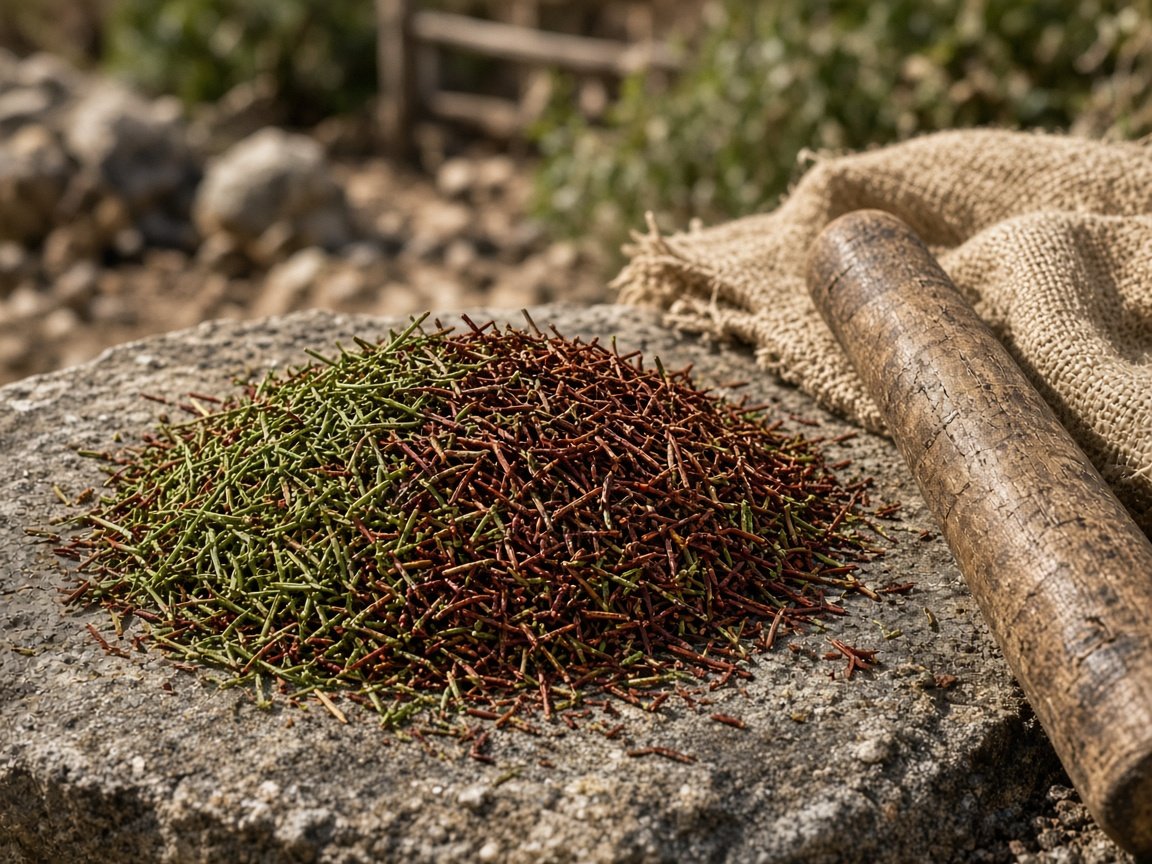
The traditional harvest was hard work. People climbed the mountains, cut the fine needle-like leaves from wild bushes, bundled them into hessian sacks, and brought them down the steep slopes by donkey. Then they bruised the leaves by beating them on a flat rock with a heavy wooden club or hammer, and left them to oxidize and dry in the sun. That oxidation is what turns the green leaves the deep red-brown that gives rooibos its name and its warm, sweet flavor.
A myth worth busting: you may read that the Swedish botanist Carl Peter Thunberg described rooibos tea in 1772. He did write that "country people make tea" from a local plant, but according to van Wyk and Gorelik, he was describing a related Aspalathus species, not rooibos itself.
The tea merchant who saw its potential
The first person to sell rooibos on a larger scale was Benjamin Ginsberg, often called the father of the rooibos industry. Drawing on his family's tradition of brewing tea and herbal infusions, in 1904 he began experimenting with rooibos at Rondegat Farm.
His clever idea was to cure rooibos the way Chinese tea makers produced Keemun black tea, by fermenting (oxidizing) the leaves in barrels. It worked, and he began trading rooibos to a wider market. There was just one big problem: every leaf still came from wild plants, and nobody knew how to grow rooibos from seed.
A country doctor and a stubborn seed
By the late 1920s, demand was outgrowing the wild supply. Enter Dr. Pieter le Fras Nortier, the district surgeon in the town of Clanwilliam and an avid amateur naturalist. With the encouragement of Ginsberg and the help of local farmers Oloff Bergh and William Riordan, Nortier set out to turn wild rooibos into a farm crop.
The seeds were tiny, hard-shelled and very hard to find. As the story is told in a 1949 book by Lawrence Green, an elderly Khoi woman found a remarkable source: she noticed ants dragging rooibos seeds, followed them to their nest, and found a whole store of seeds inside.
Nortier started his cultivation experiments in 1930 and eventually discovered the secret. The seeds' tough coats had to be scarified (lightly scratched or scuffed) before planting in acidic, sandy soil. He then showed local farmers how to germinate their own seed. The variety he developed became the backbone of the industry, and in 1948 Stellenbosch University awarded him an honorary doctorate for his contribution to South African agriculture. Today rooibos is the economic mainstay of the Clanwilliam district.
From local drink to a name protected like champagne
For most of the 20th century, rooibos was mainly a South African favorite. Around the early 2000s, it caught on around the world as more people went looking for flavorful caffeine-free drinks.
Along the way, the name itself became a legal battle. In 1994, a U.S. company registered "Rooibos" as a trademark, when the plant was barely known in America, and later demanded fees from other sellers. The American Herbal Products Association and several importers fought back, and by 2005 the name was returned to the public domain.
South Africa then moved to protect it. In 2013, its Department of Trade and Industry restricted the names "rooibos" and "red bush" to products made from Aspalathus linearis. In 2021, the European Union gave rooibos protected designation of origin (PDO) status, the same kind of protection that covers champagne. Anything sold as rooibos in the EU must come from rooibos grown in the Cederberg region.
Red rooibos and green rooibos
Most rooibos is the classic red, oxidized just as the Cederberg harvesters did it by hand, now with modern equipment. There's also green rooibos, which skips oxidation, a bit like green tea. Because it's more demanding to produce, green rooibos is less common. It brews a lighter, fresher cup with a malty, slightly grassy flavor.
Taste the story at Beantown Tea
Here's how to explore the red bush at home:
Vanilla Rooibos: top-grade rooibos with natural vanilla, smooth and dessert-like without any sugar. It's one of our five November Monthly Picks, 20% off through November 30.
Organic Rooibos: the classic. Naturally sweet, smooth and caffeine free, a lovely alternative to tea at any time of day.
Organic Green Rooibos: the unoxidized style, lighter and more delicate, with grassy notes that remind some people of a good sencha.
Summer Medley Green Rooibos: green rooibos in a bright, fruity blend.
Rooibos Chai (Caffeine Free): masala spices and vanilla with sweet rooibos, perfect for chilly evenings, with or without a splash of milk.
Brewing tip: rooibos is low in tannins, so it's very forgiving. Use about 1 teaspoon per 8 oz cup and freshly boiled water, and steep around 5 minutes, or longer if you like it bolder. It's delicious plain or with milk and honey, and it makes a wonderful iced tea too. Our tea brewing guide has more tips.
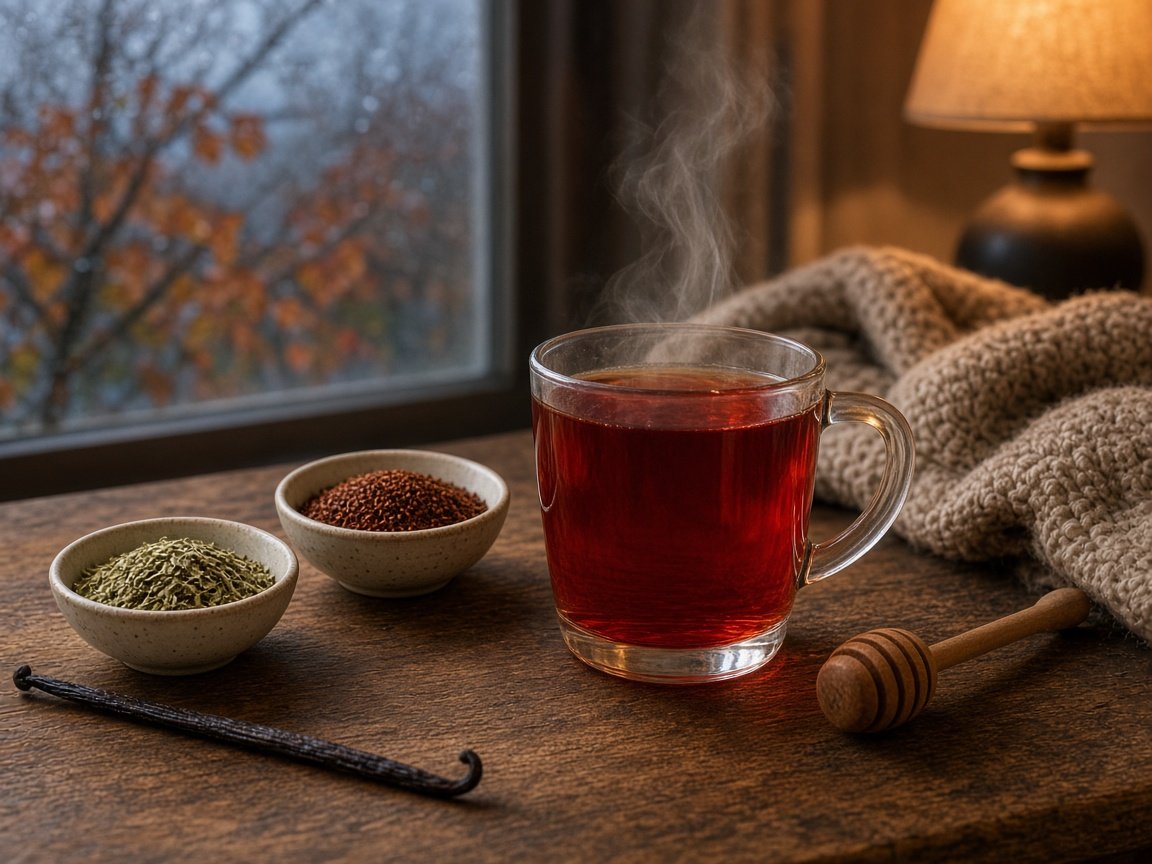
So the next time you pour a cup of rooibos, think of the harvesters cutting wild bushes on the Cederberg slopes, Ginsberg and his barrels, and Dr. Nortier patiently coaxing a stubborn seed to sprout. That's a lot of history in one cozy, caffeine-free mug.
Sources
- Van Wyk, B.-E. and Gorelik, B. (2017). "The history and ethnobotany of Cape herbal teas." South African Journal of Botany, 110: 18–38.
- Gorelik, B. (2018). "Rooibos: an ethnographic perspective." South African Rooibos Council.
- Green, L. (1949). In the Land of the Afternoon. Standard Press.
- American Herbal Products Association, "Rooibos Trademark Abandoned."
- Republic of South Africa, Department of Trade and Industry, Merchandise Marks Act final prohibition notice (September 6, 2013).
- AFP via International Business Times (June 9, 2021), "S. Africa's rooibos tea joins champagne on EU protection list."