
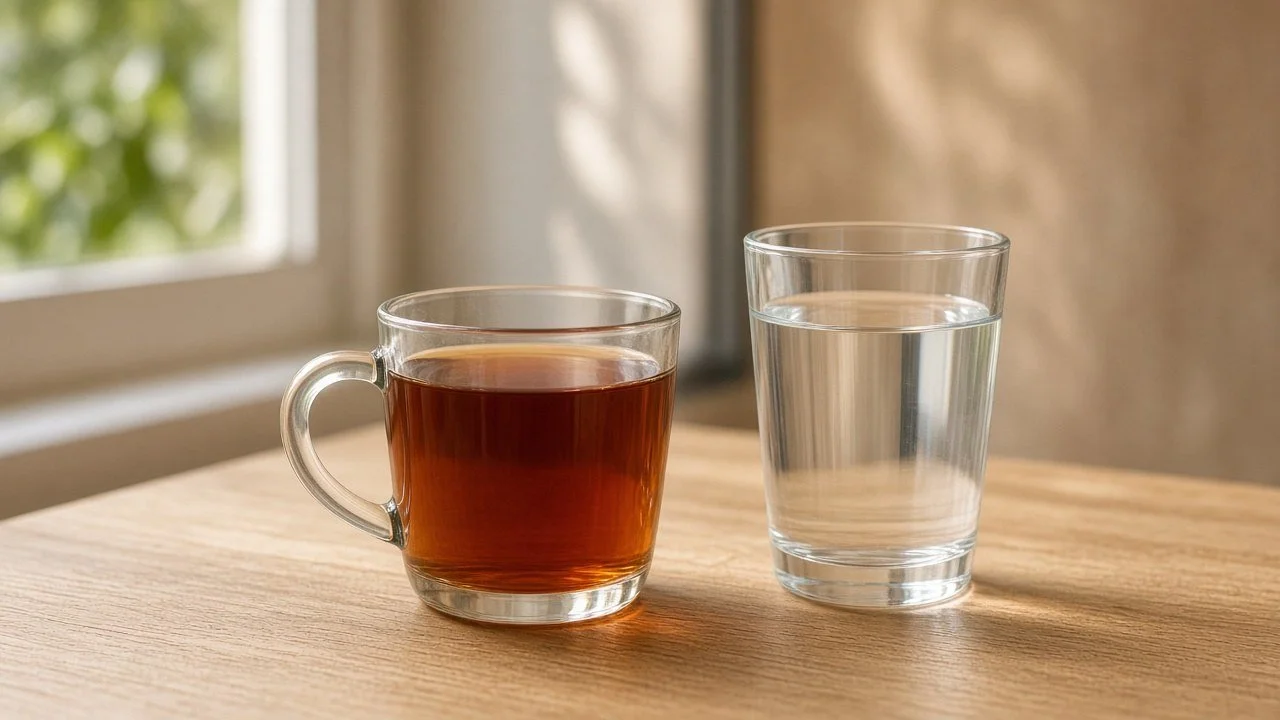
You've probably heard it: "Tea doesn't count toward your water for the day, because the caffeine dries you out." It's one of the most repeated bits of tea advice out there. But is it true?
Researchers have tested this in controlled studies, and the answer is reassuring for tea lovers. Here's what they found, how much caffeine is involved, and where the evidence has gaps. With the heat on indoors, cooler days make it easy to forget to drink, so it's a good week to look at what's in your mug.
Where the "Tea Dehydrates You" Idea Comes From
The myth has a grain of truth. Caffeine has a mild diuretic effect, meaning it can make your kidneys produce a bit more urine. The real question is whether that outweighs all the water in the cup, and brewed tea is almost entirely water.
A 2004 report from the U.S. National Academies said about 80 percent of the water people take in comes from drinking water and beverages, "including caffeinated beverages," with the rest coming from food. It added that most healthy people meet their needs by letting thirst guide them. Mayo Clinic's current guidance agrees: tea, coffee and milk help keep you hydrated and count toward your daily fluids.
What the Research Says
1. Black tea vs. water, cup for cup
Journal: British Journal of Nutrition, 2011 (randomized controlled crossover trial)
UK researchers had 21 healthy men spend four separate 12-hour days in a lab. On different days they drank four or six mugs (240 ml each) of black tea with a splash of milk, or the same amounts of boiled water. Four mugs provided 168 mg of caffeine; six provided 252 mg. Food was controlled and the men stayed at rest. Across a long list of blood and urine hydration markers, including 24-hour urine volume, there were no significant differences between tea and water. The authors concluded that black tea, in these amounts, hydrated much like water.
Limits: A small study of men only. Participants weren't blinded, and drinks after the lab session weren't controlled. It was funded by the Tea Advisory Panel, which is supported by the UK Tea Council, the trade association for the UK tea industry.
2. Ranking 13 drinks with a "Beverage Hydration Index"
Journal: American Journal of Clinical Nutrition, 2016 (randomized trial)
Scientists at three UK universities had 72 men drink 1 liter of water or one of several common drinks over 30 minutes, then collected their urine for four hours. Hot and iced black tea were tested alongside coffee, cola, juice, milk and others; the tea had 179 mg of caffeine per liter. Urine output after hot or iced tea was no different from water. Milk and an oral rehydration solution were retained a bit longer than water, likely thanks to their electrolytes. The authors saw no measurable effect of moderate caffeine (96 to 212 mg) on fluid balance.
Limits: Men only, over just four hours. Downing a liter of hot tea in 30 minutes isn't how anyone sips tea, and six volunteers dropped out because drinking that much hot tea so quickly made them sick. The study was funded by the European Hydration Institute, and the lead author chaired that institute's scientific advisory board.
3. A look at coffee, tea's stronger cousin
Journal: PLoS One, 2014 (counterbalanced crossover study)
Coffee has the same "dehydrating" reputation, so it's useful context. University of Birmingham researchers had 50 male coffee drinkers spend three days drinking four 200 ml cups of coffee a day, and three days drinking the same amount of water. Total body water, blood markers and 24-hour urine volume showed no significant differences between the two.
Limits: Participants were men who already drank 3 to 6 cups a day, so results may not apply to people who rarely have caffeine. One author was employed by PepsiCo at the time of publication.
4. The review that put caffeine dose in context
Journal: Journal of Human Nutrition and Dietetics, 2003 (literature review)
This review pulled together decades of caffeine research. A short-term rise in urine output showed up mainly with large doses, at least 250 to 300 mg at once (about 2 to 3 cups of coffee or 5 to 8 cups of tea), and mostly in people who had gone without caffeine for days or weeks. Regular drinkers build a strong tolerance, and standard servings of tea and coffee appeared to have no diuretic effect.
Limits: A narrative review, not a new experiment, covering studies only through early 2002.
How Much Caffeine Is in Your Cup?
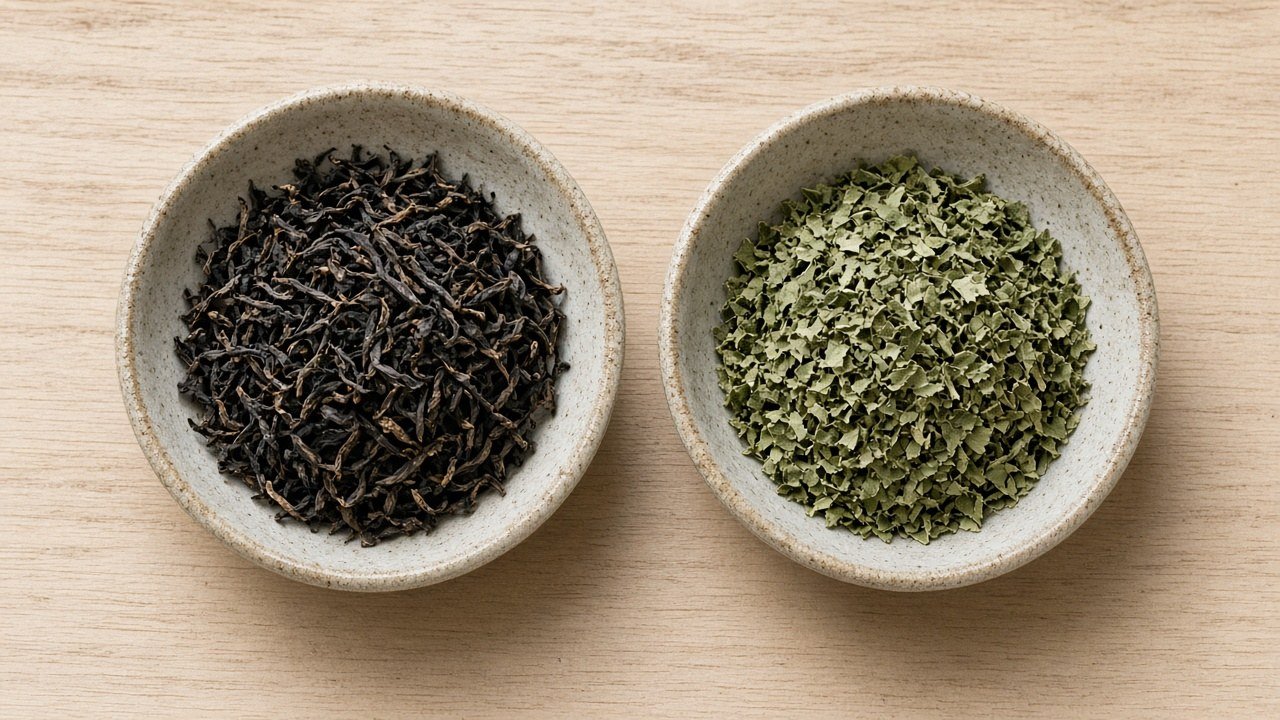
Caffeine varies with the tea and steep time, so treat these Mayo Clinic figures for an 8 oz cup as rough guides:
Brewed coffee: 96 mg
Brewed black tea: 48 mg
Brewed green tea: 29 mg
Brewed decaf black tea: 2 mg
Herbal teas like peppermint, rooibos and fruit blends: naturally caffeine free
By those numbers, 250 to 300 mg is roughly five or six cups of black tea at once, far more than most people drink in one sitting. The FDA cites 400 mg a day as an amount not generally linked with negative effects for most adults, but sensitivity varies a lot from person to person. (Tea's other well-known compound, L-theanine, was the subject of an earlier post.)
What About Herbal Teas?
Herbal teas like peppermint, rooibos and fruit blends are brewed like tea but contain no caffeine, so the diuretic question doesn't really come up. They count toward your fluids like any unsweetened drink, and they're an easy warm cup for evenings. Just go easy on the honey or sugar.
The Bottom Line
Tea counts. Research suggests that moderate amounts of black tea hydrate about as well as water in healthy adults.
Dose matters. Caffeine's small diuretic effect shows up mainly at large single doses (250 to 300 mg or more) and fades in regular drinkers.
Herbal teas are an easy add. Caffeine-free blends count as fluids and work well later in the day.
The evidence has gaps. Key studies are small, in men, and partly industry-funded.
Easy Ways to Sip More This Week
Brew a full pot instead of a single cup, and refill through the day.
Switch to a caffeine-free herbal tea in the afternoon and evening.
Make a pitcher of iced herbal tea and keep it in the fridge.
Let thirst be your guide, and drink more when you're active or sweating.
Teas to Try This Week
A few of our teas to keep your mug full, with tips from each product page:
English Breakfast: a full-bodied blend of Ceylon, Kenya and India black teas that takes milk very well. Use 1 rounded teaspoon (about 2 to 3 g) per 8 oz of freshly boiled water (205 to 212°F) and steep 3 to 5 minutes.
Irish Breakfast: a strong, malty Assam and Kenya blend, best with milk. Use 1 rounded teaspoon (about 2 to 3 g) per 8 oz of freshly boiled water (205 to 212°F) and steep 3 to 5 minutes.
Peppermint: cool, clean and naturally caffeine free. Use 1 to 2 teaspoons per 8 oz of freshly boiled water (212°F) and steep 5 to 7 minutes. For iced peppermint, brew it double strength and pour over ice.
Organic Rooibos: naturally sweet, smooth and caffeine free, a popular evening drink. Use 1 to 2 teaspoons per 8 oz of freshly boiled water (212°F) and steep 5 to 7 minutes.
Very Berry: a bright, tart fruit blend of rose hips, hibiscus, cranberries and blueberries, naturally caffeine free with no added sugar. Use 2 teaspoons per cup of freshly boiled water and steep 5 to 10 minutes.
This post is for general information only and is not medical advice. If you have a medical condition (for example, one that limits how much fluid you should drink), are pregnant or breastfeeding, take medication, or are sensitive to caffeine, please talk with your health care provider about what's right for you.