
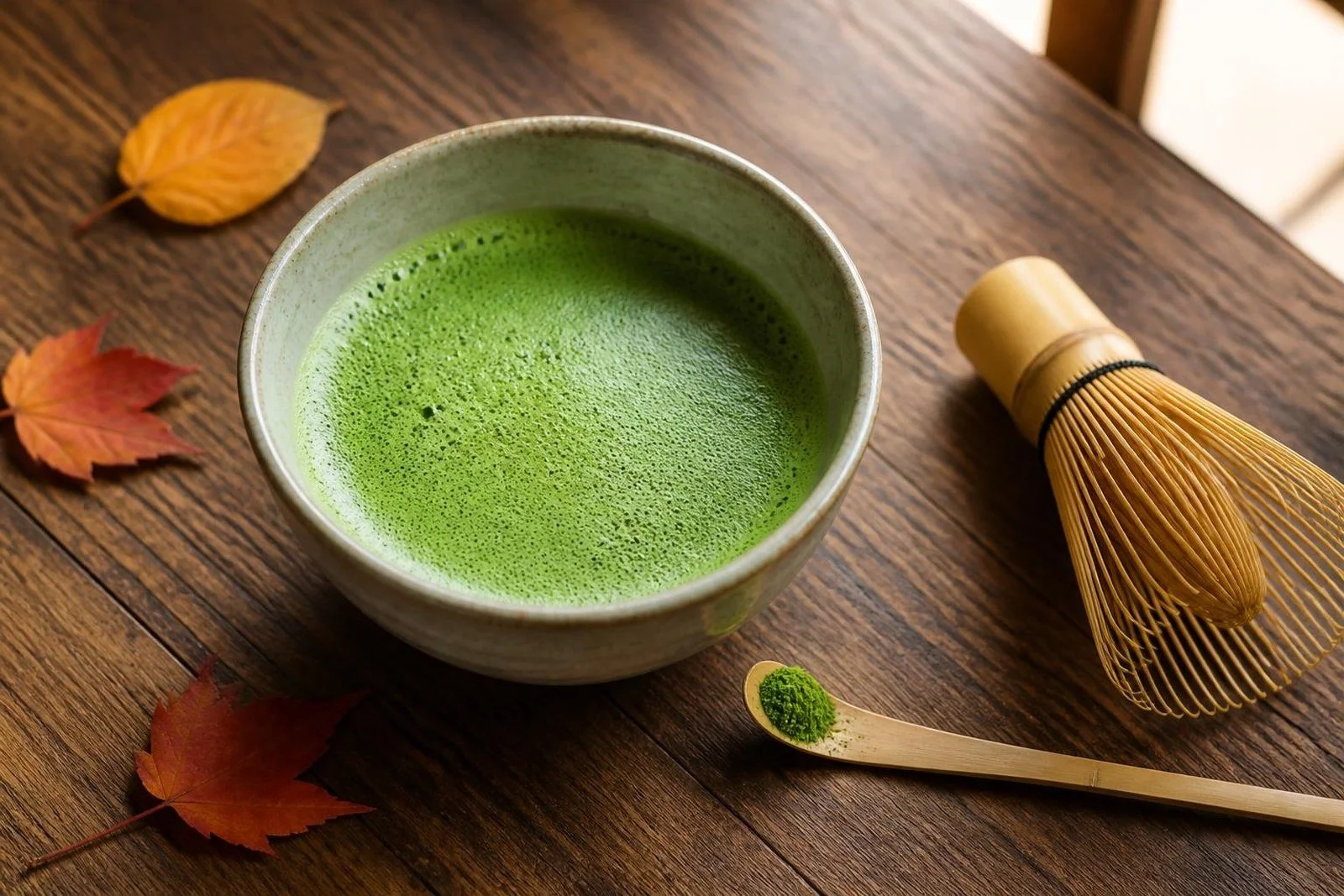
Ask a group of tea drinkers how a cup of tea makes them feel, and many will say the same thing: awake, but in a gentler way than coffee. Some people call it "calm focus." Is there something real behind that feeling, or is it just the cozy ritual of brewing a cup?
Researchers have been testing this for years, mostly by looking at two natural compounds in tea leaves: caffeine and an amino acid called L-theanine. Here's what the studies found, what they didn't, and how much caffeine different teas contain. With darker afternoons and a busy Halloween week ahead, it's a good time to think about what's in your mug.

What Is L-Theanine?
L-theanine (often just called theanine) is an amino acid found naturally in tea. Coffee doesn't contain it. That simple difference is one reason scientists wonder whether theanine helps explain why tea and coffee can feel so different, even though both contain caffeine.
One thing to keep in mind: many studies test theanine and caffeine as measured ingredients, not as brewed tea, and often in larger amounts than one cup provides.
What the Research Says
1. The big picture: a 2025 review of 50 trials
Journal: Nutrition Reviews, 2025 (systematic review and meta-analysis)
A team at the University of Aberdeen in the UK gathered 50 randomized controlled trials in healthy people that tested tea, theanine alone, or theanine plus caffeine. Fifteen of those trials had data that could be combined. Compared with a placebo, theanine plus caffeine was linked with small-to-moderate improvements on attention tasks, such as accuracy when switching between tasks and accuracy on a test of staying alert. These effects showed up mainly in the first two hours. Theanine alone was linked with faster reaction times in the first hour. The evidence on sleep was inconclusive.
Limits: The authors say the size, and sometimes even the direction, of these effects is uncertain. Most studies took place in a lab, and few used real tea or tea-sized amounts. The lowest theanine dose in the theanine-alone analyses was 50 mg, which the authors note is about two cups of black tea. The review was partly funded by Lipton Teas and Infusions, and two co-authors work for Lipton or Unilever.
2. A moderate dose: 97 mg theanine plus 40 mg caffeine
Journal: Nutritional Neuroscience, 2010 (placebo-controlled study)
Researchers gave 44 young adults either a placebo or a combination of 97 mg of theanine and 40 mg of caffeine. That much caffeine is in the range of a cup of tea (see the chart below). They tested people 20 and 70 minutes later. The combination improved accuracy on a task-switching test and raised how alert people said they felt, while lowering how tired they felt.
Limits: There was no effect on other tests, like visual search, choice reaction time, or mental rotation. It was a small study of a single dose, with more theanine than a typical cup provides. The lead researcher worked for Unilever, which makes and sells tea.
3. Tea vs. coffee: does theanine take the edge off caffeine?
Journal: Psychopharmacology, 2008 (randomized, double-blind, placebo-controlled trial)
Scientists at the University of Bristol in the UK asked why tea often feels less stimulating than coffee. They gave 48 healthy adults 250 mg of caffeine, 200 mg of theanine, both, or neither. Caffeine raised alertness, jitteriness and blood pressure. Theanine countered caffeine's rise in blood pressure, but it did not significantly change jitteriness, alertness or mood. The authors concluded that it is unclear how theanine's effects might explain the different feel of tea and coffee.
Limits: These were large single doses, not brewed drinks. 250 mg of caffeine is roughly what you'd get from five cups of black tea. The study measured short-term effects only.
4. Testing matcha itself
Journal: Food Research International, 2017 (randomized, placebo-controlled, single-blind study)
A team at Wageningen University in the Netherlands tested matcha directly. Twenty-three people tried a matcha drink, a matcha snack bar (each with 4 g of matcha powder), and placebo versions of each, one per session. One hour later, the matcha products mainly improved scores on basic attention and reaction-speed tasks. There were barely any effects on the other thinking tests and no changes in mood. The matcha drink did better than the bar on most measures.
Limits: The study was small and single-blind rather than double-blind. Each product was tested only once. The authors describe the effects as "slight." The 4 g dose is also more than the 1 to 2 g in our usual matcha brewing guide.

How Much Caffeine Is in Tea?
Caffeine varies with how the tea is grown and how long you steep it, so treat these Mayo Clinic figures for an 8 oz cup as rough guides:
Brewed coffee: 96 mg
Brewed black tea: 48 mg
Brewed green tea: 29 mg
Brewed decaf black tea: 2 mg
What about matcha? With matcha you drink the whole powdered leaf, so a serving can contain more caffeine than a cup of brewed green tea. In a 2024 trial in Japan (Nutrients), a 2.7 g daily serving of matcha contained 71.5 mg of caffeine and 50.3 mg of theanine. That study was sponsored by a matcha producer, and amounts vary from one matcha to another. Our brewing guide uses about 1 to 2 g per bowl, so a typical bowl may contain less. (Read the study)
The FDA says 400 mg of caffeine a day is not generally linked with negative effects for most healthy adults, but people differ a lot in how sensitive they are. If you're pregnant, breastfeeding, taking medication, or brewing for kids, it's worth checking with a health care provider. Caffeine-free herbal teas are an easy swap for little ones and for late evenings.
What This Means for Your Cup
The effects are real but modest. Across studies, tea's theanine-and-caffeine pairing was linked with small, short-term boosts in attention, mostly within two hours.
A cup is not a lab dose. Many trials used more theanine than a typical cup of tea contains, so results may not carry over to everyday drinking.
Theanine doesn't cancel caffeine. In the tea-versus-coffee study, theanine did not reduce caffeine's jittery feeling. If caffeine bothers you, choose a lower-caffeine tea or enjoy your caffeinated cups earlier in the day.
The pause counts, too. Waiting for the leaves to steep is a small, welcome break in a busy day.

Teas to Try This Week
A few of our green teas to brew this week, with tips from each product page:
Matcha Samidori: a premium first-harvest spring matcha from Uji, Kyoto, where you drink the whole leaf. Sift about 1 teaspoon (1 to 2 g) into a bowl, whisk it into a paste with a few drops of hot water, then add 6 to 8 oz of water at 160 to 175°F and whisk briskly until frothy.
Sencha: a classic steamed green tea from Japan's Kagoshima Prefecture, slightly sweet and vegetal. Use 1 heaping teaspoon (about 2 to 3 g) per 8 oz of water at 160 to 175°F and steep 1 to 2 minutes. Don't over-brew.
Jasmine Dragon Pearls: hand-rolled green tea pearls with a soft jasmine scent. Use about 6 to 8 pearls (about 2 to 3 g) per 8 oz of water at 175 to 185°F and steep 2 to 3 minutes. The pearls can be infused several times.
Hojicha: a toasty roasted green tea from Japan. Roasting significantly reduces its caffeine, so it's a nice choice for later in the day. Use 1 to 2 heaping teaspoons (about 3 g) per 8 oz of water at 195 to 212°F and steep 30 seconds to 2 minutes.
This post is for general information only and is not medical advice. Please talk with your doctor before making changes to your diet or health routine, especially if you take medication or are sensitive to caffeine.