Earl Grey is one of the most recognizable teas in the world. One sip and you know it: a black tea scented with oil of bergamot, a citrus fruit that tastes somewhere between a lemon, an orange, and a grapefruit, with a bright, floral edge.
It's also one of the most-searched teas on our site, so it seemed right to tell its story. The short version: the name comes from a real British prime minister, but much of the rest is legend.
Who was Earl Grey?
The tea is named after Charles Grey, the 2nd Earl Grey, who served as Britain's prime minister from 1830 to 1834. He's best remembered for the Reform Act of 1832, which overhauled Britain's voting system, and for the abolition of slavery across most of the British Empire during his time in office.
The legends
There are a few popular stories about how a prime minister ended up with a tea named after him.
The grateful mandarin. The most famous tale says a Chinese official sent the earl a gift of bergamot-scented tea after one of Grey's men saved the official's son. It's a nice story, but there's no evidence for it, and Grey never traveled to China.
The hard water. Another story says a Chinese tea master blended the tea for the Grey family home, Howick Hall in Northumberland, using bergamot to balance the taste of the local water. The family's guests loved it, and Lady Grey served it in London society.
Several British tea merchants have claimed to have the original recipe over the years, and nobody has been able to prove it.
What the record actually shows
Tea flavored with bergamot was already being sold in Britain by the 1820s, sometimes to make lower-grade tea taste like a more expensive one. But the name "Earl Grey" doesn't show up in print until the 1880s, decades after the earl's death in 1845. So the honest answer is that bergamot tea came first, and the famous name got attached to it later, probably as clever marketing.
What is bergamot?
Bergamot is a small, fragrant citrus fruit grown mostly along the coast of Calabria, in southern Italy. The fruit is too sour to eat out of hand, but the oil pressed from its peel is wonderfully aromatic. It's used in perfume as well as in tea, which is why a good Earl Grey smells so lovely the moment you open the bag.
Earl Grey today
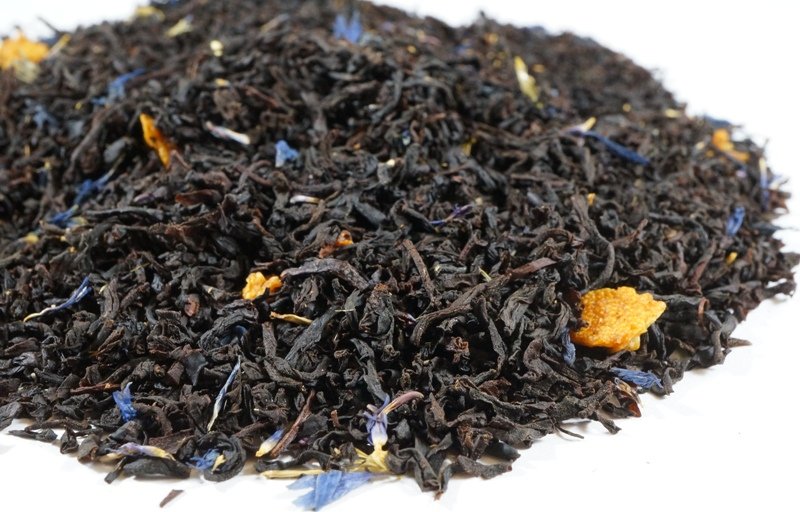
Modern Earl Grey is almost always made with black tea, though you'll also find green tea and rooibos versions. Our classic Earl Grey blends premium black tea with bergamot oil, citrus peels, and blue cornflower petals. It's bright and refreshing, and it's lovely with pastries and cake. It comes in a sample size (about 5 cups) as well as 4 oz, 8 oz, and 1 lb bags.
If you like the classic, try one of its cousins:
Cream Earl Grey, smoothed out with a touch of vanilla.
Decaf Cream Earl Grey, for an evening cup.
Lavender Earl Grey, with a soft floral note.
How to brew Earl Grey
Use 1 rounded teaspoon of loose leaf (about 2–3 grams) per 8 ounces of water.
Pour freshly boiled water (205–212°F) over the leaves.
Steep for 3–5 minutes, then taste and adjust.
Earl Grey is great on its own, with a slice of lemon, or with a splash of milk. For iced Earl Grey and a homemade London Fog latte, see our guide on how to brew Earl Grey three ways.
Two centuries after Charles Grey left office, nobody can say for sure how his name ended up on a tin of tea. But it's easy to see why the tea itself stuck around.