Why Drink Tea?

There are many good reasons to drink tea. Drink tea for its good taste and to boost energy are the primary reasons why tea is the most consumed beverage in the world.  However, to the health conscious crowd, tea drinking is not only pallet pleasing but also beneficial to our health. Let's scroll on to find out why.

  • Tea is very rich in Antioxidants. Tea has one of the highest contents of flavonoids among common food and beverage products. Catechins are the largest type of flavonoids in tea leaves. While many scientific researches have mixed conclusion on the effects of antioxidants, the antioxidants in tea might help protect against cancer.

  • Tea energizes us with its caffeine but in a less abrupt way then coffee does. After drinking tea, the caffeine is released into our body more slowly. So the result is a gentle and longer lasting boost of energy.

  • Tea could be beneficial to the cardiovascular system. Researches have showed that tea drinking may associate with a reduced risk of stroke. Research also showed that long-term tea consumption can help lower the cholesterol in our body. In short, tea might be very beneficial to our heart.

  • Tea may help protect against age-related cognitive impairment/decline and dementia later in life, based on correlations found in epidemiological studies.

  • Tea can help boost metabolism and exercise endurance. Scientists have found that the antioxidant rich tea might help speed up metabolism and increase our body's ability to burn fat as fuel.

  • Tea could help control blood sugar. Studies suggest that tea drinking might help our body tometabolize sugar better.

  • Tea can have immune boosting effects on our body. Again, because of all the antioxidants tea has, tea might be beneficial to our immune system to fight against common cold and flu.

 In conclusion, moderate long-term tea drinking could be very beneficial to our health. Let's brew some tea now. Enjoy!

More Info On Cold Brewing

What is Cold Brewed Tea

Cold brewed tea is tea steeped in cold water for an extended period of time.

Pictured above is Sencha green tea cold brewed for 12 hours.

Pictured above is Sencha green tea cold brewed for 12 hours.

The process brews the tea leaves slowly, using time rather than temperature to release the flavors. Free form catechins(antioxidants) and tanning acids, which are good for the human body, are more dissolvable and readily released in cold brewing as opposed to regular hot brewing. In addition, the amount of caffeine released from cold brewing tea is only half of the caffeine released from regular hot tea brewing.

How to Cold Brew

IMG_5547.JPG
  • Use cold water or iced water to brew tea. (It takes longer to brew tea with iced water).

  • Ratio of tea leaves to water is usually 1:50 by weight (you can adjust the ratio according to your taste).

  • Put loose tea or tea bags into a water container filled with cold or room temperature water.

  • Put the container into the refrigerator. * Do Not Put It In Freezer

  • Tea leaves which come in stripped form such as green tea, black tea or flat/wavy Oolong tea (Pouchong) should be brewed in the refrigerator for at least 4 hours. We recommend 4-12 hours.

  • Tea leaves that are rolled such as Jade Oolong and Ti kuan Yin should be brewed in the refrigerator for at least 6 hours. We recommend 6-12 hours.

  • Strain the tea leaves and enjoy the refreshing cold brewed tea. And if you have excess tea left over, put it back to the refrigerator (remember to strain the leaves).

Black Tea and Its Production

What is Black Tea

Black Tea is a fully fermented (oxidized) tea. It is the most common form of tea in southern Asia (India, Pakistan, Bangladesh, Sri Lanka, etc.). Black tea is generally stronger in flavor and contains more caffeine than the more lightly oxidized teas. The characteristic flavors of black tea range from flowery to fruity, nutty and spicy.

Processing and Production of Black Tea

After the harvest, the leaves are first withered by blowing air on them.
Then black teas are processed in either of two ways, CTC (Crush, Tear, Curl) or orthodox. The CTC method is used for lower quality leaves that end up in tea bags and are processed by machines. This method is efficient and effective for producing a better quality product from medium and lower quality leaves. Orthodox processing is done either by machines or by hand. Hand processing is used for high quality teas. While the methods employed in orthodox processing differ by tea type, this style of processing results in the high quality loose tea sought by many connoisseurs.
Next, the leaves are oxidized under controlled temperature and humidity. (This process is also called "fermentation" although no actual fermentation is taken place.)
Then the leaves are dried to arrest the oxidation process.
Finally, the leaves are sorted into grades according their sizes (whole leaf, broken leaf, fannings and dust), usually with the use of sieves. The tea could be further sub-graded according to other criteria.
 

Below are the basic grades for whole leaf orthodox black tea (for more information on grading of tea leaves click Here)

  • OP (Orange Pekoe)

  • FOP (Flowery Orange Pekoe)

  • GFOP (Golden Flowery Orange Pekoe)

  • TGFOP (Tippy Golden Flowery Orange Pekoe)

  • FTGFOP (Fine Tippy Golden Flowery Orange Pekoe)

  • SFTGFOP (Super Fine Tippy Golden Flowery Orange Pekoe)

Sleep Well Herbal Blend
FullSizeRender.jpg

Available soon is our new herbal blend Sleep Well tea. Chamomile is long regarded as a sleep inducing remedy. Mint and lemongrass are soothing and help promote digestion. Green rooibos is known to cure insomnia, digestion. We blend them together for the health bennefits and great taste. It is truely a harmonious blend. Brew a cup of this soothing and relaxing tea after dinner or before bed. Sleep Well!

What is Green Tea?

​Green Tea is a lightly oxidized (5-15%) tea. Unlike Black Tea, Green Tea leaves have not undergone the withering and oxidation processes. There is a minimal amount of oxidation by application of heat; either with steam, a traditional Japanese method; or by dry cooking in hot pans, the traditional Chinese method. Green tea is processed within one to two days of harvesting. Green Tea has a high level of antioxidants called catechins.

Chinese and Japanese Green Tea

There are 2 traditional methods, Chinese and Japanese, in making Green Tea. The differences between the two are the in the Kill Green Process where the Japanese Green Tea uses a steam then dry method while the Chinese implements a panfrying method to finally seal and lock the moisture content.

​

Health Benefits

Green tea has been credited with providing a wide variety of health benefits, although many of which have not been validated by clinical evidence. These claims and any for which academic citations are currently missing are listed here:

  • Stopping certain neurodegenerative diseases such as Alzheimer's and Parkinson's.

  • Preventing cancer.

  • Treating multiple sclerosis.

  • Preventing the degradation of cell membranes by neutralizing the spread of free radicals (which occurs during the process of oxidation).

  • Reducing the negative effects of LDL cholesterol (bad cholesterol) by lowering levels of triglycerides and increasing the production of HDL cholesterol good cholesterol.

  • Increasing fat oxidation (helps the body use fat as an energy source) and raising metabolism.

  • Japanese researchers claim if you drink five cups of green tea a day, you'll burn 70 to 80 extra calories. Dr. Nicholas Perricone, an anti-aging specialist, appeared on the Oprah Winfrey show and told Oprah's viewers they can lose 10 lbs. in 6 weeks drinking green tea instead of coffee.

  • Drinking green tea mixed with honey can oftentimes have a soothing effect on a sore throat.

Cold Brew

In this video, we demonstrated how to cold brew using the Mist Iced Tea Jug. It has a lid with built-in filter, which is perfect for cold brewing or making iced tea.

Moroccan Mint

Our version of the Moroccan Mint is a blend of Chinese Gunpowder green tea, 1st grade Chun Mee green tea, and mints. It would be available for purchase soon at beantowntea.com

FullSizeRender.jpg
Green Tea with Honey
FullSizeRender.jpg

A nice cup of green tea with drops of honey is delicious and very soothing. It is a classic remedy for a sore throat and some cold symptoms. 

Making green tea with honey is easy. Just brew a green tea like you normally would. When the tea is brewed, add in some honey according to your taste. You can also squeeze some lemon or lime juice to add that citrus flavor and the extra vitamins. 

Enjoy! 

FullSizeRender.jpg
Spiced Chai

Our Spiced Chai is a blend of fine black tea and seven other different varieties of spices. It is full bodied with mellow notes of spices. Ingredients in this blend are Black tea, Coriander, Cumin,Sweet Fennel, Cinnamon, Cardamom, Curry, and Lemongrass.

IMG_5429.JPG
How to use paper tea filter
FullSizeRender.jpg

The disposable paper tea filters are convenient, easy to use and bio-degradable.

Here is how to use them:

1. Put tea leaves into the filter. Remember not to over fill it. Because you want to leave some room for the tea leaves to expand.

2. Put the filled tea filter into a cup or a tea pot. Leave the flap of the filter on the edge of the cup or tea pot.

3. Fill the cup or tea pot with hot water. And steep for desirable amount of time.  

4. When the tea is brewed, take the filter out and enjoy!


How To Brew Jasmine green tea

Brewing hot tea using loose tea leaves is very easy and simple. Loose teas are of much better quality and less expensive than tea bags. This video we post here demonstrates how to make a pot of Jasmine Green Tea in 5 minutes. Enjoy!

Aged White Tea
Aged (5 years) Silver Needle White Tea

Aged (5 years) Silver Needle White Tea

Aged White tea? Yes. White teas can actually be aged like Puer tea. The Chinese have been aging White teas pretty much since the time they started making White teas. There are two objectives in aging White teas.

First is aging them for medicinal purposes. Chinese believe that aged White teas can be drunk as an herbal supplement to keep a good balance of their elements. Because in traditional Chinese medicine, keeping the elements (5 elements) balanced is crucial to their health. 

Second is aging the teas for taste. If stored right, the White tea would continue to oxidized and develop a different taste profile. A properly aged white tea would have a deeply mellow taste with less astringency. Honey sweet notes would become more pronounced. This change of taste profile would apex when the tea is aged at 5 to 8 years. 

Currently, we stock 2 varieties of aged White tea. The Aged Silver Needle and the Aged Snowbud W hite Tea. Both of them are properly aged for more than 5 years in natural and dry storage.

Both are exceptional and deeply mellow. The Aged Silver Needle is slightly floral with notes of honey and with almost no astringency. While the Aged Snowbud is slightly astringent with hints of oakiness. Notes of walnut is present in the Aged Snowbud. You can't go wrong with either one of them.


English Breakfast Tea

Our English Breakfast is a blend of Ceylon, Kenya and India black tea. It brews a full bodied breakfast tea with excellent body and full flavor. Enjoy it as it is or with a few drops of milk. Can't go wrong either way. 

FullSizeRender.jpg
How To Whisk Matcha

Many have asked the same question. How to froth up the Matcha? It is pretty simple. A good  whisk is the key here. Traditionally, a bamboo whisk is required for whisking. Nowadays, there are many gadgets we can used. In this video, we are doing a quick demonstration with a traditional bamboo whisk.

First, we put Matcha into a bowl. The amount of Matcha we put in is one teaspoon for 8 oz of water. The amount of Matcha is up to personal preference. For someone who is new to Matcha, we recommend using less to start.

Second, we slowly pour hot water into the bowl. Water should be at around 165 degrees Fahrenheit (75 degrees Celsius).

Third, we will start whisking slowly in a "M" motion to submerge the tea powder. Then speed up and whisk in a back and forth direction.

Forth, slow down once the tea is frothed up well and a layer of creamy foam appear.  

At the end, slowly whisk a few "M" or zigzag a few a few times. This is to reduce the big bubbles and creat a nice foam.

Enjoy! 


Matcha Samidori
IMG_5078.JPG

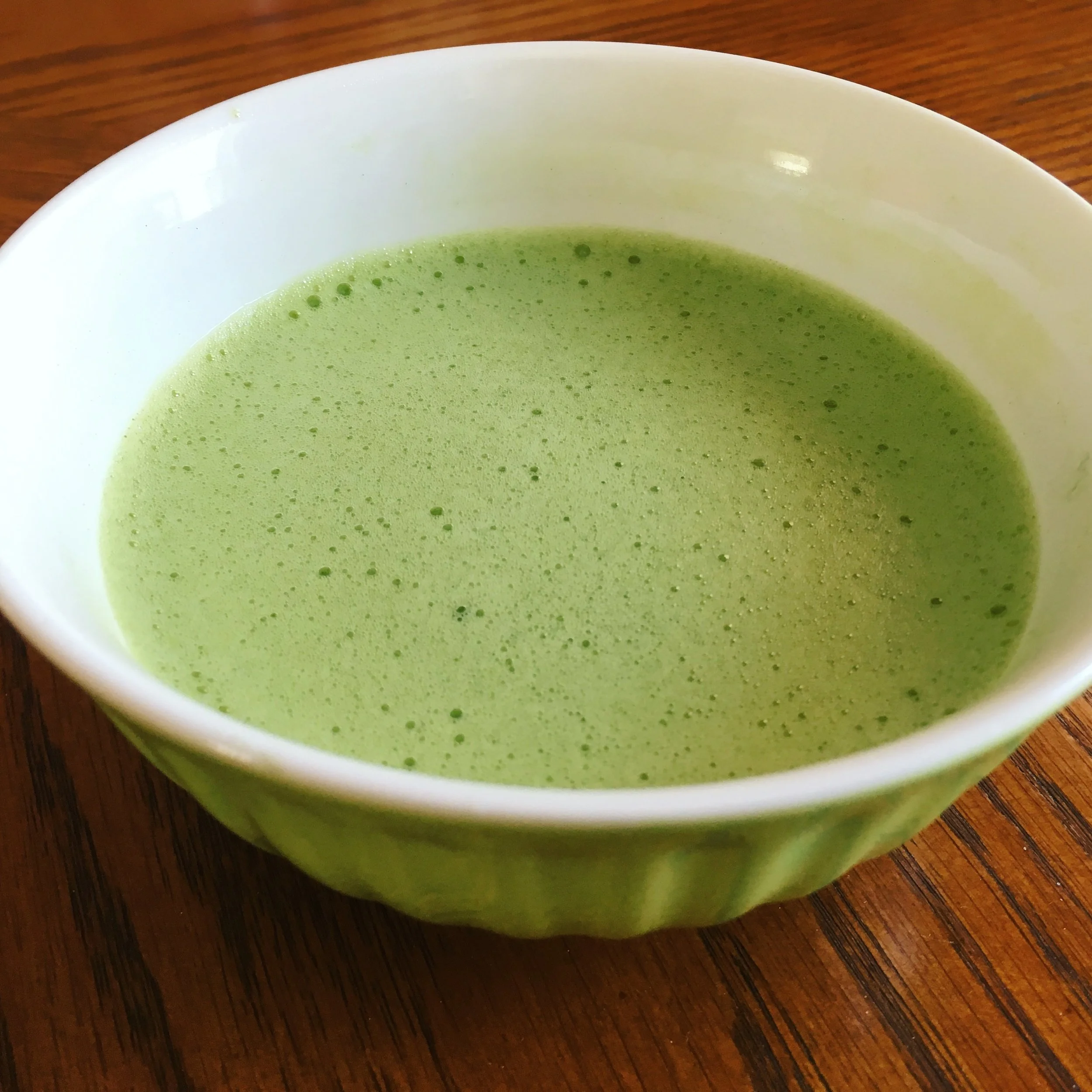
This is a bowl of whisked up Matcha using our  Matcha Samidori. It is rich, and creamy without anything added. Whisk it back and forth to froth it up and then at the end whisk it in M motion to eliminate the big bubbles. We will post a instruction video soon.

Wuyi Oolong

Now available on our website. Wuyi Oolong is full bodied Oolong that is toasty, slightly earthy with a floral aftertaste. It is exceptionally well balanced. Hints of honey is also present in the infusion. It is complex and layered with flavors and notes. A must try for Oolong tea drinkers.

FullSizeRender.jpg
IMG_5044.JPG
How to Make Refreshing Iced Tea
FullSizeRender.jpg

Making iced tea is fairly simple and easy. Picture above is a demonstration on making iced tea.

1. To make 32 oz. iced tea, we need 4-5 teaspoons of tea. In this demonstration we use 5 teaspoons of our sleeping dragon green tea. 

2. To make 32 oz. of iced tea we will brew 16 oz. of hot tea first. We put the tea leaves into a tea pot. 

3. Pour hot water (195 degrees Fahrenheit) into the tea pot. Steep for a 3-5 minutes. 

4. Then we will prefill a glass jar about half full with ice.  

5. Pour the hot tea in to the glass jar. Use a strainer or filter to strainer the tea leave. You don't have to use a strainer, if you don't mind bits of leaves floating around, but pour it slowly.

6. The hot tea will melt some of the ice we put in earlier. So the last step is to top the jar off with some more ice.  

Now the iced tea is made. It only takes 5-10 minutes. You can garnish it with a few drops of lemon juice, mint and or sweetener.  

Beantown Tea Comment