The Iron Goddess of Mercy: The Legends and Real History of Tieguanyin Oolong

Few teas carry a name as memorable as Tieguanyin. It translates to "Iron Guanyin," and it is usually rendered in English as "Iron Goddess of Mercy." Guanyin is the bodhisattva of compassion, one of the most beloved figures in Chinese Buddhism. The tea named for her is one of China's best-known oolongs, and it comes from Anxi County in Fujian Province.

Like many famous Chinese teas, Tieguanyin arrives wrapped in legend. This week we're looking at those stories, and at what the historical record actually supports.
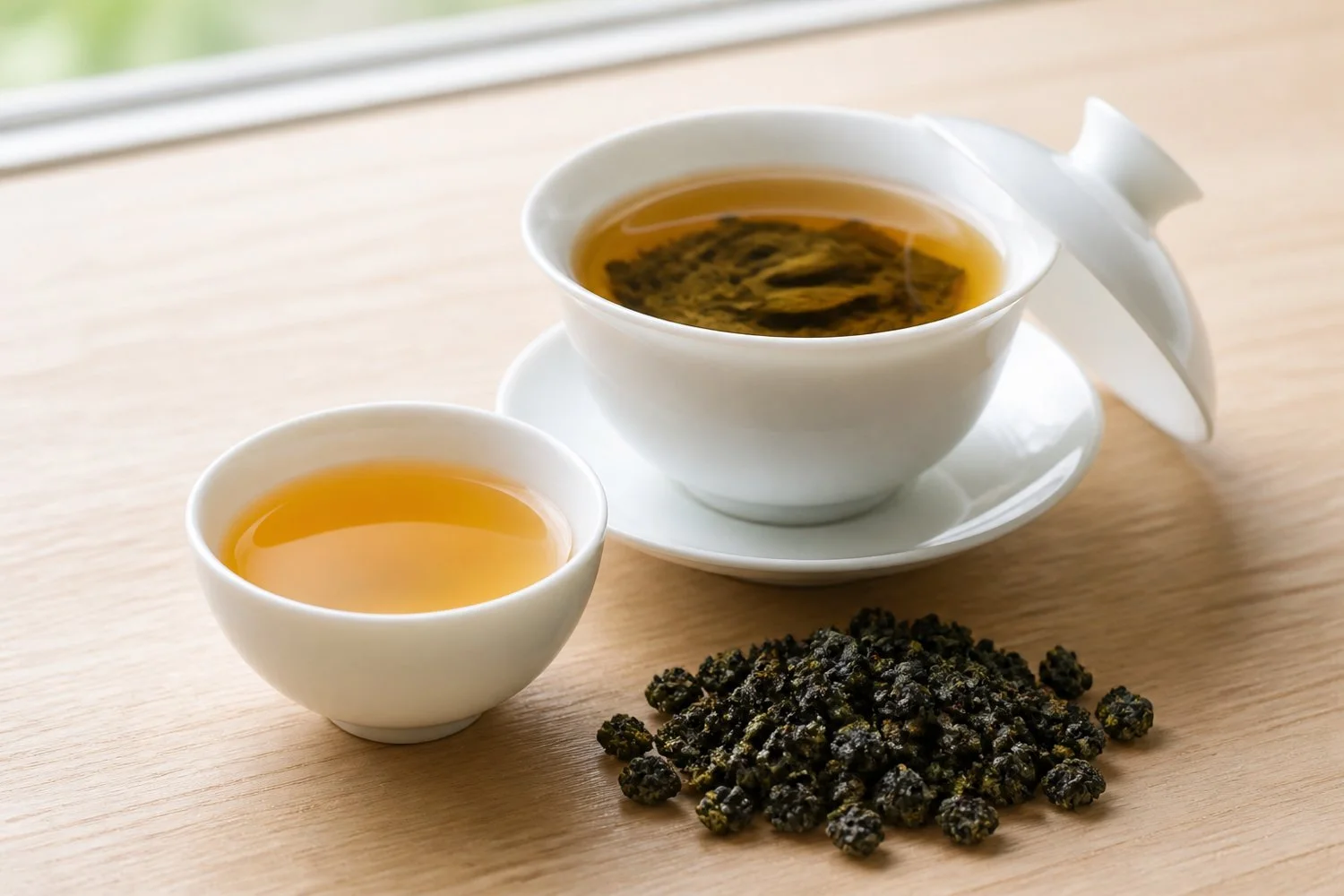
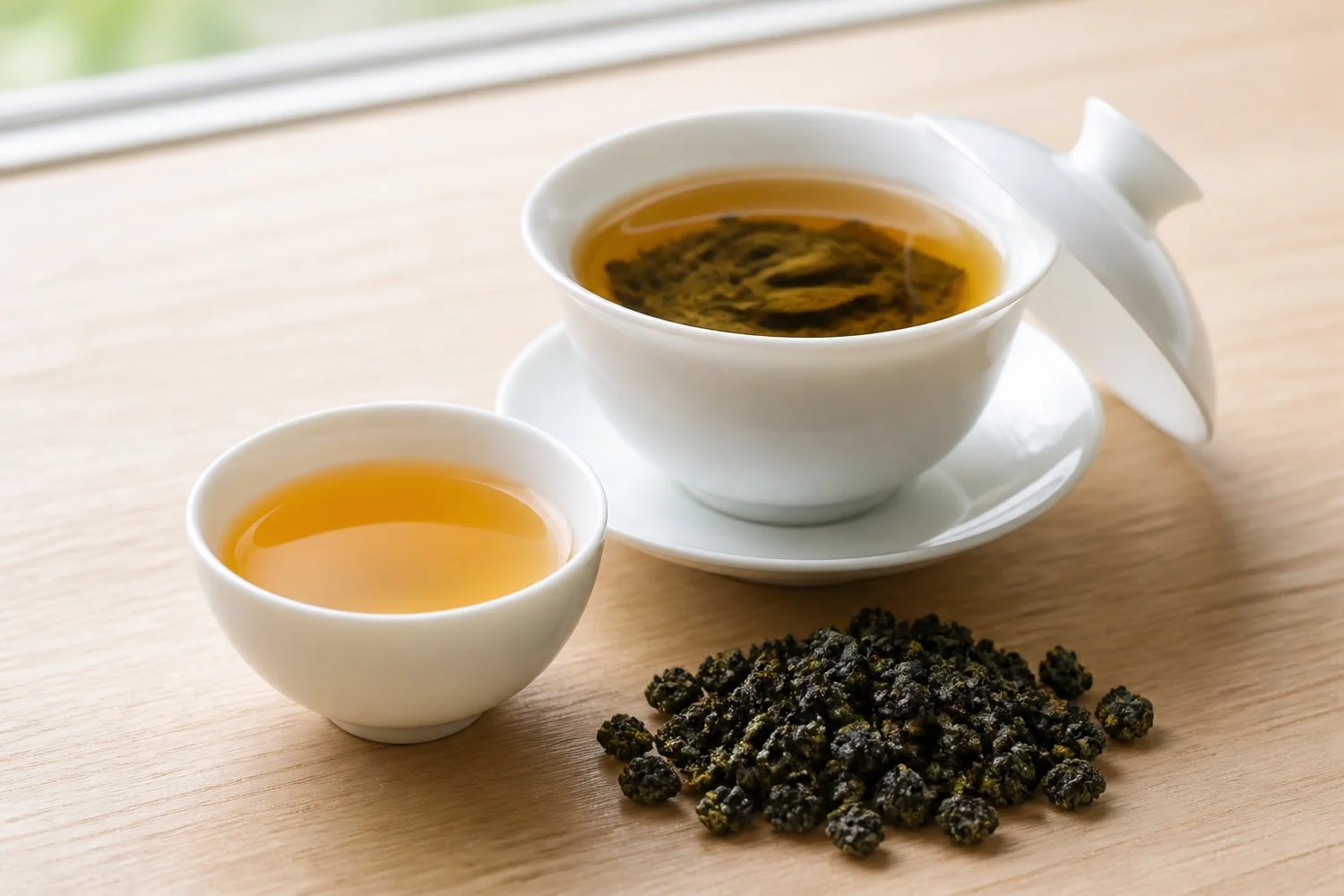
A cup of Tieguanyin oolong tea beside a gaiwan

Two legends, one tea

There are two traditional accounts of how Tieguanyin got its name, known in Chinese as the "Wei telling" and the "Wang telling."

The more famous one centers on Wei Yin, a tea farmer in Xiping, Anxi, who was devoted to Guanyin. According to the version summarized on Wikipedia, which draws on Chinese and Taiwanese sources, Guanyin appeared to Wei in a dream and guided him to an unusual tea plant growing in a crevice among the rocks. He found the plant where the dream had shown him, brought it home, and cultivated it. Because the plant came to him through Guanyin, and because the finished leaves were dark, glossy, and heavy like iron, he named the tea Tieguanyin. Some tellings, as the tea history site Oolong Tea notes, add that he raised the plant in a cracked iron pot.

Western tea sellers often tell a slightly different version, in which a poor farmer named Wei sweeps and tends a run-down temple holding an iron statue of Guanyin, and is rewarded with a tea shoot he shares with all his neighbors. Wikipedia points out that this version circulates among tea merchants in Canada and the UK but has no clear counterpart in China or Taiwan.

The second account swaps the miracle for imperial approval. In this version, a scholar named Wang Shirang found a special tea bush near his study in 1736, the first year of the Qianlong Emperor's reign. A few years later he brought the tea to Beijing as a gift. It passed through a court official to the emperor, who is said to have admired the dark, heavy leaves and named the tea after Guanyin. The UN's Food and Agriculture Organization (FAO) includes this story in its heritage documentation for Anxi, and it is careful to introduce it with "according to the legend."

What history can and can't confirm

So which story is true? Probably neither, at least not literally. Oolong Tea's review of the evidence cites a Chinese-language analysis concluding that both are folk legend, and notes that no document confirms the dream, the crevice, or the emperor's tasting.

What the record does support is still impressive. According to the FAO, tea production in Anxi is believed to date back to the 10th century, and Tieguanyin itself emerged in the 18th century. The FAO also cites county records compiled during Qianlong's reign showing that Anxi tea was already supplying neighboring towns at that time.

There is even a living link to the first legend. According to People's Daily Online, tea maker Wei Yuede of Anxi is the ninth generation of his family in the tea business and traces the tea's story to his ancestor, Wei Yin.

The farming trick that made a single bush famous

A great tea plant is only useful if you can grow more of it, and tea grown from seed doesn't come out exactly like its parent.

According to the FAO, around 1640 Anxi tea farmers noticed that tea branches accidentally buried in soil could take root and sprout. From that, they developed whole-plant layering: pinning a branch to the ground so it roots while still attached to the mother plant. Later generations refined this into cutting methods, including a short-cutting technique developed in Xiping around 1935. The FAO describes Anxi as the birthplace of vegetative propagation of tea trees in China.

That matters for Tieguanyin, because it is both a tea style and a specific tea plant variety. Propagating by layering and cuttings let farmers multiply an outstanding bush with its character intact. Oolong Tea calls this the real mechanism behind the legend: however the first bush was found, cuttings are what turned it into a countywide tea.

From Anxi to Taiwan, and to world heritage

Tieguanyin's reputation eventually crossed the Taiwan Strait. According to the Taipei City Government, tea master Zhang Nai-miao brought Tieguanyin plants from Fujian in 1895 and replanted them in the hills of Muzha, in what is now Taipei. The Maokong area there is still known for its Tieguanyin, and a memorial hall in Zhang's name tells the story.

Back in Anxi, the tea has earned formal recognition. In May 2022, the FAO designated the Anxi Tieguanyin Tea Culture System a Globally Important Agricultural Heritage System, citing local farmers' traditional know-how in managing the land and producing exceptional tea leaves.

Terraced tea fields in the hills of Anxi, Fujian

How the leaf becomes Iron Goddess

Tieguanyin is a semi-oxidized tea, sitting between green and black tea. As our Iron Goddess Oolong product page describes, the leaves are wilted in the sun and then shaken in bamboo baskets to bruise their edges, so the edges oxidize faster than the center. After a period of oxidation, the tea is fired to stop the process. Look closely at the leaves after brewing and you'll often see those slightly brownish edges.

The result is a cup that's nutty and mineral, with a lingering floral, orchid-like finish. It's also a tea that rewards patience: the same leaves can be steeped several times, and each cup shows something a little different.
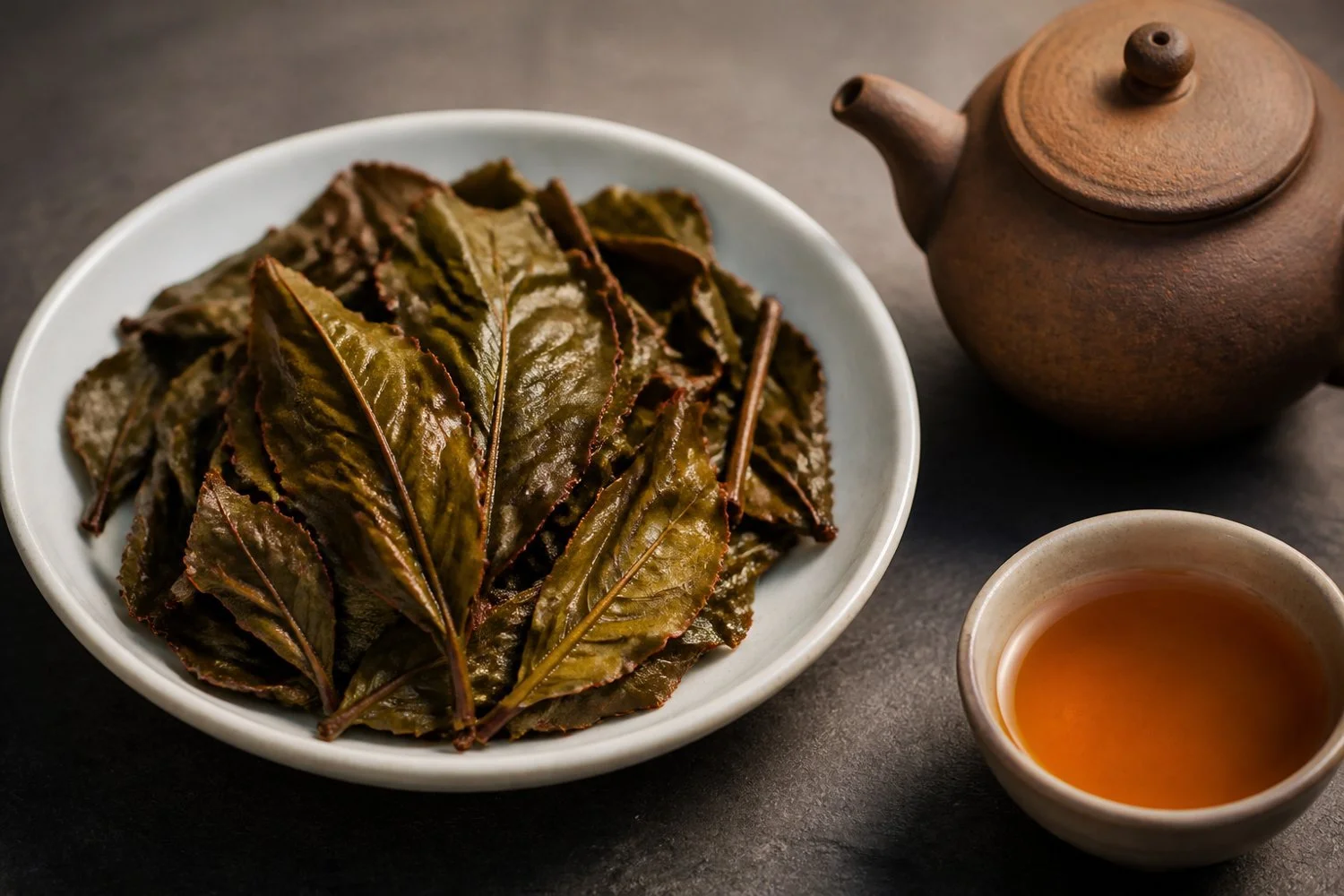
Unfurled oolong tea leaves beside a clay teapot

Brewing a cup of the Iron Goddess

Our general guideline is 1 to 2 teaspoons (about 3 grams) per 8 ounces of water at 185 to 205°F, steeped 3 to 5 minutes. Then add more hot water to the same leaves and steep again. Pair it with dim sum, roasted nuts, or a fruit plate. As the evenings get cooler, it also makes a calm, warming cup after dinner, and it's a nice treat between handfuls of Halloween candy.

If Tieguanyin's story makes you curious about Fujian's other great oolongs, try our Wuyi Oolong, a "rock tea" from the Wuyi Mountains in the north of the province, with its own famous legend of the Big Red Robe. It's toasty, earthy, and honeyed, a fine contrast to the floral Iron Goddess.

Taste the legend

Whether you believe in Wei Yin's dream or Wang Shirang's trip to the emperor, the tea itself is the best part of the story. Brew a pot of Iron Goddess Oolong, steep it a few times, and see how the cup changes. Then explore the rest of our Oolong Tea collection to find your next favorite.
Matcha Samidori: A Vivid, Sweet Spring Matcha from Uji

Matcha is one of the teas our customers search for most, and Matcha Samidori is the one we reach for when we want a bowl that's vivid, sweet, and rich. It's a premium first-harvest spring matcha from Uji, Kyoto, made from leaves of the Samidori cultivar. And with all the pumpkin spice around this month, a bright green bowl makes a refreshing change.

Here's where it comes from, what it tastes like, and how to whisk a good bowl at home.

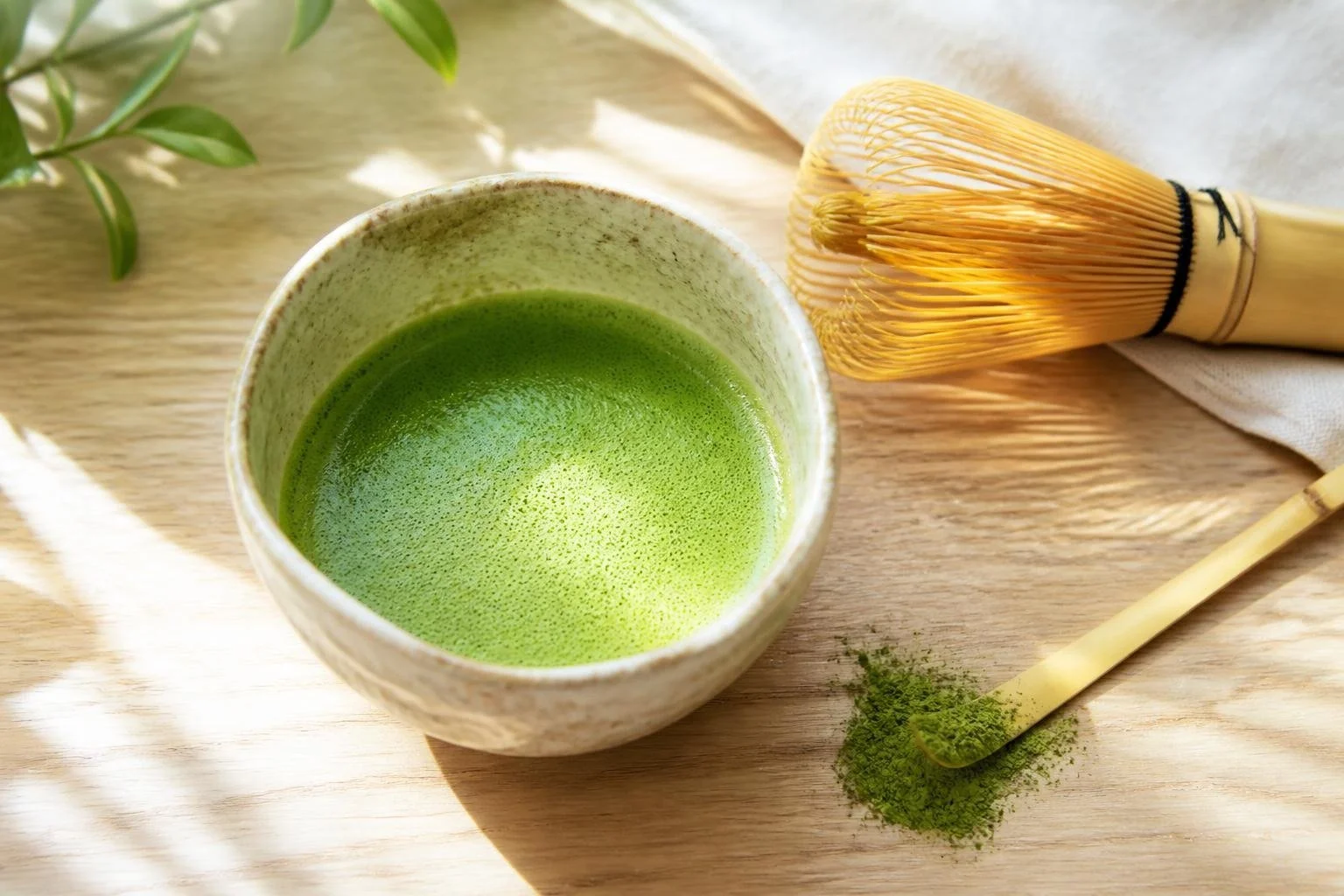
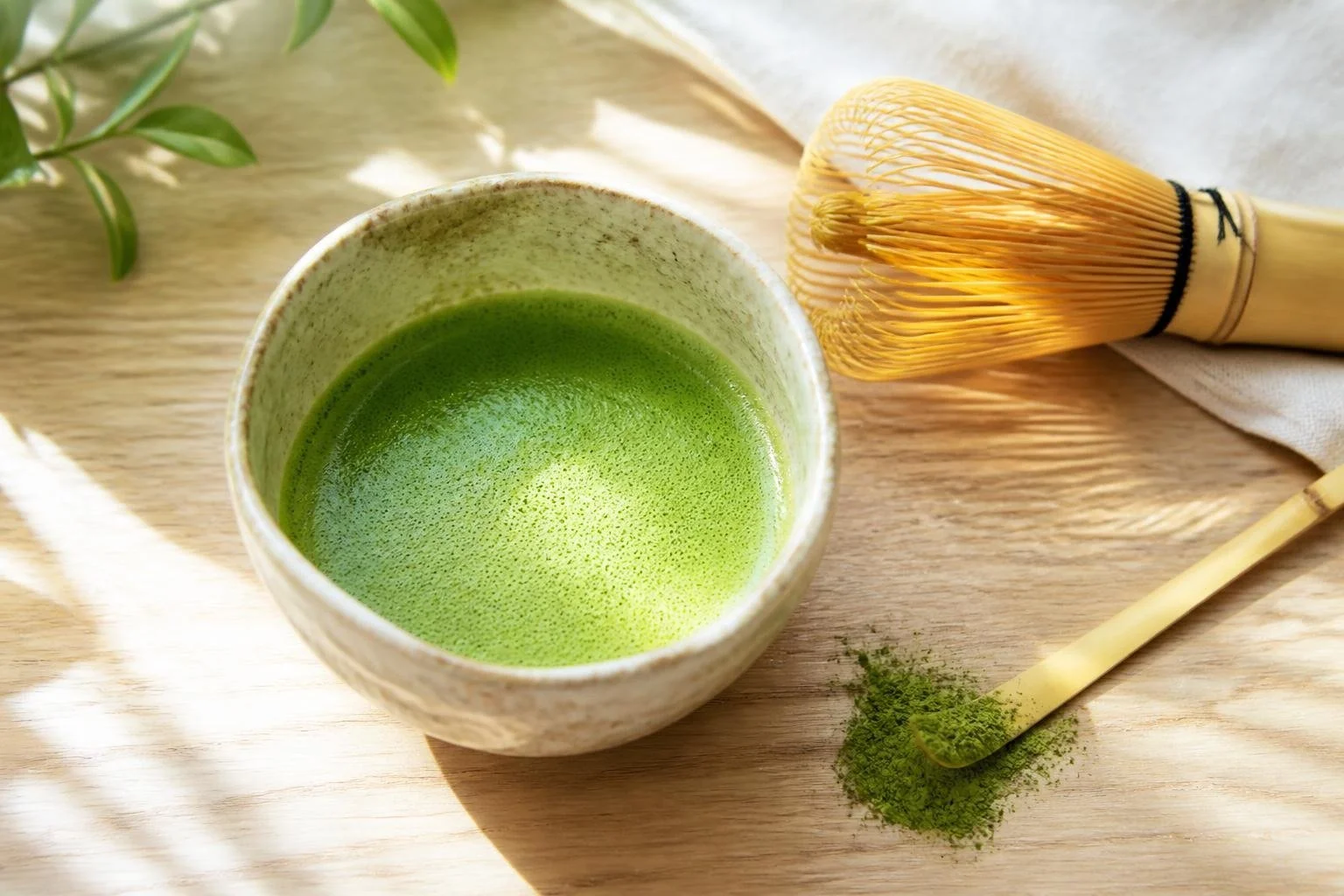
A bowl of whisked Matcha Samidori with a bamboo whisk and scoop


From Song Dynasty China to Uji

Matcha's roots reach back to Song dynasty China, where tea was ground to powder and whisked in bowls. The Zen monk Eisai is traditionally credited with bringing tea seeds and the practice of powdered tea to Japan around 1191. Over the following centuries, matcha became the heart of the Japanese tea ceremony, which the tea master Sen no Rikyu refined in the 16th century.

Uji, near Kyoto, has been one of Japan's most celebrated tea regions for centuries. Growers there developed the technique of shading tea plants before harvest. The plants rest under special shades for about three weeks before plucking, which deepens their green color and sweetness. Those shaded spring leaves are what get ground into a fine matcha like Matcha Samidori.

What It Tastes Like

Matcha Samidori whisks up into a rich, vegetal cup with sweet notes from full-flavored spring leaves. It's smooth, with a finish that lingers. Since you drink the whole powdered leaf, the flavor is fuller than a steeped green tea, but a good first-harvest matcha like this one stays sweet instead of bitter.

Enjoy it whisked on its own, with a traditional Japanese sweet, or as a matcha latte. It also pairs beautifully with white chocolate and fresh strawberries.

How to Whisk Matcha Samidori

These are the preparation steps from our product page:

  1. Add 1 teaspoon of matcha to a bowl.

  2. Put a few drops of hot water into the bowl and whisk the matcha into a paste.

  3. Pour 6 to 8 oz. of hot water (160–180°F) into the bowl.

  4. Using a slow "M" motion, submerge any loose bits of matcha floating on the surface.

  5. Whisk more briskly, back and forth, until the surface becomes frothy.

  6. Enjoy right away.

Keep the water below boiling. Water that's too hot can make matcha taste bitter. A traditional Bamboo Matcha Whisk, carved from a single piece of bamboo into fine tines, makes the froth much easier than a spoon or fork.

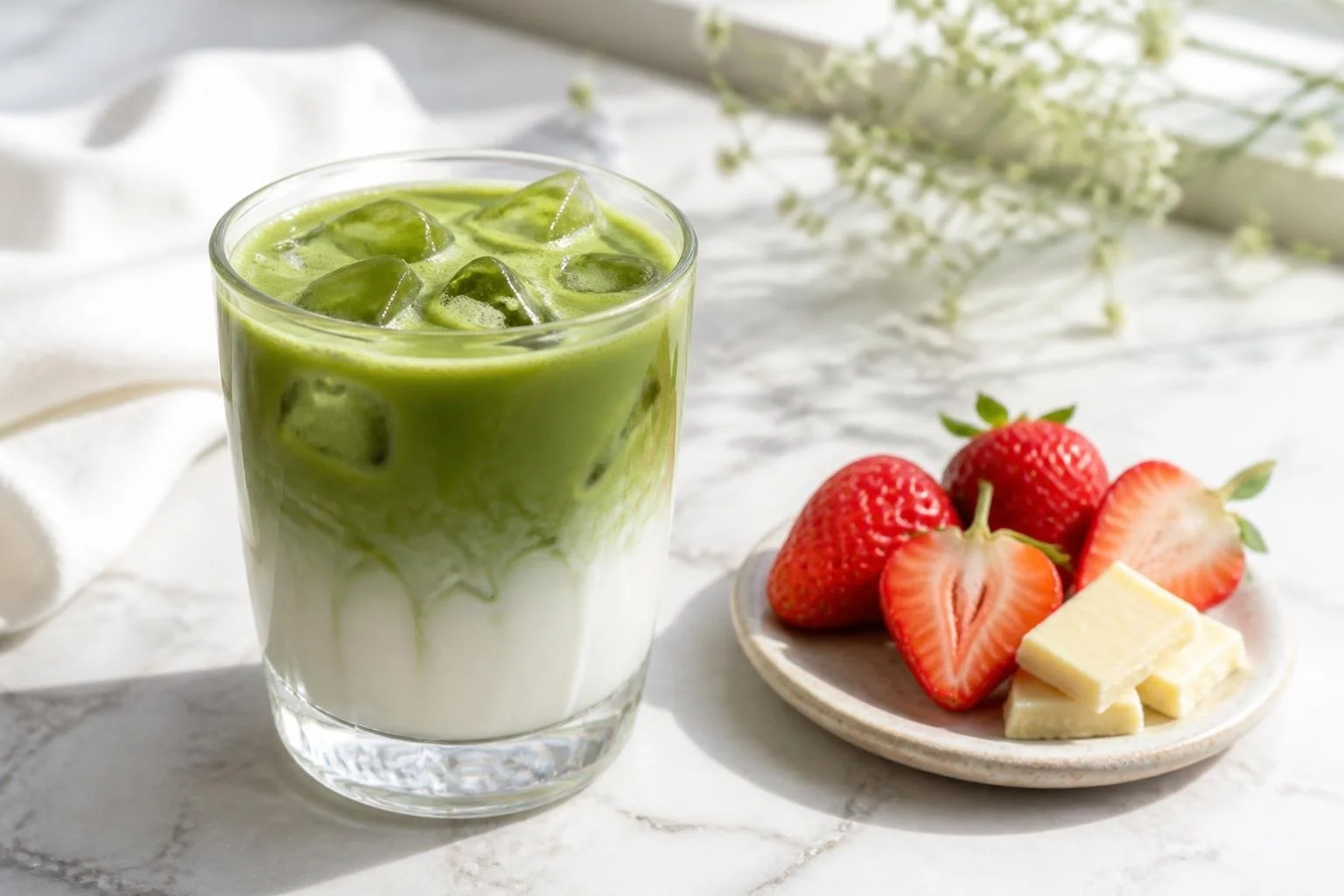
Iced matcha latte with fresh strawberries and white chocolate


Beyond the Bowl

Matcha has broken from tradition, and now it's enjoyed cold, in lattes and smoothies, and in ice cream and baked goods. For a simple iced latte, whisk your matcha into a paste with a little warm water, then pour it over ice and cold milk. For baking and everyday mixing, our Culinary Matcha is made for exactly that, so you can save Samidori for sipping.

Sizes and Where to Find It

Matcha Samidori comes in a sample size, plus 1 oz. (12 servings), 2 oz. (25 servings), and 4 oz. (50 servings) bags. If you'd like to compare it with our other matchas, the Matcha Sampler Pack includes Matcha Samidori, Matcha Green, Matcha Kenya Highlands, Matcha Kenya Superior, and Culinary Matcha. You can see them all in our Matcha collection.

As tea enthusiasts, we have been sharing quality tea at affordable prices since 2006. If you've been curious about matcha, Matcha Samidori is a lovely place to start.

Happy whisking!

How to Brew Earl Grey Three Ways: Hot, Iced, and a London Fog at Home

If there's one tea people look for on our site more than any other, it's Earl Grey. That makes sense. A good cup has bright citrus up top, a sturdy black tea underneath, and a fragrance that fills the kitchen before you've even poured.

Earl Grey is also one of the most flexible teas you can keep in the cupboard. Here's a quick guide to what makes it Earl Grey, how our four bergamot teas differ, and three easy ways to brew it at home: a classic hot cup, a pitcher of iced tea, and a London Fog latte.


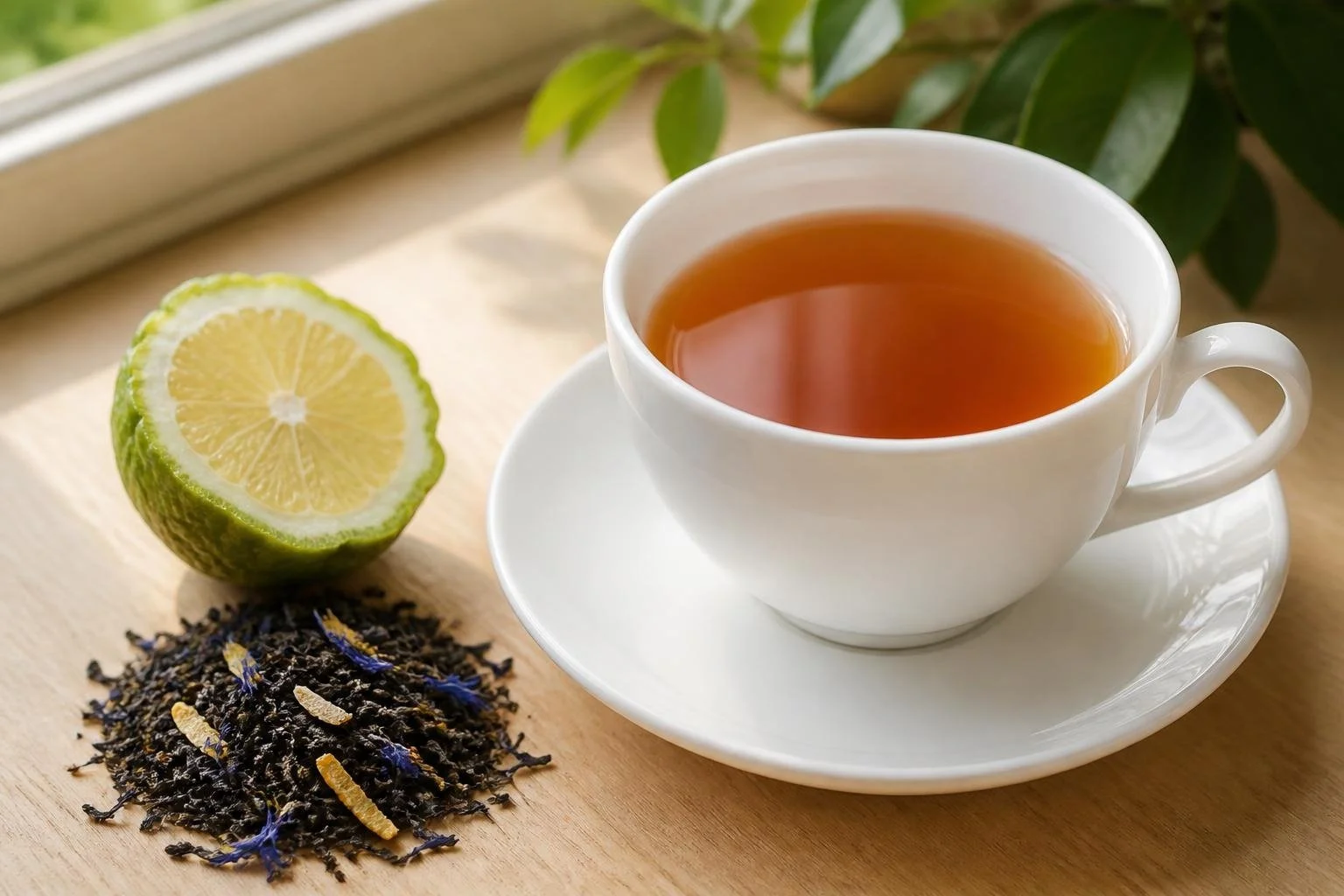
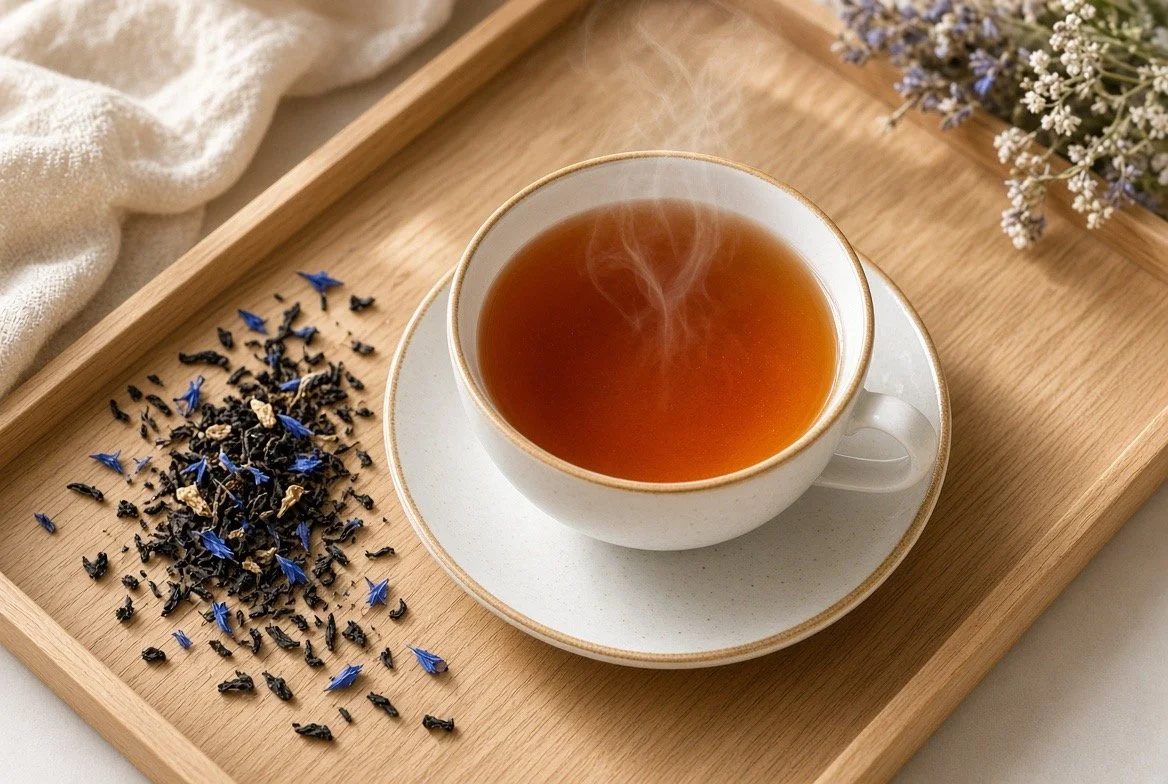
A cup of Earl Grey tea beside loose-leaf Earl Grey and a halved bergamot

What Makes Earl Grey, Earl Grey

Earl Grey is black tea scented with oil of bergamot, a fragrant citrus fruit about the size of an orange. Bergamot is too sour to eat out of hand, but its peel holds an aromatic oil that tastes like a mix of lemon, orange, and something a little floral.

The tea is named after Charles Grey, the 2nd Earl Grey, who was British Prime Minister in the 1830s. You may have heard the story that a grateful Chinese mandarin gave him the recipe, but historians generally treat that as legend. Bergamot-scented tea was already being sold in England by the 1820s. Because the name was never trademarked, blenders have been making their own versions ever since.

Our Four Bergamot Teas

  • Earl Grey is the classic: premium black tea with bergamot oil, blue cornflower petals, and citrus peels. It's piquant and refreshing, with a true bergamot taste that goes beautifully with pastries and cakes.

  • Cream Earl Grey adds smooth vanilla overtones to the bergamot on a Ceylon black tea base, for a softer, mellower cup with a bright, coppery color.

  • Decaf Cream Earl Grey has the same creamy, citrusy flavor with the caffeine removed by a natural CO2 process, so it's an easy evening cup.

  • Lavender Earl Grey blends our classic Earl Grey with blue lavender flowers. It's citrusy, floral, slightly sweet, and mellow.

Way 1: The Classic Hot Cup

This is the brewing guideline on our product pages, per 8 oz of water:

  • Amount: 1 rounded teaspoon (about 2–3 g)

  • Water: freshly boiled (205–212°F)

  • Steep: 3–5 minutes

Start tasting at 3 minutes. Bergamot is bright and lively, and a shorter steep keeps the citrus in front. Go toward 5 minutes if you plan to add milk or want a bolder cup. If it ever tastes bitter, shorten the steep rather than using less tea. Our fill-your-own Paper Filters make loose-leaf cleanup quick if you don't have an infuser handy.

Earl Grey is lovely plain, with a little sugar or honey, or with a thin slice of lemon to echo the bergamot. Try it with lemon shortbread, scones, madeleines, or vanilla cake.


A glass and pitcher of iced Earl Grey tea with orange slices and mint

Way 2: Iced Earl Grey

Earl Grey makes a surprisingly refreshing iced tea, and Decaf Cream Earl Grey is especially good this way. The easiest method is to brew it strong and pour it over ice:

  1. Use about 2 rounded teaspoons of tea for every 8 oz of freshly boiled water, roughly double what you'd use for a hot cup.

  2. Steep 3–5 minutes, then strain.

  3. Pour the hot tea into a tall glass filled to the top with ice. The melting ice brings it back to normal strength.

Making a pitcher? Brew the strong tea, let it cool, then add an equal amount of cold water and refrigerate. A slice of orange or a sprig of mint is a nice finishing touch.

Way 3: A London Fog at Home

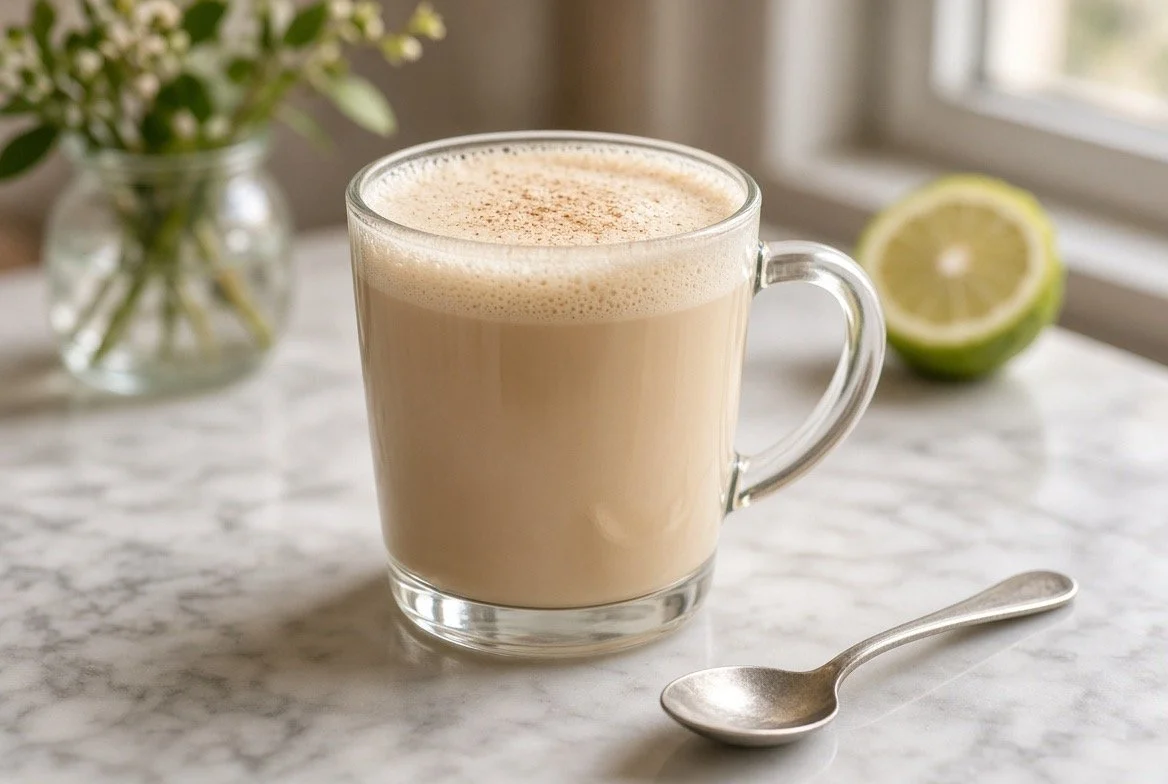
A London Fog is an Earl Grey latte: strong tea, steamed milk, and a little vanilla and sweetness. It's the coziest way to drink Earl Grey on a cool October afternoon, and you don't need a café machine to make one.

  1. Steep 1 heaping teaspoon of Earl Grey in about 4 oz of freshly boiled water for 4–5 minutes. You want it concentrated.

  2. Strain into a mug and stir in honey or sugar to taste, plus a drop of vanilla extract if you like.

  3. Heat about 4 oz of milk (dairy or oat both work well) until steaming, then froth it with a whisk, a handheld frother, or by shaking it in a sealed jar.

  4. Pour the milk over the tea and spoon the foam on top.

Cream Earl Grey is a natural fit here because its vanilla note does half the work for you. For a floral twist, use Lavender Earl Grey for a lavender London Fog. If you want one after dinner, Decaf Cream Earl Grey lets you skip the caffeine.


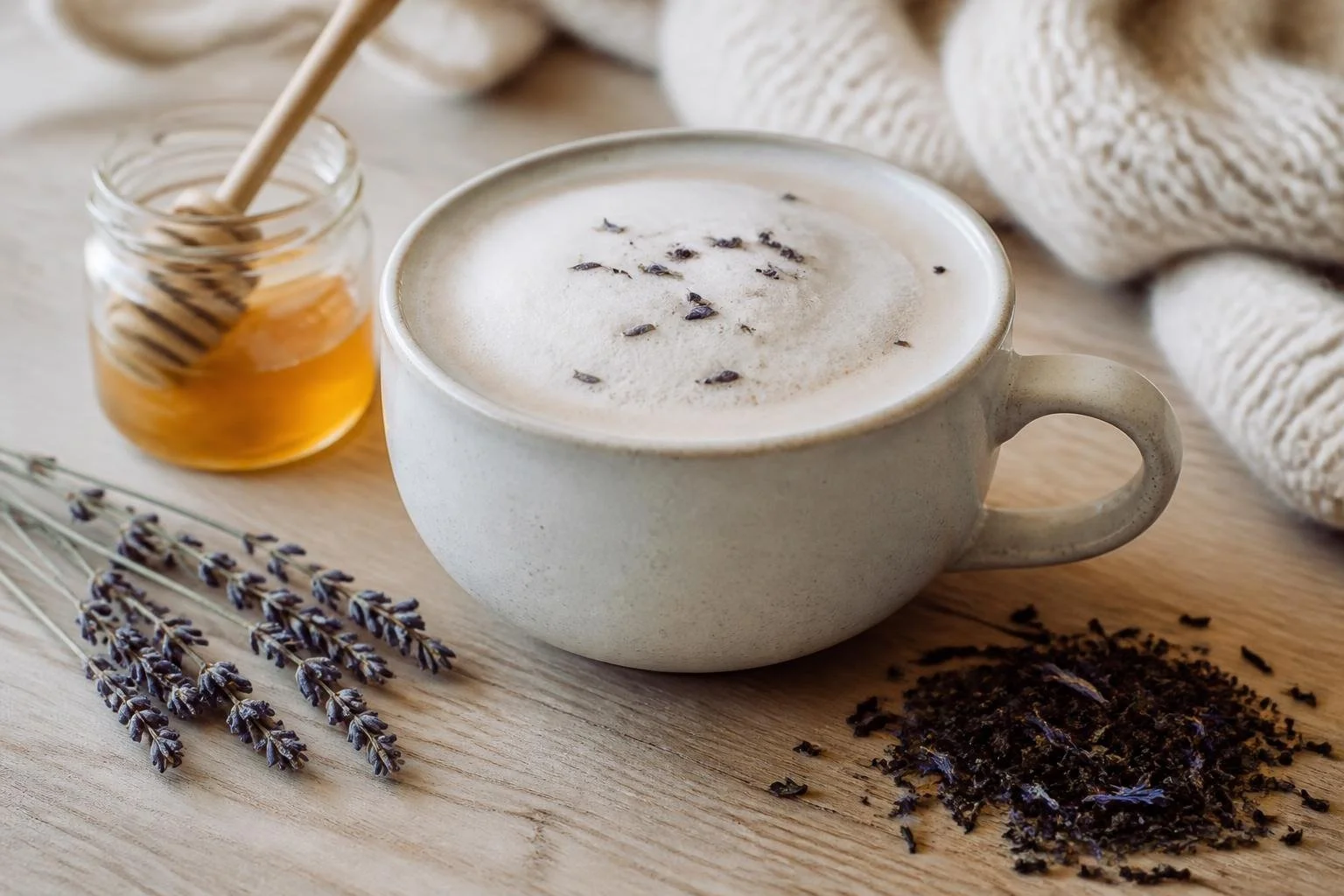
A London Fog Earl Grey latte with honey and lavender

Keeping Your Earl Grey Fresh

Bergamot's aroma is what makes this tea special, so treat it kindly. Store your tea in an airtight container away from light, heat, moisture, and strong smells like spices or coffee. Keep it in a cool, dark cupboard rather than next to the stove.

Where to Start

New to our Earl Greys? Every one comes in a sample size, so you can try a few side by side before choosing a favorite, and larger bags are there once you find it. You'll find all four, plus plenty of other classics, in our Black Tea collection.

As tea enthusiasts, we have been sharing quality tea at affordable prices since 2006. Hot, iced, or under a cloud of foam, we hope your next Earl Grey is a great one.

Happy steeping!

Calm Focus in a Cup: What Research Says About L-Theanine and Caffeine in Tea

Ask a group of tea drinkers how a cup of tea makes them feel, and many will say the same thing: awake, but in a gentler way than coffee. Some people call it "calm focus." Is there something real behind that feeling, or is it just the cozy ritual of brewing a cup?

Researchers have been testing this for years, mostly by looking at two natural compounds in tea leaves: caffeine and an amino acid called L-theanine. Here's what the studies found, what they didn't, and how much caffeine different teas contain. With darker afternoons and a busy Halloween week ahead, it's a good time to think about what's in your mug.

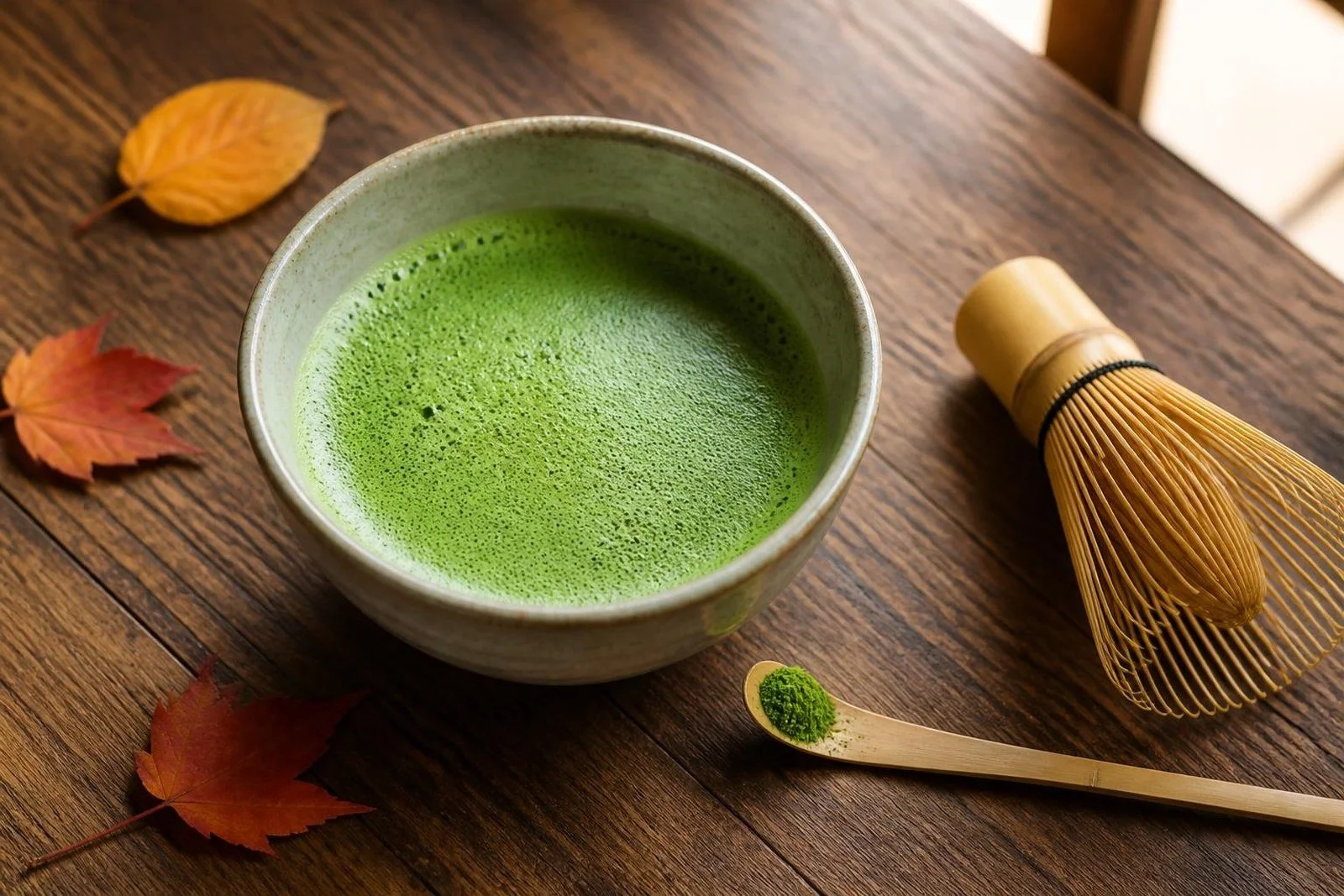
A ceramic bowl of frothy whisked matcha green tea beside a bamboo whisk and a bamboo scoop of matcha powder on a wooden table with a few autumn leaves

What Is L-Theanine?

L-theanine (often just called theanine) is an amino acid found naturally in tea. Coffee doesn't contain it. That simple difference is one reason scientists wonder whether theanine helps explain why tea and coffee can feel so different, even though both contain caffeine.

One thing to keep in mind: many studies test theanine and caffeine as measured ingredients, not as brewed tea, and often in larger amounts than one cup provides.

What the Research Says

1. The big picture: a 2025 review of 50 trials

Journal: Nutrition Reviews, 2025 (systematic review and meta-analysis)

A team at the University of Aberdeen in the UK gathered 50 randomized controlled trials in healthy people that tested tea, theanine alone, or theanine plus caffeine. Fifteen of those trials had data that could be combined. Compared with a placebo, theanine plus caffeine was linked with small-to-moderate improvements on attention tasks, such as accuracy when switching between tasks and accuracy on a test of staying alert. These effects showed up mainly in the first two hours. Theanine alone was linked with faster reaction times in the first hour. The evidence on sleep was inconclusive.

Limits: The authors say the size, and sometimes even the direction, of these effects is uncertain. Most studies took place in a lab, and few used real tea or tea-sized amounts. The lowest theanine dose in the theanine-alone analyses was 50 mg, which the authors note is about two cups of black tea. The review was partly funded by Lipton Teas and Infusions, and two co-authors work for Lipton or Unilever.

Read the study

2. A moderate dose: 97 mg theanine plus 40 mg caffeine

Journal: Nutritional Neuroscience, 2010 (placebo-controlled study)

Researchers gave 44 young adults either a placebo or a combination of 97 mg of theanine and 40 mg of caffeine. That much caffeine is in the range of a cup of tea (see the chart below). They tested people 20 and 70 minutes later. The combination improved accuracy on a task-switching test and raised how alert people said they felt, while lowering how tired they felt.

Limits: There was no effect on other tests, like visual search, choice reaction time, or mental rotation. It was a small study of a single dose, with more theanine than a typical cup provides. The lead researcher worked for Unilever, which makes and sells tea.

Read the study

3. Tea vs. coffee: does theanine take the edge off caffeine?

Journal: Psychopharmacology, 2008 (randomized, double-blind, placebo-controlled trial)

Scientists at the University of Bristol in the UK asked why tea often feels less stimulating than coffee. They gave 48 healthy adults 250 mg of caffeine, 200 mg of theanine, both, or neither. Caffeine raised alertness, jitteriness and blood pressure. Theanine countered caffeine's rise in blood pressure, but it did not significantly change jitteriness, alertness or mood. The authors concluded that it is unclear how theanine's effects might explain the different feel of tea and coffee.

Limits: These were large single doses, not brewed drinks. 250 mg of caffeine is roughly what you'd get from five cups of black tea. The study measured short-term effects only.

Read the study

4. Testing matcha itself

Journal: Food Research International, 2017 (randomized, placebo-controlled, single-blind study)

A team at Wageningen University in the Netherlands tested matcha directly. Twenty-three people tried a matcha drink, a matcha snack bar (each with 4 g of matcha powder), and placebo versions of each, one per session. One hour later, the matcha products mainly improved scores on basic attention and reaction-speed tasks. There were barely any effects on the other thinking tests and no changes in mood. The matcha drink did better than the bar on most measures.

Limits: The study was small and single-blind rather than double-blind. Each product was tested only once. The authors describe the effects as "slight." The 4 g dose is also more than the 1 to 2 g in our usual matcha brewing guide.

Read the study

A glass cup of brewed green tea next to an open blank notebook and pencil, with a small glass teapot of loose tea leaves on a sunny wooden desk

How Much Caffeine Is in Tea?

Caffeine varies with how the tea is grown and how long you steep it, so treat these Mayo Clinic figures for an 8 oz cup as rough guides:

  • Brewed coffee: 96 mg

  • Brewed black tea: 48 mg

  • Brewed green tea: 29 mg

  • Brewed decaf black tea: 2 mg

What about matcha? With matcha you drink the whole powdered leaf, so a serving can contain more caffeine than a cup of brewed green tea. In a 2024 trial in Japan (Nutrients), a 2.7 g daily serving of matcha contained 71.5 mg of caffeine and 50.3 mg of theanine. That study was sponsored by a matcha producer, and amounts vary from one matcha to another. Our brewing guide uses about 1 to 2 g per bowl, so a typical bowl may contain less. (Read the study)

The FDA says 400 mg of caffeine a day is not generally linked with negative effects for most healthy adults, but people differ a lot in how sensitive they are. If you're pregnant, breastfeeding, taking medication, or brewing for kids, it's worth checking with a health care provider. Caffeine-free herbal teas are an easy swap for little ones and for late evenings.

What This Means for Your Cup

  • The effects are real but modest. Across studies, tea's theanine-and-caffeine pairing was linked with small, short-term boosts in attention, mostly within two hours.

  • A cup is not a lab dose. Many trials used more theanine than a typical cup of tea contains, so results may not carry over to everyday drinking.

  • Theanine doesn't cancel caffeine. In the tea-versus-coffee study, theanine did not reduce caffeine's jittery feeling. If caffeine bothers you, choose a lower-caffeine tea or enjoy your caffeinated cups earlier in the day.

  • The pause counts, too. Waiting for the leaves to steep is a small, welcome break in a busy day.

Close-up of thin, needle-shaped loose-leaf sencha green tea leaves in a handmade ceramic dish on a light wooden surface

Teas to Try This Week

A few of our green teas to brew this week, with tips from each product page:

  • Matcha Samidori: a premium first-harvest spring matcha from Uji, Kyoto, where you drink the whole leaf. Sift about 1 teaspoon (1 to 2 g) into a bowl, whisk it into a paste with a few drops of hot water, then add 6 to 8 oz of water at 160 to 175°F and whisk briskly until frothy.

  • Sencha: a classic steamed green tea from Japan's Kagoshima Prefecture, slightly sweet and vegetal. Use 1 heaping teaspoon (about 2 to 3 g) per 8 oz of water at 160 to 175°F and steep 1 to 2 minutes. Don't over-brew.

  • Jasmine Dragon Pearls: hand-rolled green tea pearls with a soft jasmine scent. Use about 6 to 8 pearls (about 2 to 3 g) per 8 oz of water at 175 to 185°F and steep 2 to 3 minutes. The pearls can be infused several times.

  • Hojicha: a toasty roasted green tea from Japan. Roasting significantly reduces its caffeine, so it's a nice choice for later in the day. Use 1 to 2 heaping teaspoons (about 3 g) per 8 oz of water at 195 to 212°F and steep 30 seconds to 2 minutes.

This post is for general information only and is not medical advice. Please talk with your doctor before making changes to your diet or health routine, especially if you take medication or are sensitive to caffeine.

Monk's Blend: Vanilla, Grenadine, and a Quietly Heavenly Cup

Some teas announce themselves. Monk's Blend is quieter. Open the bag and you get soft vanilla, a fruity hint of grenadine, and those bright petals mixed in with the black tea. On a crisp morning, it's an easy cup to reach for without thinking too hard.

If you've ever typed "monk" into our search bar, this is probably what you were looking for. Here's what's in the blend, how it tastes, and how we brew it at home.


What's in Monk's Blend

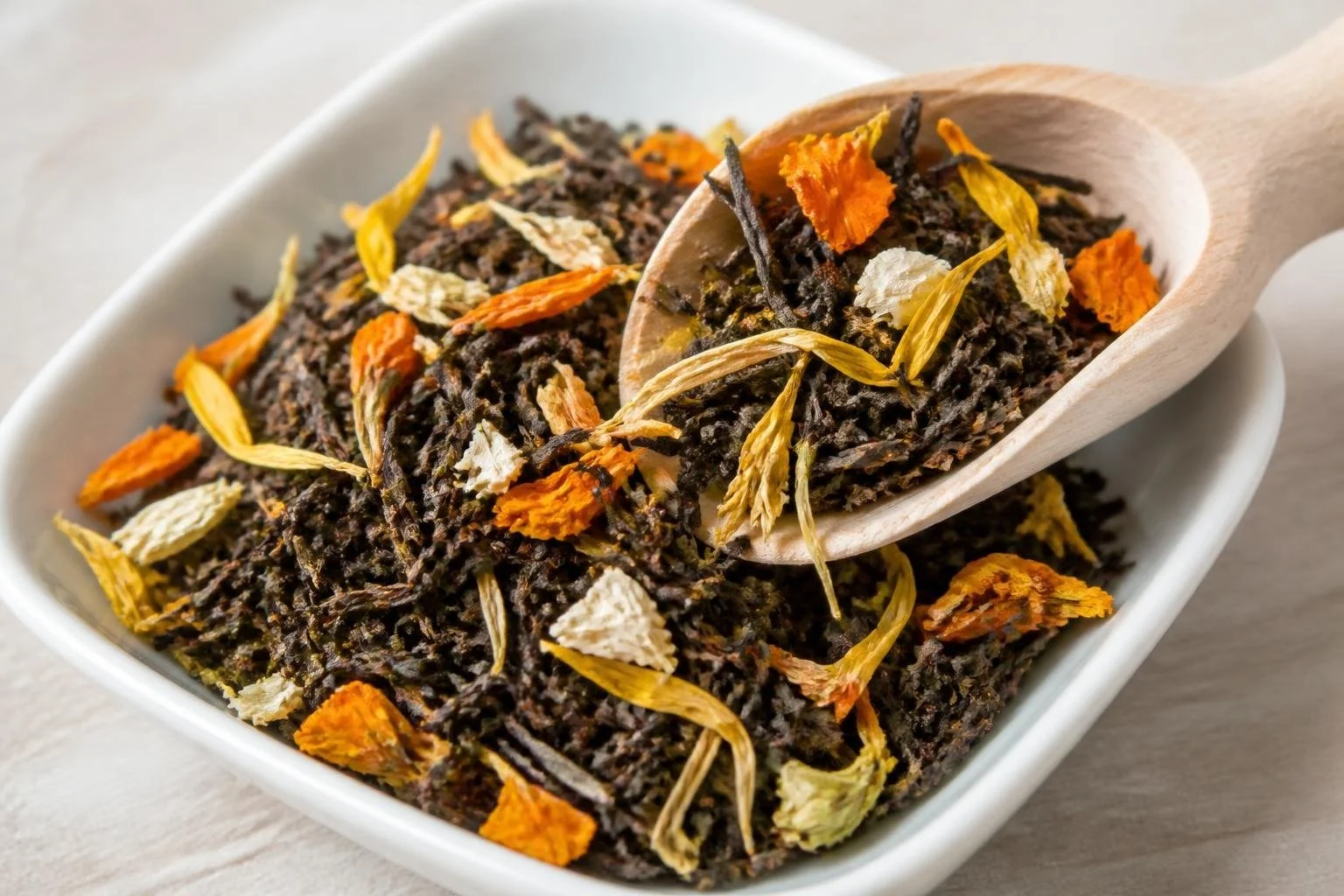
Monk's Blend starts with an OP (Orange Pekoe) Ceylon black tea from Sri Lanka, grown at 4,800 to 7,600 feet and made in the orthodox style. Ceylon's lively, bright character is why it takes flavors so well. Into that leaf go natural vanilla and grenadine flavor oils, plus calendula petals, white daisy, and marigold petals.

Sri Lanka's tea story began in 1867, when Scottish planter James Taylor planted the island's first tea field at the Loolecondera estate near Kandy. After coffee rust wiped out the coffee plantations, planters turned to tea, and Ceylon became famous for brisk black teas that blend beautifully with flavors like these.

What It Tastes Like

Expect a medium-bodied cup with soft vanilla sweetness and a fruity grenadine lift over that piquant Ceylon base. It's fragrant without being heavy, and a little mysterious in the nicest way. The petals don't just look pretty in the scoop; they tip the aroma toward floral and light.

It takes a splash of milk well. Pair it with vanilla cookies, fruit tarts, or crêpes. Plain, with a little sugar, or milky, it stays smooth.

How to Brew Monk's Blend

These are the brewing instructions from our product page, per 8 oz. of water:

  • Amount: 1 rounded teaspoon (about 2–3 g)

  • Water: freshly boiled (205–212°F)

  • Steep: 3–5 minutes

Adjust to taste. Go shorter for a lighter cup, or longer if you want more body. Our fill-your-own Paper Filters make loose-leaf brewing quick when you don't want to hunt for an infuser.


Sizes and Where to Find It

New to this tea? The sample size is an easy way to try it first, and larger bags are there when it becomes a regular. Browse our full Black Tea collection for more Ceylon classics and flavored blacks.

As tea enthusiasts, we have been sharing quality tea at affordable prices since 2006. Whether Monk's Blend is already on your list or you're just curious about that "monk" search, we hope the next cup feels a little heavenly.

Happy steeping!

Caffeine-Free Teas for Cozy Fall Nights (and Halloween, Too)

Fall evenings are made for a warm mug. The sun sets earlier, the porch lights come on, and on Halloween night there's a long stretch of doorbells, costumes and candy before anyone heads to bed. The trouble is that a strong cup of black tea at 8 p.m. can keep some of us staring at the ceiling.

The good news is you don't have to give up your evening cup. Here's a simple guide to tea without the caffeine, plus five of our favorite cozy picks for fall nights.

A steaming glass mug of rooibos tea beside a glowing jack-o'-lantern and autumn leaves

Caffeine-Free vs. Decaf: What's the Difference?

These two words get mixed up a lot, but they mean different things.

  • Caffeine-free drinks are made from plants other than the tea plant, like rooibos, chamomile, peppermint, spices or dried fruit. They never had caffeine to begin with. These are often called herbal teas or tisanes.

  • Decaf tea is real tea (black, green or oolong) that has had most of its caffeine removed. A small amount usually stays behind, so it's very low in caffeine, not zero.

If you want no caffeine at all, or you're brewing for kids, reach for a caffeine-free blend. If you love the taste of real black tea and just want a lot less caffeine, decaf is your friend.

What Is Rooibos?

Rooibos (say "ROY-boss") means "red bush." It grows in the Cederberg mountains of South Africa's Western Cape and isn't related to the tea plant at all. After it's cut, the leaves are bruised and left to ferment, which gives rooibos its sweet aroma, its red color and its smooth, honey-like taste. It's naturally caffeine free, so it makes a great base for evening blends, and it takes milk beautifully.

Five Cozy Caffeine-Free (and Low-Caffeine) Picks for Fall

1. Rooibos Chai: All the Spice, None of the Caffeine

Love chai but not the late-night buzz? Rooibos Chai blends rooibos with ginger, cinnamon, cloves, cardamom, orange and natural vanilla flavor. Like all chai, it really opens up with warm milk (whole or soy both work well). Serve it with gingersnaps or a slice of pumpkin bread.

How to brew: Turn the bag upside down a few times first so the spices mix evenly. Use 1 heaping teaspoon per 8 oz. of boiling water (212°F) and steep 5–7 minutes. Add warm milk and a little sweetener to taste.


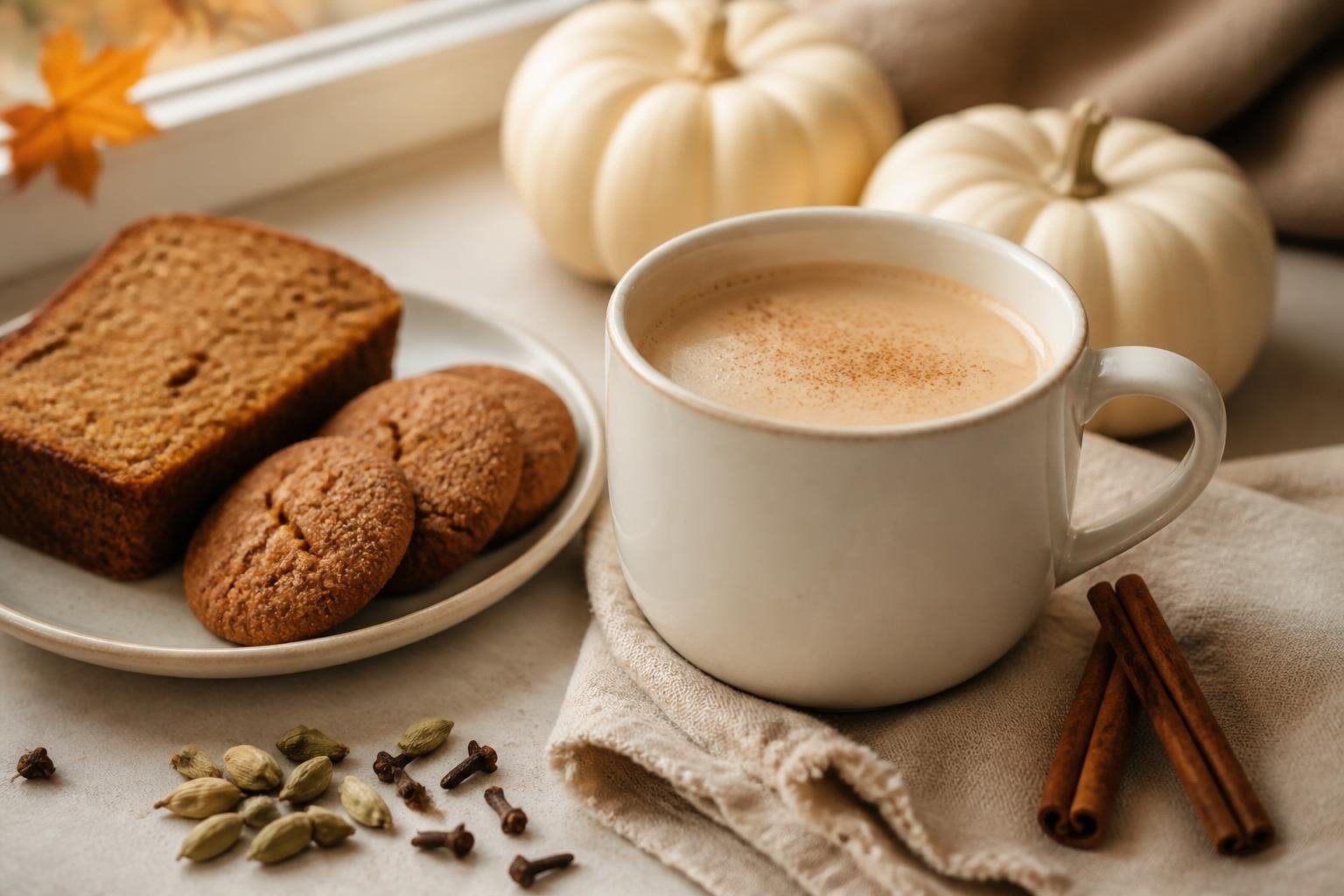
A creamy rooibos chai latte with gingersnaps, pumpkin bread and whole spices

2. Vanilla Rooibos: Dessert in a Mug

Vanilla Rooibos is top-grade rooibos with natural vanilla. It's smooth, mellow and creamy, and it's naturally sweet, so many people drink it without any sugar. Add a splash of milk for an evening treat, and pair it with vanilla cookies or a fruit tart.

How to brew: Use 1–2 teaspoons per 8 oz. of freshly boiled water (212°F) and steep 5–7 minutes.

3. Apricot Cinnamon: A Warm Fruit Blend for Pie Season

Apricot Cinnamon is a blend of cinnamon chips, diced apricot pieces and whole marigold petals. It's warm, sweet and a little floral, and it was made to go with dessert. Try it next to apple pie or oatmeal cookies. Leftovers make a nice iced tea the next day.

How to brew: Use 1–2 teaspoons per 8 oz. of freshly boiled water (212°F) and steep 5–7 minutes.

4. Sleep Well: For After the Trick-or-Treaters Go Home

When the porch light is off and the candy is put away, wind down with Sleep Well. It's our own blend of chamomile, peppermint, lemongrass and green rooibos. It tastes soft and floral, with a little mint and a gentle lemony lift. A few drops of honey are optional.

How to brew: Use 1–2 teaspoons per 8 oz. of freshly boiled water (212°F) and steep 5–7 minutes.


A cup of chamomile herbal tea with honey and a book by a lantern on an autumn night

5. Decaf Cream Earl Grey: For Real-Tea Lovers

If nothing beats the taste of black tea for you, try Decaf Cream Earl Grey. It's the same creamy, citrusy Ceylon black tea with bergamot and vanilla notes as our regular Cream Earl Grey, decaffeinated with a natural CO2 process. That process uses pressurized carbon dioxide to draw the caffeine out while the leaves keep their shape and flavor. Enjoy it with shortbread or lemon pound cake.

How to brew: Use 1 rounded teaspoon (about 2–3 g) per 8 oz. of freshly boiled water (205–212°F) and steep 3–5 minutes.

Quick Tips for Brewing Herbal Tea

  • Use boiling water. Unlike green tea, rooibos and herbal blends like water right off the boil.

  • Give it time. Most herbal blends need 5–7 minutes to bring out their full flavor. Rooibos doesn't turn bitter easily, so a longer steep is fine.

  • Go a little heavier. Fluffy blends with flowers and fruit pieces often need closer to 2 teaspoons per cup.

  • Skip the infuser hunt. Our fill-your-own Paper Filters make loose-leaf brewing quick, and cleanup is as easy as tossing the filter. You can find more brewing tools in our tea accessories.

Try Before You Stock Up

Every tea above comes in a sample size (about 5 cups) as well as larger bags, so it's easy to try a few and find your favorite fall nightcap. Browse our full Herbal & Fruit Tea collection and our Chai collection for even more ideas.

As tea enthusiasts, we have been sharing quality tea at affordable prices since 2006. Whatever you're doing this Halloween, we hope it ends with a warm mug and a good night's sleep.

Happy steeping!

Spooky Season Sipping: Our Autumn Harvest Tea Box Is Here

The porch pumpkins are carved, the candy bowl is filling up, and the evenings are getting darker earlier. This is the time of year when a warm mug matters most. So we packed our favorite fall teas into one box, ready for Halloween and every cozy night after it.

Meet the Autumn Harvest Tea Box. It holds about 225 cups of tea, and it has everything you need to start brewing the day it arrives.

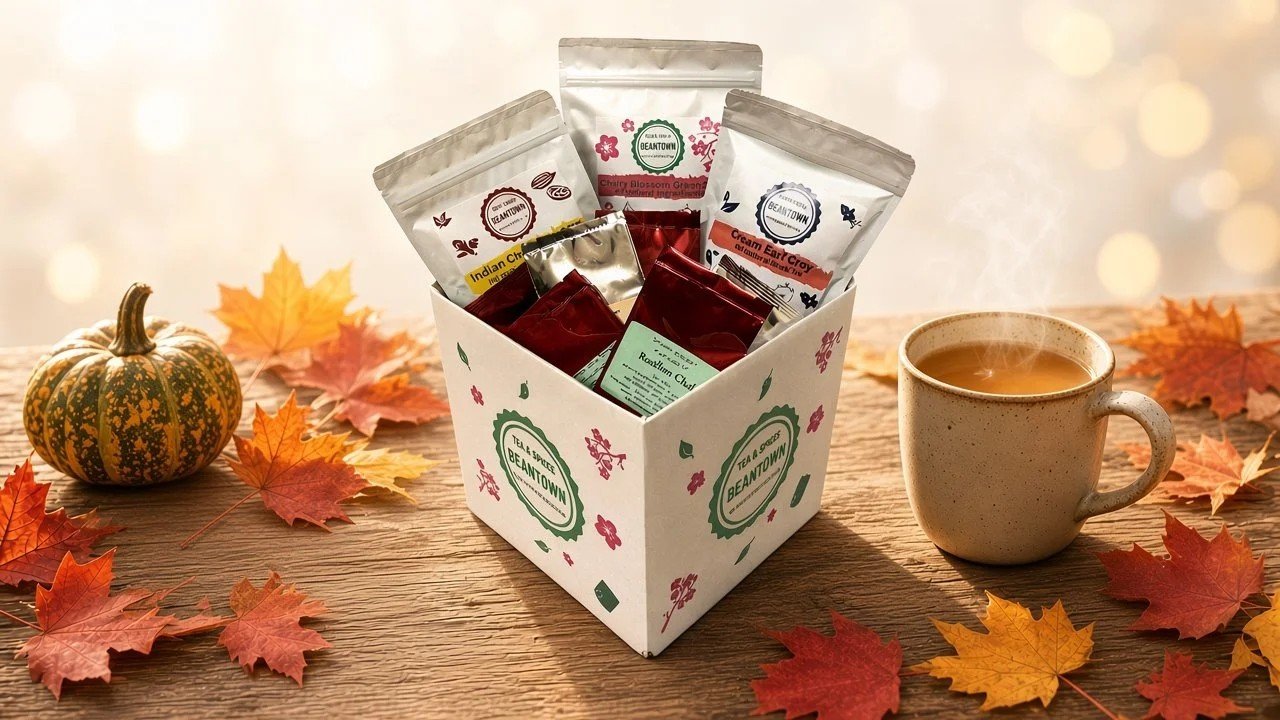
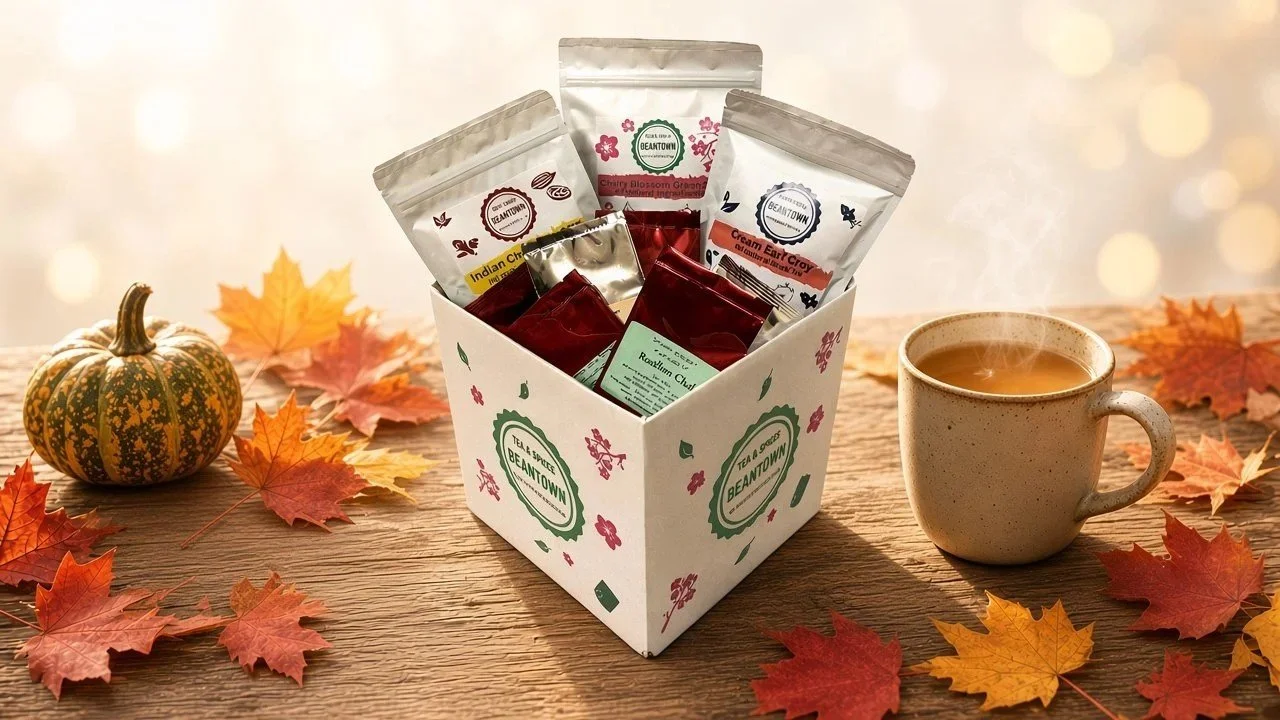
The Autumn Harvest Tea Box from Beantown Tea and Spices with three bags of fall tea, samplers and paper filters

What's Inside the Box

  • Three full 4 oz. bags (about 50 cups each) of our favorite autumn teas: Indian Chai Spice Mix, Cream Earl Grey and Cherry Blossom Green Tea.

  • 15 gourmet tea samplers (about 5 cups each), so you can try new flavors and find your next favorite.
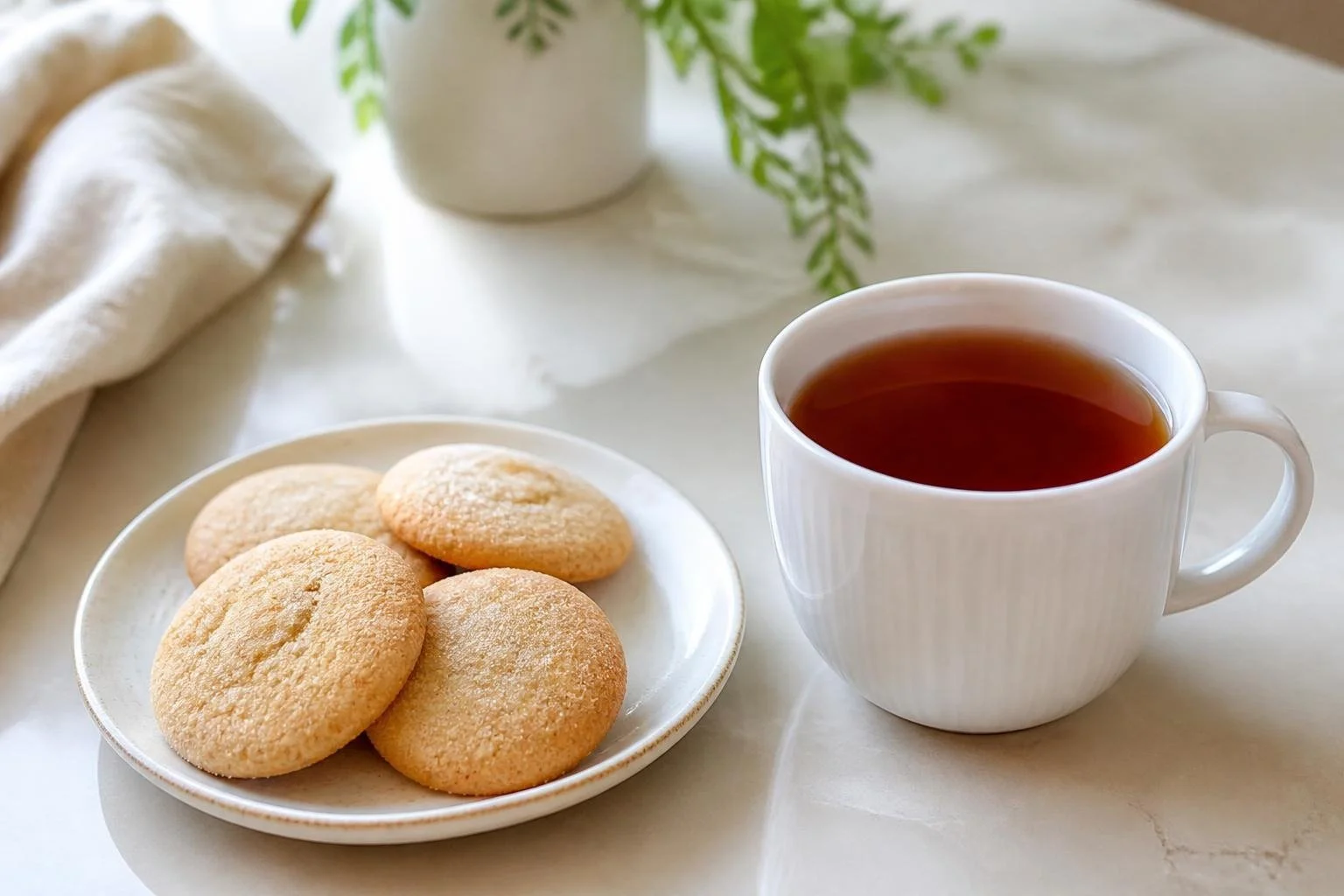
  • 100 paper tea filters, so there's no infuser to hunt for and no mess to clean up.

Indian Chai Spice Mix: Your Halloween Night Mug

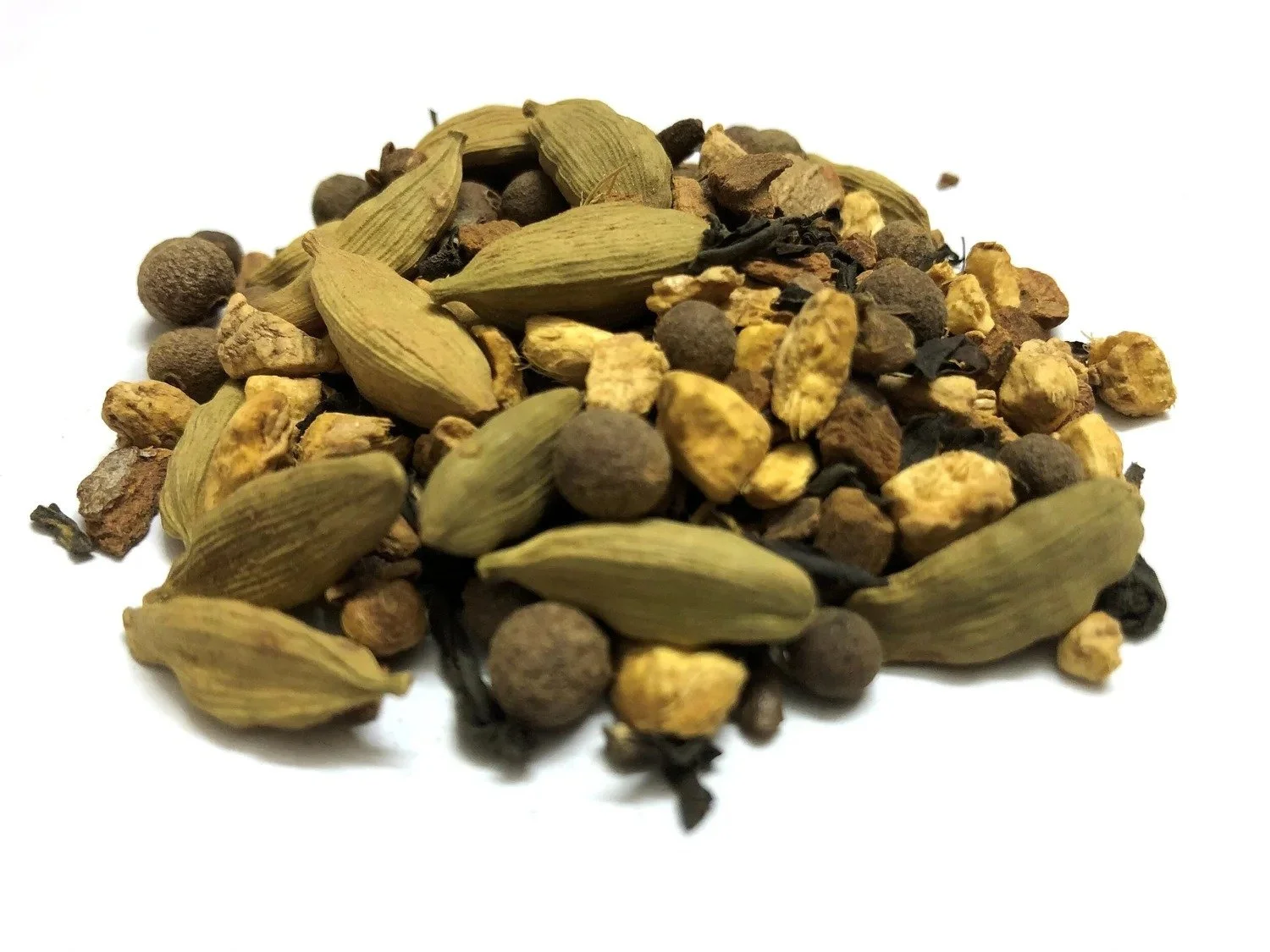
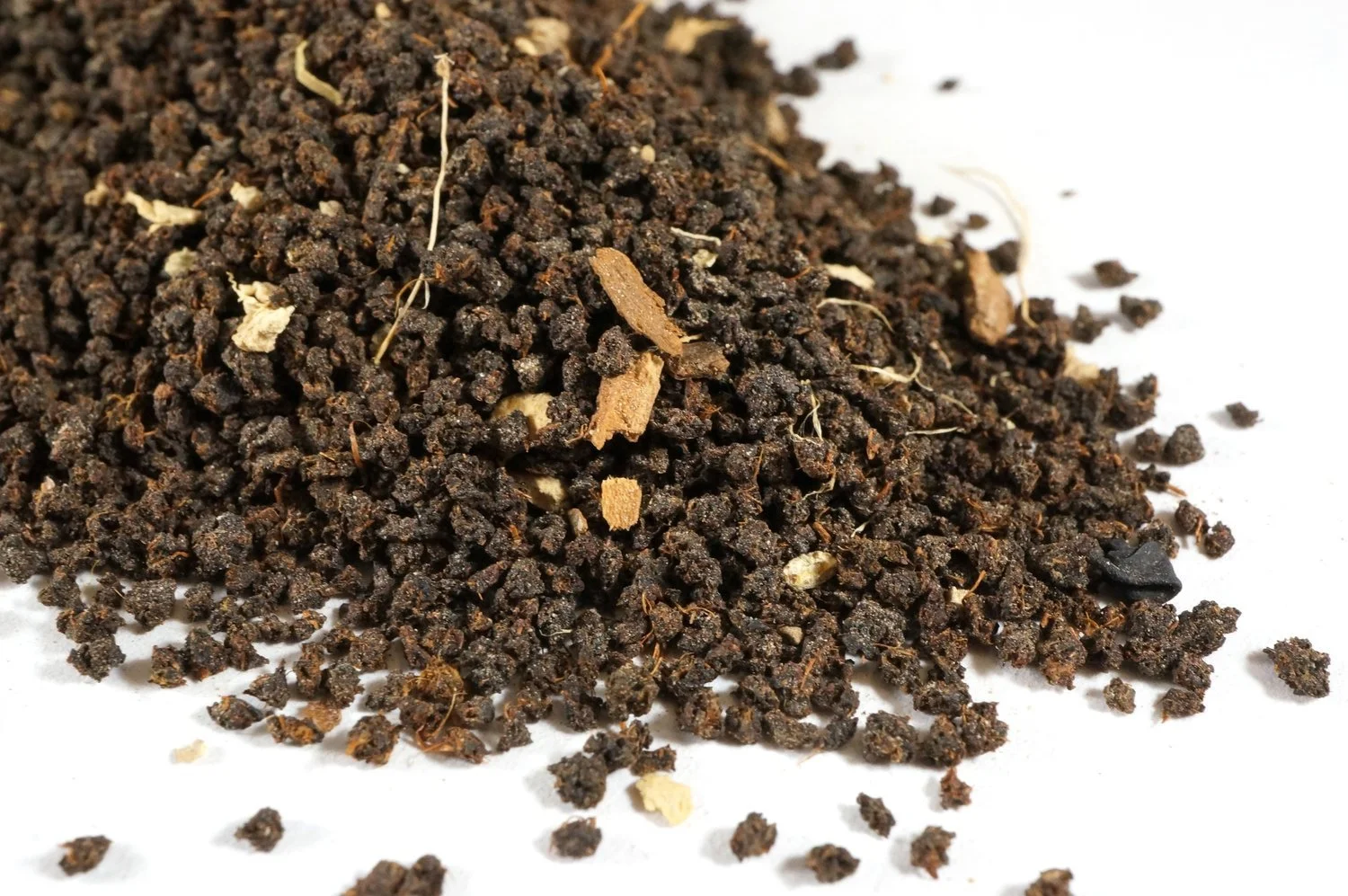
Our Indian Chai Spice Mix is a blend of cinnamon, ginger, green cardamom pods, allspice, cloves and black pepper. There is no tea in it, so it's naturally caffeine free. That makes it a great pick after the trick-or-treaters are home and everyone still needs to sleep.

For a rich, homemade chai, put 3 teaspoons in a pot with 1 cup of water and 2 cups of milk. Bring it to a boil, then simmer for 3–5 minutes (watch it, because it can foam up fast). Stir in sugar or honey, strain, and pour. Want a little caffeine? Add your favorite black tea while it simmers.

Mug of milky homemade chai beside a small saucepan, whole spices, fall leaves and glowing jack-o'-lanterns


Cream Earl Grey: For Rainy Afternoons

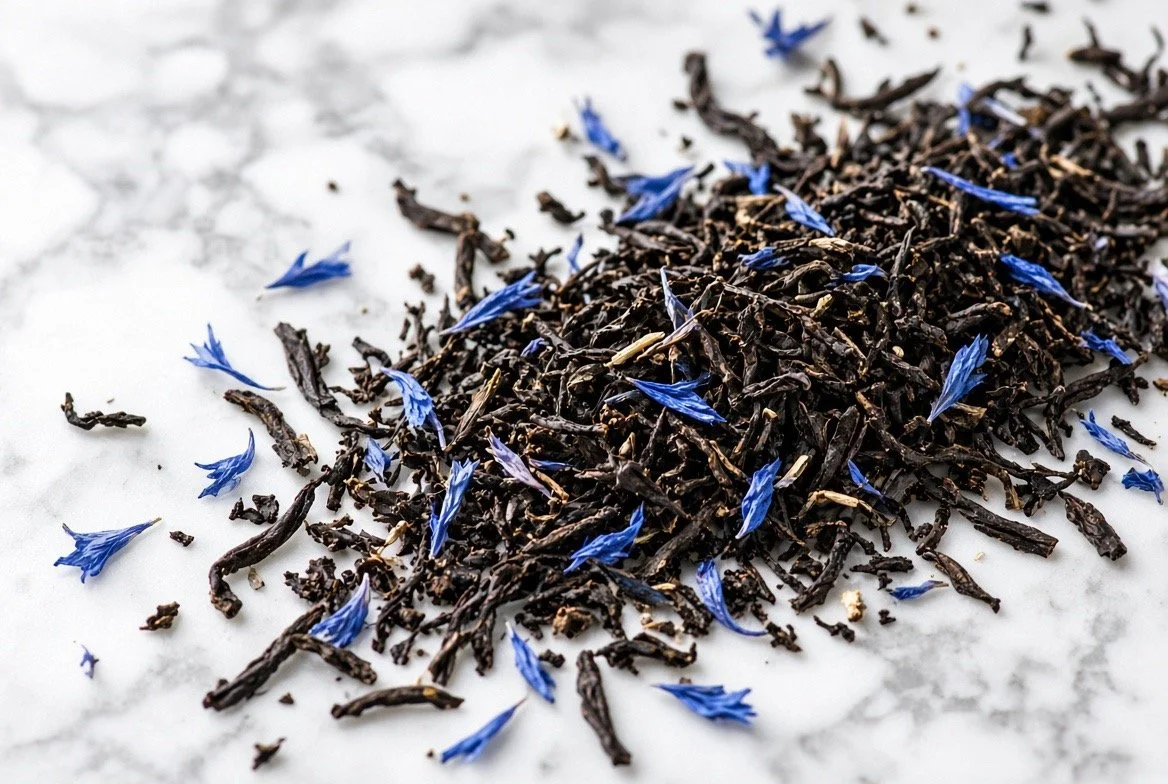
Cream Earl Grey starts with Ceylon black tea grown at 4,800 to 7,600 feet, then adds bergamot, a smooth vanilla note and blue cornflower petals. It brews a bright, coppery cup that's creamy and mellow. Try it with vanilla cake or madeleines, or make a London Fog latte with steamed milk.

Use 1 rounded teaspoon per 8 oz. of freshly boiled water and steep 3–5 minutes.

Cherry Blossom Green Tea: A Gentle Pick-Me-Up

Cherry Blossom Green Tea is a steamed Chinese green tea blended with cherries and rose petals. It's fresh and smooth, light enough for any time of day, and a nice break from heavier fall flavors. It pairs well with shortbread and fresh berries.

Use 1 teaspoon per 8 oz. of water at 175–185°F and steep 2–3 minutes. Skip the boiling water, which can make green tea bitter.

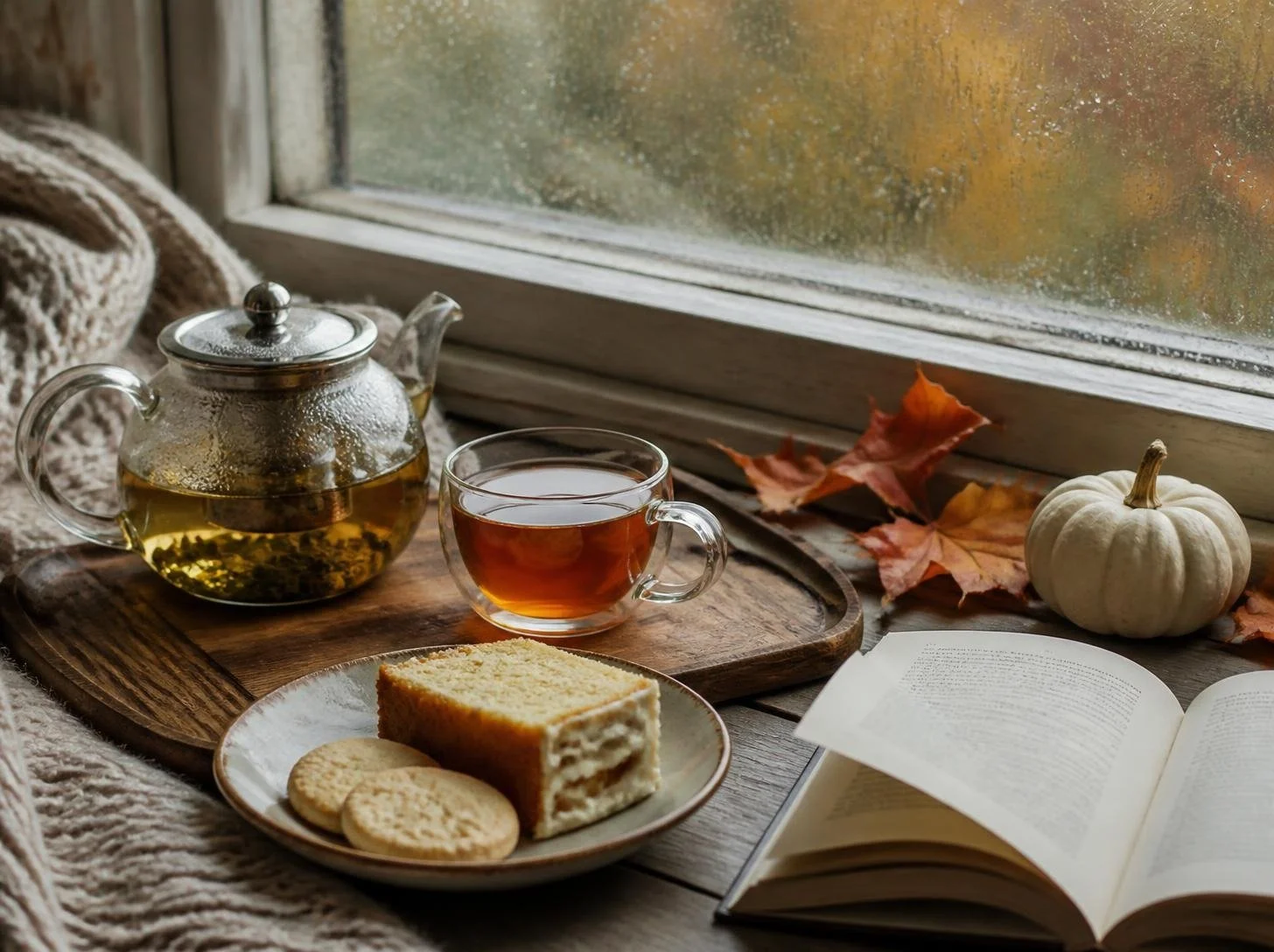
Glass teapot of green tea and a cup of black tea with vanilla cake and shortbread on a tray by a rainy autumn window


A Halloween Host Gift (or a Treat for You)

Heading to a Halloween party or a fall dinner? The Autumn Harvest Tea Box makes an easy host gift. It's also a thoughtful thank-you for teachers and coworkers, and a fun surprise for the tea lover who has everything. The 15 samplers make it a good fit for someone just getting into loose-leaf tea, too.

Of course, you can keep it for yourself. We won't tell.

Every box is packed by fellow tea enthusiasts at Beantown Tea & Spices. We've been sharing quality tea at affordable prices since 2006, and this is our favorite way to bring fall to your kitchen: fall in a tea box, ready for spooky season and beyond.

Shop the Autumn Harvest Tea Box, or browse more tea sets and gifts.

Happy Halloween, and happy steeping!

What New Research Says About Tea and Your Health (2025–2026)

Here in Boston, we drink tea mostly because it tastes good and slows the day down. Researchers keep studying what else it might do. Below are four studies published between July 2025 and October 2026, explained in plain language. Each one shows a link between tea and a health result. None of them proves that tea causes that result, and we point out the limits of each one.

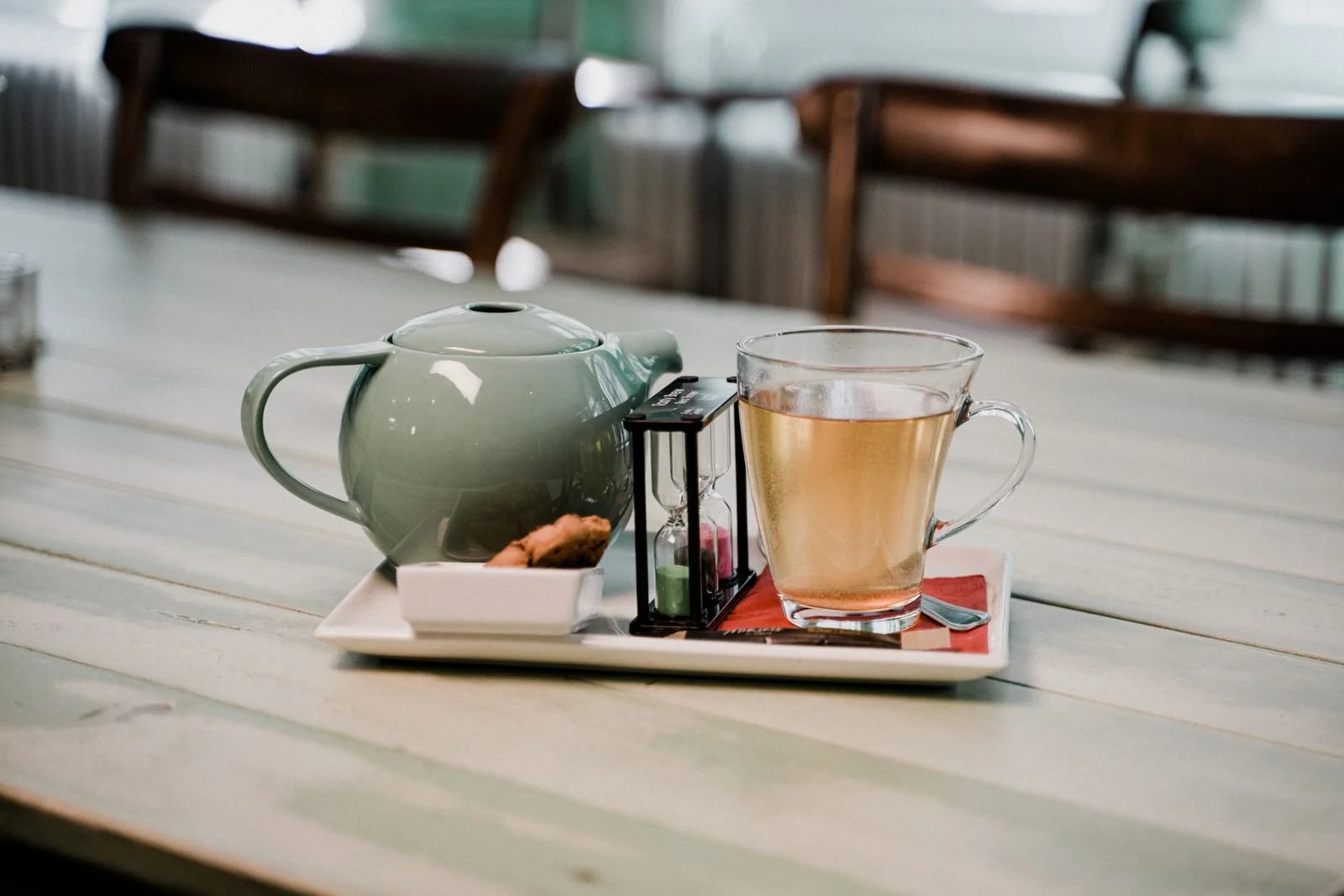
A green ceramic teapot next to a glass cup of tea on a wooden table.

Photo: Bert Christiaens / Pexels


1. Tea and blood pressure

Journal: Frontiers in Nutrition, August 2026 (systematic review and meta-analysis)

Researchers combined 20 observational studies with about 320,000 adults in total. In the four studies that followed people over time, regular tea drinkers were about 13% less likely to develop high blood pressure than people who did not drink tea. The link was strongest at lower intakes and leveled off at higher intakes, so more cups did not keep adding benefit. In the subgroup analyses, the link was stronger among black tea drinkers.

Limits: All of the studies were observational, and their results varied a lot. The authors write that a clear protective effect "cannot be confirmed."

Read the study

2. Tea and bone strength over 13 years

Journal: The American Journal of Clinical Nutrition, October 2026 (prospective cohort study)

A team in Guangzhou, China, measured bone mineral density in 1,708 adults four times over 13 years. People who drank tea at a moderate frequency generally had the highest bone density scores across the whole body, lower spine and hip. People with higher blood levels of certain tea catechins (EGCG and ECG) also tended to have better bone measurements.

Limits: The differences were small, and the blood-marker results did not rise in a straight line. The study was done in one region of China, and as an observational study it cannot show cause and effect.

Read the study

3. Unsweetened tea and longer life

Journal: Frontiers in Nutrition, July 2025 (prospective cohort study)

Using data from 195,361 UK Biobank participants followed for a median of 13.6 years, researchers compared people who drank no tea with people who drank tea unsweetened, with sugar, or with artificial sweeteners. People who drank about 3.5 to 4.5 cups of unsweetened tea a day had a 20% lower risk of dying from any cause during the study, plus lower risks of dying from heart disease and cancer. Tea with sugar or artificial sweeteners showed no consistent link with lower risk.

Limits: Tea intake came from short dietary recalls, and tea drinkers may differ from non-drinkers in other ways. The link was U-shaped, so the lowest risk sat at a moderate intake, not at the highest one.

Read the study

4. Green tea catechins, exercise and leg strength

Journal: Archives of Gerontology and Geriatrics, August 2026 (randomized, placebo-controlled trial)

In Japan, 78 adults aged 60 and older who felt they were getting weaker or slower all took part in group exercise classes for 24 weeks. Half also drank a catechin-enriched green tea each day (613 mg of catechins), and the rest drank a placebo drink. The green tea group gained more knee-extension (thigh) strength.

Limits: There was no difference between the groups in overall physical performance tests or muscle mass. Only 51 people completed the trial. The tea used was specially enriched with catechins, more than a typical cup provides, and the study was partly funded by a tea company whose employees were co-authors.

Read the study

What this means for your cup

  • Moderate and regular seems to be the pattern. In three of these studies, the best results came at moderate intake, not the highest.

  • Try it plain. The UK Biobank study linked lower risk with unsweetened tea only. A naturally flavorful tea makes skipping the sugar easy.

  • Tea works alongside a healthy lifestyle. In the strength trial, everyone exercised, and the tea was an addition.

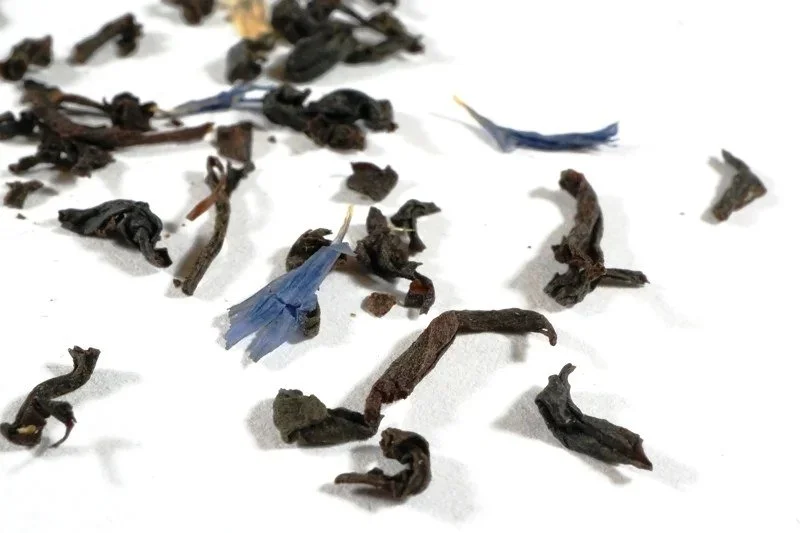
Loose-leaf Earl Grey black tea from Beantown Tea & Spices.


A few teas from our shop to brew this week:

  • Earl Grey: a classic black tea with bergamot, bright enough to enjoy without sugar.

  • Jasmine Dragon Pearls: hand-rolled green tea with a natural floral sweetness.

  • Matcha Samidori: powdered green tea, where you drink the whole leaf.

This post is for general information only and is not medical advice. Please talk with your doctor before making changes to your diet or health routine, especially if you take medication or are sensitive to caffeine.

Jasmine Dragon Pearls: The Hand-Rolled Tea That Blooms in Your Cup

Some teas you simply drink. Jasmine Dragon Pearls is one you watch. Each small, hand-rolled pearl slowly opens in hot water, and the room fills with the sweet scent of jasmine. It is one of our favorite teas for a quiet afternoon, any time of year.

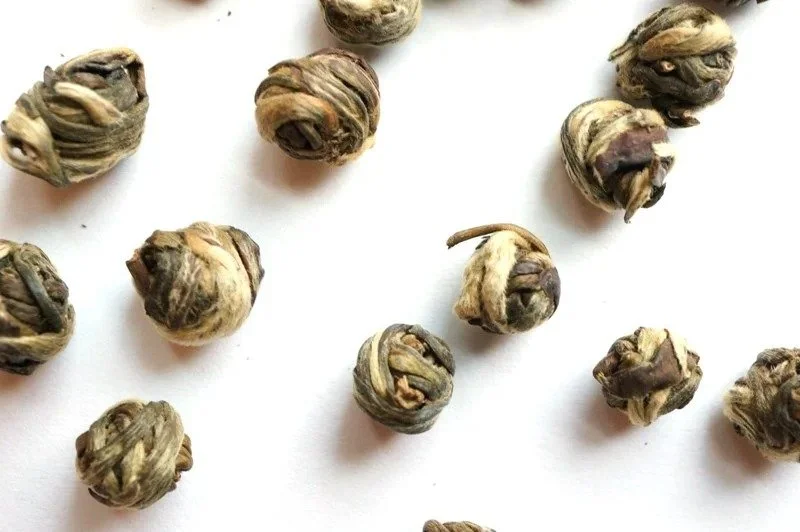
Loose Jasmine Dragon Pearls, small hand-rolled balls of green tea leaves, on a white surface

Where Jasmine Dragon Pearls Come From

Jasmine tea has a long history in China. The city of Fuzhou, in Fujian province, is especially famous for it, and its scenting traditions go back to the Southern Song dynasty.

The pearls are made from the top two leaves and the bud of new spring growth, picked in late March and early April. Each pearl is then rolled by hand.

The jasmine scent comes from real flowers. The blossoms are gathered during the day while they are still closed. In the evening, as the flowers open and release their fragrance, they are layered with the tea. After resting together, the spent flowers are removed and the tea is dried. This process is often repeated several times to give the tea a deeper scent.

What It Tastes Like

Jasmine Dragon Pearls is smooth and silky, with a clean green tea base under a sweet jasmine perfume. It is gentle, never bitter when brewed well, and pleasantly floral.

When the pearls open, look for the two leaves and the bud coming back to life. You may see a little soft "hairy down" on the bud. That is a sign of high quality and careful handling.

It pairs nicely with dim sum, steamed fish, almond cookies or fresh lychees. It is also lovely on its own.

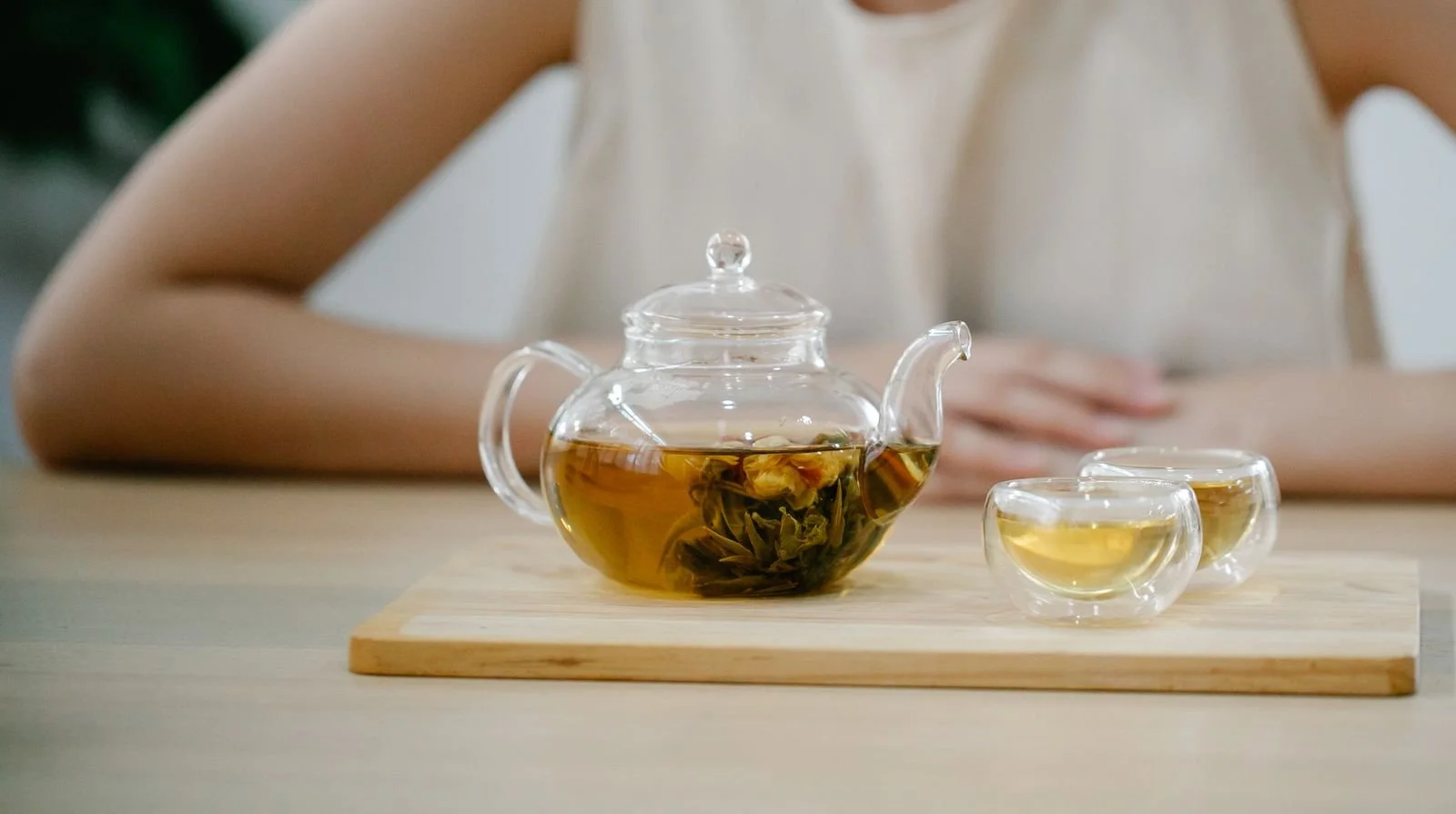
Glass teapot of golden green tea with opened leaves, beside two small glass cups on a wooden tray

How to Brew Jasmine Dragon Pearls

These are the brewing instructions from our product page, per 8 oz. of water:

  • Water temperature: 195°F / 90°C

  • Amount: 2 teaspoons

  • Steep time: 2–3 minutes

Tip: brew it in a glass teapot or a clear mug so you can watch the pearls open. You can steep the same pearls several times.

Sizes

See sizes on the product page

New to this tea? The sample size is an easy way to try it first.

Shop Jasmine Dragon Pearls from our tea shop in Boston, and explore the rest of our green tea collection.

Which Tea Goes With Your Halloween Candy?

Halloween candy is glorious, and a little overwhelming. After a night of chocolate bars, caramel chews, and whatever glow-in-the-dark mystery piece ended up in the bowl, a good cup of tea does more than warm your hands. It resets the palate, cuts the sweetness, and turns the candy pile into an actual tasting night instead of a sugar fog.

Here is how we pair our loose-leaf teas with common Halloween treats. No fancy equipment. Just a kettle, a mug, and whatever made it home in the bag.

Mug of tea with Halloween chocolate and caramel

Chocolate bars and Cream Earl Grey

Milk chocolate and dark chocolate both love bergamot. Our Cream Earl Grey is Ceylon black tea with classic bergamot, rounded out by vanilla and a soft cream note, plus those blue cornflower petals. The citrus lifts the cocoa, and the vanilla echoes the sweetness without fighting it.

Brew it strong enough to stand up to the chocolate: 1 teaspoon per 8 oz of freshly boiled water, steeped 3–5 minutes. Sip between bites of a plain chocolate bar or a peanut-butter cup. Samples are available if you want to try it before you stock up.

Caramel, toffee, and Pumpkin Spiced Tea

Anything sticky and caramel-forward belongs with spice. Pumpkin Spiced Tea is premium Ceylon black tea blended with cinnamon, ginger, cloves, cardamom, marigold flowers, and natural pumpkin flavor. It tastes like October in a mug, and it handles candy corn, soft caramels, and toffee without tasting fake.

Use 1 heaping teaspoon per cup, boiling water, 3–5 minutes. Add a splash of milk if the candy was especially rich. Bags are available.

Spiced chai with cinnamon candies

Spicy cinnamon candy and Masala Chai

Hot cinnamon fireballs and red cinnamon chews need a partner that already speaks spice. Masala Chai is a full-bodied black tea with South Indian masala spices: ginger, cardamom, coriander, cinnamon, cloves, and black pepper. The ginger-cardamom finish matches that candy heat instead of getting steamrolled by it.

Turn the bag upside down a few times first (the powdered spices settle). Use 1 heaping teaspoon per cup, steep 5–10 minutes, then add warm milk and a touch of sugar. Samples are available.

Berry tea with fruit candies

Fruity chews and Very Berry

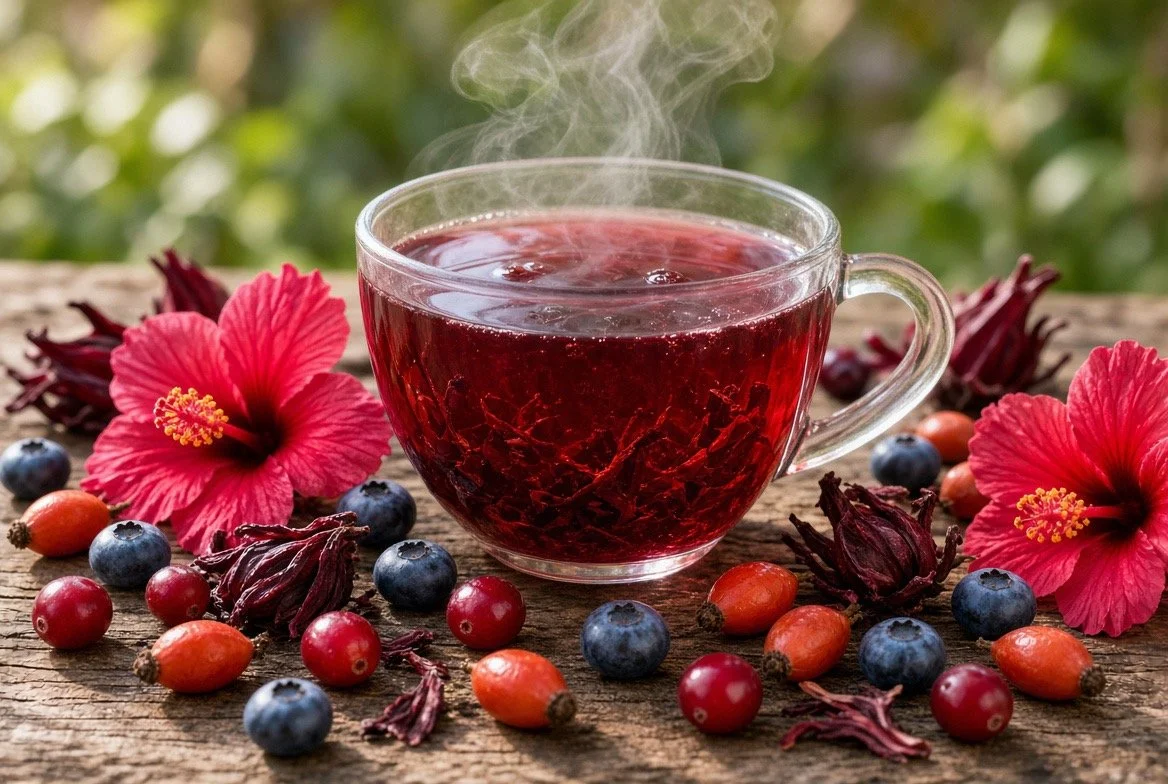
Gummy bears, fruit snacks, and berry hard candies can taste thin next to black tea. Reach for Very Berry instead: rose hips, hibiscus, cranberries, blueberries, and natural forest-berry flavor. It is naturally caffeine-free, with no added sugar, and it brews into a deep red cup that tastes like fruit punch.

Use 2 teaspoons per cup, boiling water, steep 5–10 minutes. Kids can join this round. Samples are available, and it makes a great iced pitcher if you are hosting.

After the sugar rush: Sleep Well

When the porch light is off and the leftover candy is in a sealed container (yes, hide it from yourself), wind down with Sleep Well. It is our own caffeine-free blend of chamomile, peppermint, lemongrass, and green rooibos. Soft, floral, lightly minty, with a gentle lemon lift.

Use 1–2 teaspoons per 8 oz of boiling water, steep 5–7 minutes. A drop of honey is optional. Samples are available.

A few pairing tips that always help

  • Brew a little stronger than usual when you are eating sweet candy. Sugar softens the tea.

  • Alternate sip and bite. Let the tea clear the palate before the next piece.

  • Keep caffeine earlier in the evening if the kids (or you) still need to sleep.

  • Store opened candy airtight, and keep tea in an airtight tin away from light, air, moisture, and heat so both stay tasting like themselves.

Quality loose leaf at everyday prices has been our approach since 2006, from our Tea Zone days in Boston to our shop in Somerville. Whether your bowl is mostly chocolate or mostly mystery fruit, there is a cup that makes the haul more fun.

Happy Halloween, and happy steeping from all of us at Beantown Tea & Spices.

Tea Leaves and Barmbrack: How Tea Became Part of Halloween Fortune-Telling

Long before trick-or-treating caught on, Halloween was a night for parties, autumn treats, and trying to peek into the future. And in many homes across Ireland, Britain, and America, the most important prop for that fortune-telling was something already on the table: a pot of tea.

This week, as the leaves turn and jack-o'-lanterns start appearing on Boston stoops, we're looking back at three old traditions that tie tea to Halloween night.

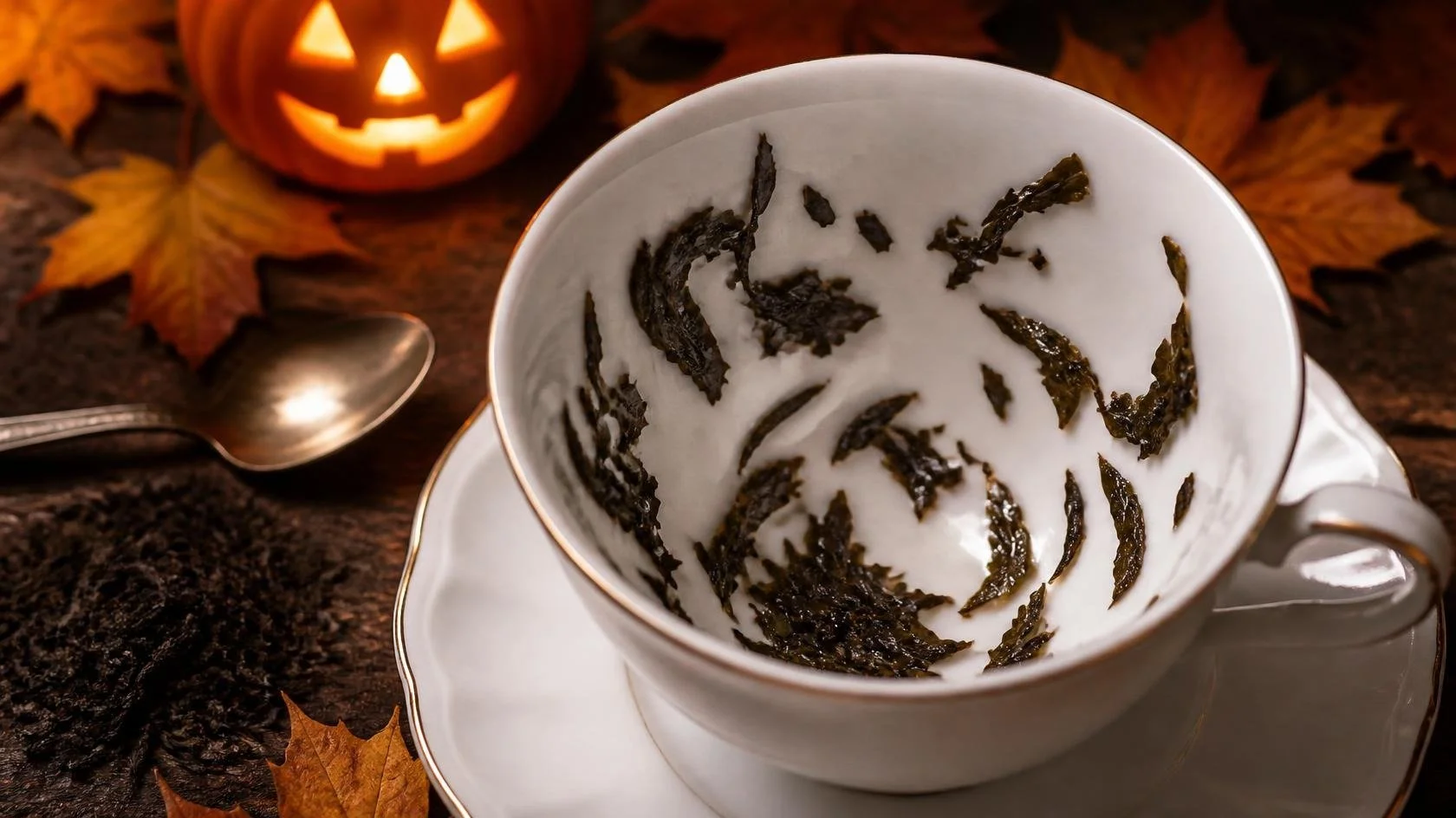
Teacup with loose tea leaves left inside for tea-leaf reading, beside a glowing jack-o'-lantern


Reading the leaves: a brief history of tasseography

Tea arrived in Britain from China in the mid-1600s as an expensive luxury. As trade grew and prices fell, it became an everyday drink for ordinary households, and the leftover leaves at the bottom of the cup took on a new life. Reading the shapes those leaves formed, a practice called tasseography, became a popular way to tell fortunes. According to NPR's history of the practice, it offered a much simpler alternative to older divination methods that involved molten lead or hot wax.

The oldest English-language book on the subject, Reading Tea Leaves by a writer calling themselves "a Highland Seer," described generations of Scottish "spae wives" (from an old Norse word for prophecy) peering into teacups to see what was coming. The Victorian era was the practice's real heyday. A reader would have the drinker swirl the last bit of tea three times, turn the cup upside down on the saucer to drain, and then study the leaves left clinging inside. Leaves near the rim were said to point to the near future, and those near the bottom to events further off.

By the early 1900s, porcelain makers in England and the United States were even selling "fortune-telling cups," painted inside with zodiac signs, playing cards, or symbols, so that anyone could read a fortune by noting where the leaves landed. Atlas Obscura notes that in the 1920s, fortune-telling tearooms offering leaf readings sprang up in cities.

The Halloween tea party

In the late 1800s, Halloween in America was mostly a holiday for parties, often for adults, filled with fall foods and games meant to forecast the future, especially romance. The New-York Historical Society notes that reading tea leaves was a favorite at Halloween parties of that era, alongside games like peeling apples and dropping melted lead into water (a game we strongly suggest you skip).

Some hostesses built a whole evening around it. In 1898, the Western Mail described a "candlelight tea" for sixteen young women, with a parlor decorated in autumn leaves, fruit, nuts, ears of corn, and jack-o'-lanterns lined along the mantel. Guests found hand-painted fortune cards at each place setting. One popular tea game of the time: balance a dry spoon on the rim of your cup, then drip tea into it from a second spoon until it tips. Each drop was said to stand for one year until your wedding.

Barmbrack: Ireland's tea-soaked Halloween bread

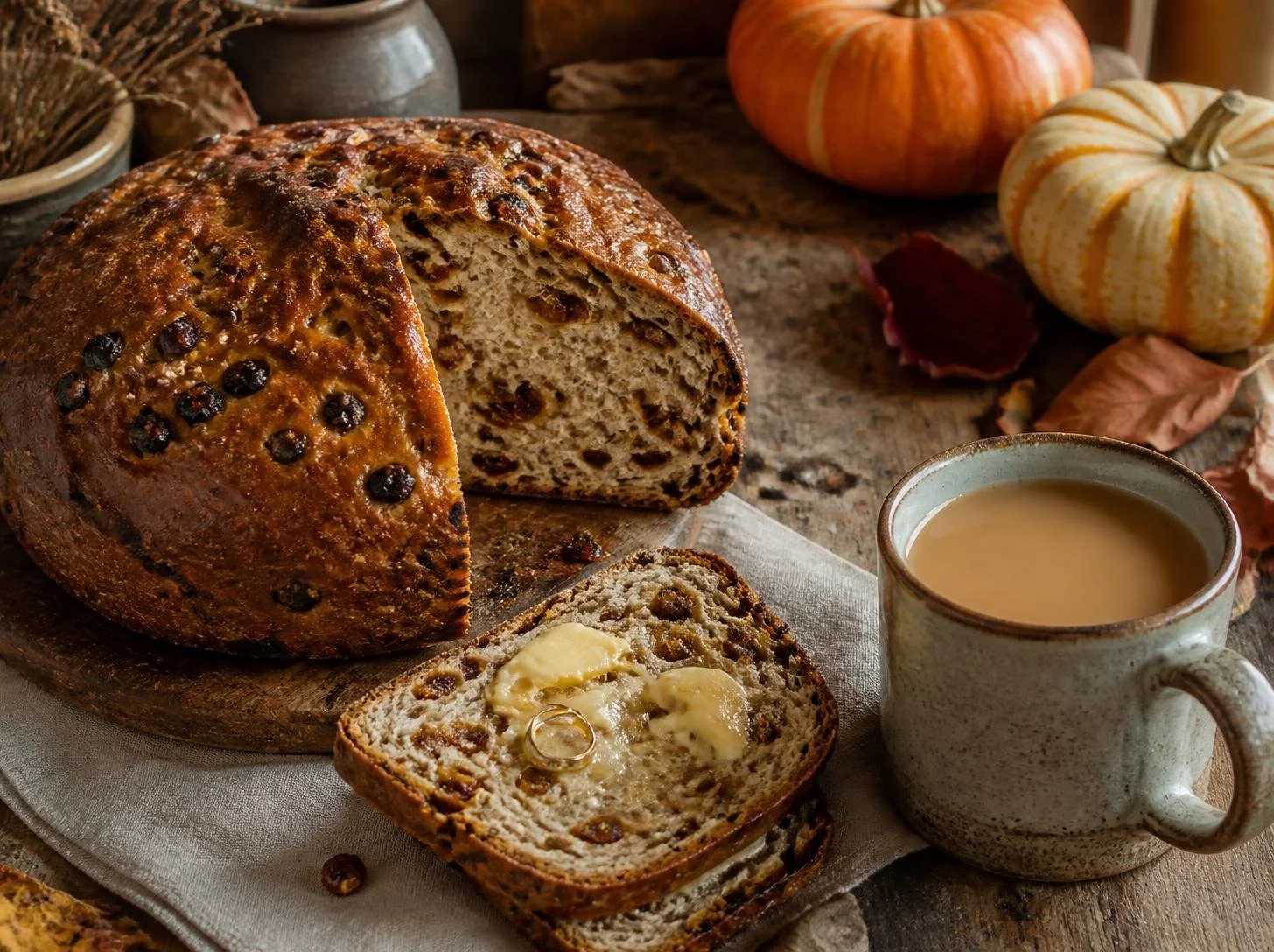
In Ireland, the fortune-telling happened in a slice of bread. Báirín breac, usually called barmbrack, is a sweet loaf studded with dried fruit; the name means "speckled loaf." Irish families have baked it on the eve of Samhain, October 31, for generations, and the fruit is traditionally soaked in strong tea (and sometimes a splash of whiskey) before baking.

The fun was in what was hidden inside. According to the National Museum of Ireland and Ireland's official tourism sites, a barmbrack might hold several small charms, each with a meaning for whoever found it in their slice:

  • A ring meant you would marry within the year.

  • A coin meant wealth and good fortune.

  • A pea meant no wedding that year.

  • A bean meant good fortune, but without riches.

  • A rag meant hard times or bad luck.

  • A stick meant a quarrelsome marriage.

Today, most shop-bought barmbracks hold just a ring, but plenty of families still bake the full set at home. And if you've ever had a slice, you know it's best served toasted, buttered, and with a strong cup of tea alongside.

Brew your own Halloween traditions

You don't need a crystal ball to bring a little of this history to your table this October. A few of our teas fit right in:

  • Irish Breakfast: Our robust blend of Assam and Kenya black teas is strong enough to stand up to milk and sugar, which makes it a natural partner for a buttered slice of barmbrack. Brew a strong pot and use the leftovers to soak your dried fruit, the way Irish home bakers have done for generations.

  • China Black Tea: Want to try reading the leaves? Brew a loose-leaf tea right in the cup without a strainer, then leave a little liquid at the bottom, swirl, and turn the cup over. This smooth, slightly malty classic is a pleasant cup to linger over while you wait to see what shapes appear.

  • Pumpkin Spiced Tea: Ceylon black tea with cinnamon, ginger, cloves, and cardamom tastes just like the autumn parlors those Victorian hostesses decorated.

  • Apricot Cinnamon: A caffeine-free choice so the whole family can join in on Halloween night.

Hosting friends this month? Our Autumn Harvest Tea Box brings together a selection of fall favorites, perfect for setting out at your own candlelight tea.

Whatever you find at the bottom of your cup this Halloween, we hope it's a cozy evening and a good brew. Happy Halloween from all of us at Beantown Tea & Spices!

Sources

Spiced Chai for Crisp October Nights

Halloween week always sneaks up on me. One minute the leaves are just starting to turn, and the next I'm looking for a mug that feels a little warmer, a little spicier, and still easy on the wallet.

That's when I reach for our Spiced Chai.

Steaming mug of spiced chai with autumn leaves

What makes this blend different

This is a full-bodied black tea blended with seven classic spices: cinnamon, ginger, green cardamom pods, allspice, cloves, and black pepper. It brews into a warm cup with a gentle peppery kick, aromatic without tasting artificial.

If Masala Chai is the one you already know from our shop, Spiced Chai sits right beside it with a little more allspice and that black-pepper finish. Excellent hot, and it holds up iced if a warm October afternoon shows up again.

Samples start at $2.95, so you can try it before you commit to a bigger bag. Same idea we've always had: quality loose leaf at prices that make sense for everyday drinking.

Spiced Chai loose leaf blend of cardamom pods, black tea, cinnamon, ginger, and allspice

How we brew it at home

Turn the bag upside down a few times first. The powdered spices like to settle at the bottom.

For each 8 oz cup:

  • Use 1 heaping teaspoon of Spiced Chai

  • Pour freshly boiled water (212°F / 100°C) over the leaves

  • Steep 4–5 minutes (go longer if you want more spice)

  • Add warm milk and a touch of honey or sugar to taste

Pair it with oatmeal cookies, apple pie, or just a quiet porch minute while the kids are out trick-or-treating. Around here that counts as a solid October plan.

Masala Chai loose leaf black tea blend with warming spices

More cozy chai if you want options

Browse the full chai selection for Masala Chai, Vanilla Chai, and the rest of the lineup. Grab Spiced Chai when you want that peppery fall cup ready for the kettle.

Happy steeping from all of us at Beantown Tea & Spices.

Three Cozy Fall Tea Lattes You Can Make at Home

Mornings get crisp fast now, and the evenings come earlier every day. A homemade tea latte is about the easiest comfort I know of, and you can pour one for yourself.

We are picky tea drinkers here, and we care about good leaf that doesn't cost a fortune. These are three latte recipes we reach for all autumn. You don't need a café line for any of them, just loose leaf, hot water, and the milk you like.


1. Pumpkin Spice Tea Latte

Start with our Pumpkin Spiced Tea: premium Ceylon black tea with cinnamon, ginger, cloves, cardamom, marigold flowers, and natural pumpkin flavor. It is the first blend I grab once the leaves start turning.

For each cup:

  • Use 1 heaping teaspoon of loose leaf

  • Pour freshly boiled water (212°F / 100°C) over the leaves

  • Steep 3–5 minutes, then strain

  • Froth or warm about ½–¾ cup milk (dairy or plant-based) and pour it over the tea

  • Sweeten lightly with maple syrup or honey, and dust with cinnamon if you like

If you want the spice to hold its own against the milk, brew it a touch stronger. It is just as good in the afternoon, honestly.

2. Classic Masala Chai Latte

Our Masala Chai is a full-bodied black tea with South Indian masala spices (ginger, cardamom, coriander, cinnamon, cloves, and black pepper). You can taste the ginger and cardamom right at the finish.

Hot chai method (from how we brew it in-house):

  • Bring fresh water to a rolling boil

  • Use 1 heaping teaspoon of chai per cup

  • Steep 5–10 minutes (at least 7 for a true chai taste)

  • Prepare your cup with a little sugar and about 20% milk by volume, then pour in the strained chai

Like it creamier? Brew the chai as usual and top it with steamed milk, just like a latte. Craving vanilla with the same spice? Try our Vanilla Chai the same way. Browse the full chai selection if you are hunting for a new favorite.
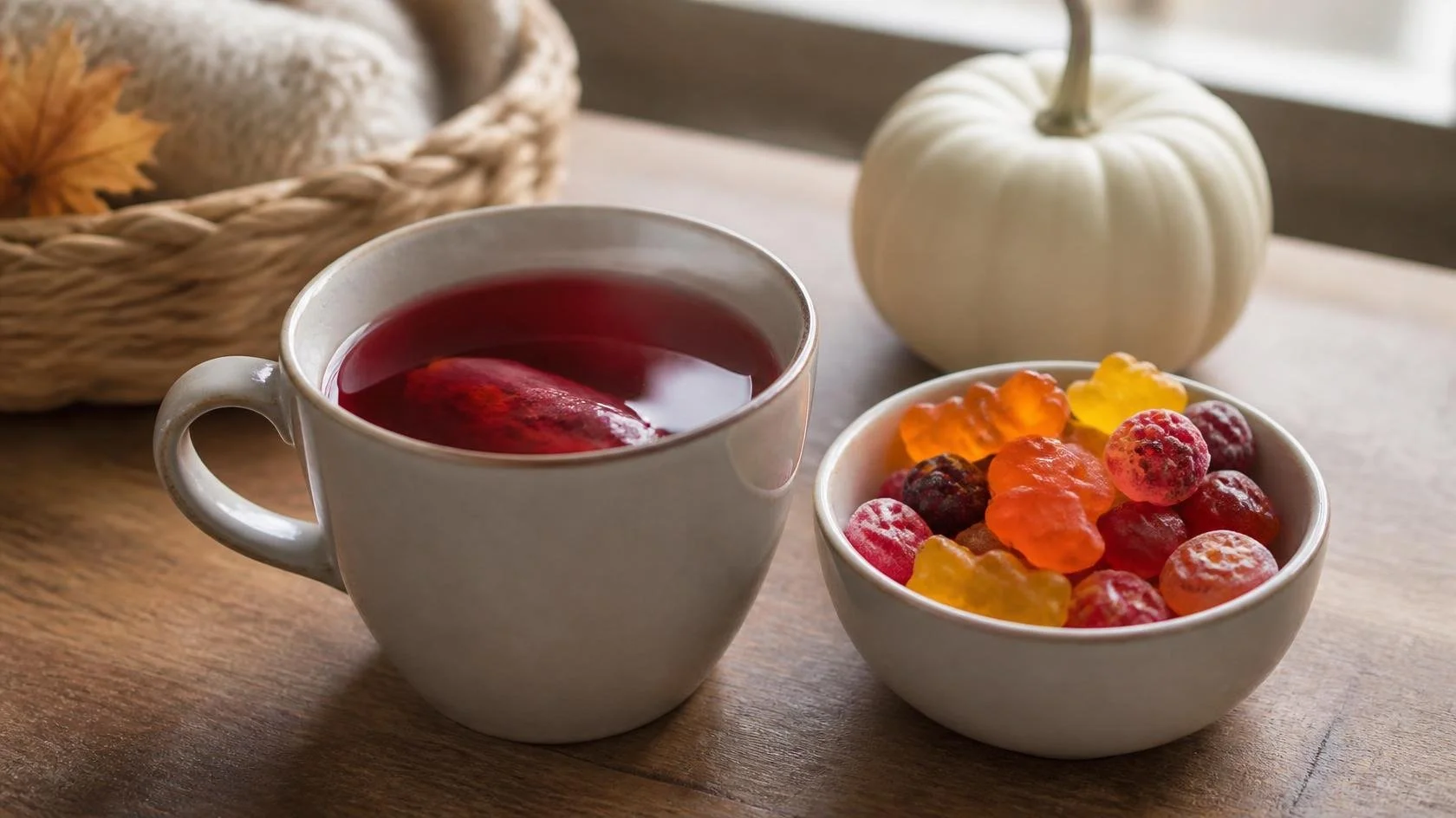
3. Homemade London Fog

A London Fog is really just Earl Grey with steamed milk and a hint of vanilla sweetness. Our Cream Earl Grey (also known as Earl Grey de la Crème) was made for exactly this. It is Ceylon black tea with bergamot, rounded out by smooth vanilla and soft cream, with blue cornflower petals.

Per 8 oz cup:

  • Use 1 teaspoon of Cream Earl Grey

  • Steep in freshly boiled water for 3–5 minutes

  • Strain into your mug

  • Add steamed milk and a small splash of vanilla syrup or a drop of vanilla extract with a touch of honey

The vanilla is already in the leaf, so you won't need much sweetener. It makes a quiet, elegant cup for slow mornings or a late-afternoon reset.

A few latte tips that always help

  • Brew a little stronger than you would for black tea, since milk mellows the cup.

  • Fresh water matters. Reboiled water can taste flat.

  • Keep loose leaf in an airtight container, away from light, air, moisture, and heat, so the flavors stay bright.

  • Want to try a blend first? Samples start at just $2.95, well before you commit to a larger bag.

Pumpkin-spiced, classic chai, or London Fog, it's all quality tea at prices that won't make you wince. That's the same approach we've followed since our Tea Zone days in Boston.

Warm up the milk, pick your favorite, and let the season feel a little cozier. See you in the next post, and happy steeping from all of us at Beantown Tea & Spices!

Cream Earl Grey: A Smooth, Vanilla-Kissed Classic

If you love traditional Earl Grey but sometimes wish it were a little softer and more indulgent, our Cream Earl Grey (also known as Earl Grey de la Crème) is the blend you’ve been waiting for.

This is classic Earl Grey with a softer side. Premium Ceylon black tea gets bright, aromatic bergamot, then a gentle rounding of smooth vanilla and soft cream. You still get the citrus you love, with a velvety, dessert-like finish. Those blue cornflower petals are a nice touch in every scoop.

What you’ll taste

The vanilla comes through first, sitting right above the bergamot, with just a hint of cream underneath. It is a smooth, refined cup that goes nicely with breakfast or a few quiet minutes to yourself.

The details

•  Origin: Sri Lanka

•  Grade: OP (Orange Pekoe)

•  Altitude: 4,800–7,600 ft

•  Infusion: Bright and coppery

•  Ingredients: Ceylon black tea, cornflower petals, natural flavors

How to brew it at home

Per 8 oz of water:

Use 1 teaspoon of loose leaf and bring fresh water to a full boil (212°F / 100°C). Pour it over the leaves and steep 3–5 minutes. Go shorter for a lighter cup, or longer if you like more body.

It is lovely black, with a splash of milk, or turned into a homemade London Fog. It is also great iced on warmer days.

Sizes run from a $2.95 sampler (about 5 cups) up to 1 lb (200 cups). Whether you’re restocking your favorite or trying it for the first time, this is one of our most-loved flavored black teas.

Shop Cream Earl Grey now → beantowntea.com/black-tea-products/cream-earl-grey

Browse more of our Black Teas or explore the full collection at Beantown Tea & Spices.

Pour yourself a cup that feels classic and a little luxurious, or pass one along to someone you love. Happy steeping from all of us at Beantown Tea & Spices!

Beantown Tea
Why Pumpkin Spiced Tea Belongs in Your Autumn Ritual

The first real chill in the air sends me straight to the kettle, and a steaming mug suddenly feels like a hug.

Around here, October is when we start reaching for bold, warming blends that cut through crisp mornings and early evenings, whether you live in Greater Boston or somewhere far from it.

At Beantown Tea & Spices, we want quality teas at the right prices, carefully sourced and, in many cases, blended by us. Today I'm talking about one of our favorite fall standouts: Pumpkin Spiced Tea.

Why This Blend Shines in Fall

This is a cup built for fall and winter. The base is premium Ceylon black tea, and then we blend in classic pumpkin spices (cinnamon, ginger, cloves, and cardamom), along with marigold flowers and natural pumpkin flavor.

What you get is smooth and aromatic, comforting without being overly sweet or artificial. Think of it as autumn in a mug: spicy, a little sweet, and satisfying.

Start a crisp fall or winter morning with a pumpkin spice tea latte, or enjoy it black or with a splash of milk in the afternoon. It's one of those blends that still feels special each time you brew it.

Ingredients: black tea, cinnamon, ginger, cloves, cardamom, marigold flowers, and natural pumpkin flavor.

loose leaf

How We Like to Drink It

• Straight-up: 1 heaping teaspoon per cup, freshly boiled water, 3–5 minutes. It shines all on its own.

• As a latte: Brew it a bit stronger, then add steamed milk (dairy or plant-based) and a touch of maple or honey. Dust with cinnamon if you're feeling fancy.

• Iced: It works beautifully over ice, which comes in handy on those warm October afternoons that still sneak in.

Because it's loose-leaf and 100% natural, you decide how strong it gets. No artificial flavors, no filler. Just good tea.

Want It in Your Routine?

Pick up our Pumpkin Spiced Tea here:

Pumpkin Spiced Tea (from $10.95)

We're picky about tea ourselves, and this is a blend we keep coming back to every autumn. Grab a bag, brew a cup, and let the season settle in.

Until next time,

The Beantown Tea team

Beantown Tea
Bursting with Berry Goodness: Meet Our Very Berry Fruit Blend

Want a caffeine-free tea that tastes like pure fruit punch? Meet our Very Berry herbal blend does exactly that. It is bright, refreshing, and rich in antioxidants, and kids and adults both love it. Make it your everyday favorite, whether you sip it hot on a crisp fall morning or pour it over ice on a sunny afternoon.

What Makes Very Berry Special?

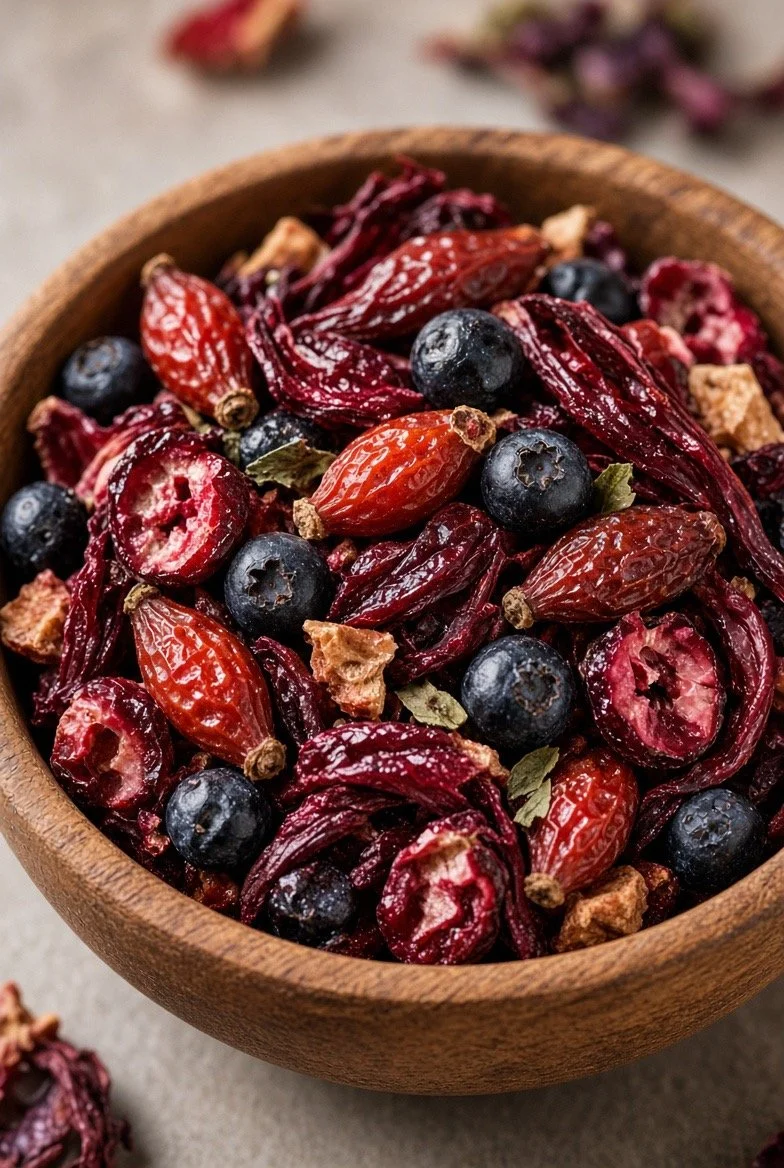
Very Berry is a fruit-and-herb tisane, so there are no tea leaves in it. It is made with rose hips, hibiscus, cranberries, blueberries, and natural forest berries flavor. There is no caffeine and no added sugar or sweeteners, just straight berry taste. It is naturally rich in vitamins and antioxidants, which makes it a wholesome swap for sugary drinks.
The name says it all: bold, juicy, and “very berry.” Pour a cup and you will get a deep red, burgundy-colored brew that balances sweet and tart nicely. It tastes like a fresh berry fruit punch, and it is great hot or iced.

How to Brew It Perfectly

Hot method (per 8 oz cup):

For an 8 oz cup, use 2 teaspoons of the fruit mix. Pour boiling water over it, steep 5–10 minutes, and strain. Drink it as is, or stir in a touch of honey or sugar if you like it sweeter.

Iced method (for 1 liter / 1 quart):

For a 1 liter (quart) batch, use 10–12 teaspoons of tea. Pour 1¼ cups of freshly boiled water over the leaves and steep 5–10 minutes. Strain into a pitcher that is already a quarter full of cold water, add ice, top with more cold water, and garnish. Sweeten to taste. It makes a great fridge staple for the whole family.

Iced Very Berry fruit tea

Why You’ll Love It

• Naturally caffeine-free, so it works any time of day or evening

• A fruit-punch taste the kids will love, without the sugar crash

• Makes excellent iced tea that stays refreshing in the fridge

• All-natural ingredients that bring vitamins and antioxidants

• Starts at just $2.95, so it is easy on the wallet

Shop Very Berry here → Very Berry Fruit Blend

Whether you need a caffeine-free after-school drink for the kids, a calm evening sip, or a colorful pitcher for guests, Very Berry has you covered. Stock up now and keep that berry goodness going all season long.

Visit beantowntea.com for our full range of herbal and fruit blends. Grabbing a sampler pack with Very Berry in it is an easy way to try it alongside our other favorites.

Do you like Very Berry hot with honey or iced with a squeeze of lemon? Share your favorite way to enjoy it with us on Instagram @beantownteaspices!

Happy steeping!

Beantown Tea
Cozy Up This Fall: Why Masala Chai (and a Strong Irish Breakfast) Belong in Your Autumn Ritual

The first real chill of the season makes me reach for the kettle, and a hot mug suddenly feels like a hug. Around here, October is when we start craving bold, warm blends that cut through the crisp mornings and early evenings, whether you live in Greater Boston or somewhere else. At Beantown Tea & Spices, we want quality teas at the right prices, carefully sourced and, in many cases, blended by us. Today’s daily tea note is about leaning into the season with two of our standouts: classic Masala Chai and robust Irish Breakfast.

Why Chai Shines in Fall

Masala Chai is one of our bestsellers, and once you taste it, the reason is obvious. It’s a full-bodied black tea base layered with South Indian masala spices: ginger, cardamom, coriander, cinnamon, cloves, and black pepper. Lively ginger and cardamom notes come through on the finish. Brew it traditionally with milk (or add warm milk after steeping) and a bit of sweetener, and you get a thick, aromatic, comforting cup that tastes like the season itself.

We also offer Vanilla Chai (creamy Madagascar vanilla that dances with those same Malabar Coast spices), Spiced Chai, a caffeine-free Rooibos Chai, and a pure Indian Chai Spice Mix you can blend with your favorite tea or even coffee. Every one of these is a proprietary or carefully chosen blend we stand behind, since our team is full of picky tea drinkers who sample everything more than once.

Quick brewing tip for true chai flavor:

Use 1 heaping teaspoon per cup and boiling water, then steep 5–10 minutes (at least 7 for the real deal). Prepare your cup with sugar and about 20% milk by volume, then pour the chai in. It also makes excellent iced chai when the Indian summer days hang on.

Start the Day Strong with Irish Breakfast

For those cooler mornings when you need something malty and robust to get going, reach for our Irish Breakfast. It’s a CTC (cut, tear, curl) blend of Assam and Kenya black teas: full-bodied and deeply malty from the Assam, with rich flavor from the Kenya leaf. CTC processing creates tiny pellets that deliver more strength and a bolder cup, which is why it shines with milk (the casein softens the tannins). A perfect “cheer-you-up” tea.

Country of origin: India and Kenya. Grade: BOP/BP1. Enjoy it with milk, the way a classic Irish breakfast tea should be.

A Few Seasonal Pairing Ideas

• Morning ritual: Irish Breakfast with a splash of milk, alongside a simple breakfast.

• Afternoon wind-down: Masala or Vanilla Chai, perhaps with a cookie or a square of dark chocolate.

• Evening option: Swap in one of our herbal blends (Sleep Well, Vanilla Rooibos, or Throat Soother) to keep the cozy feeling without the caffeine.

• Gift or share: Grab a sampler pack or the Holiday Tea Lover’s Box. They are a great way to introduce friends to the green, black, white, chai, and herbal teas we carry.

Keep any tea tasting its best by storing it in an airtight container away from light, air, moisture, and heat. Freshness matters, and we source and taste-test carefully so what you receive is ready to shine.

Whether you remember us from the old Tea Zone days in Boston or you’re just finding us now, these fall cups are what we love sharing: the calm, harmonious feeling of a really good tea at an everyday price.

Ready to stock up? Browse our chai selection, black teas, and sampler packs at beantowntea.com. Tag us in your autumn tea pics on Instagram @beantownteaspices. We love seeing how you enjoy them.

Until next time,

The Beantown Tea & Spices Team

Green Tea and Anti-Aging: What EGCG Actually Does

Spring days finally feel real again, and once the weather warms up we drink a lot more tea just to stay hydrated. Customers ask us all the time what tea is actually good for, and green tea comes up more than anything else. Here is the version we share in the shop about green tea and aging — clear, careful, and without the fluff.

A note before we go further: tea is a food and a beverage, not a treatment. Nothing in this post is medical advice, a diagnosis, or a substitute for care from a qualified clinician. The information here is for general education only. Always talk with a healthcare provider about your own health questions, and never delay medical care because of something you read about tea. Tea is not intended to diagnose, treat, cure, or prevent any disease.

Antioxidants, free radicals, and why green tea shows up in this conversation

Antioxidants are compounds that help neutralize free radicals — unstable molecules that can damage cells when they build up faster than the body can handle. That imbalance is often called oxidative stress, and it is one of the processes researchers study when they talk about cellular aging.

Green tea is rich in plant compounds called polyphenols, especially a family of them known as catechins. The best-studied catechin in green tea is EGCG (epigallocatechin-3-gallate). EGCG is a big reason green tea keeps appearing in research on inflammation, oxidative stress, and cellular health.

Green tea is especially interesting here because the leaves are heated soon after harvest to stop heavy oxidation. That keeps more of the natural catechins intact compared with fully oxidized black tea.

What research suggests (and what it does not prove)

Scientists have looked at green tea catechins for decades. The areas that come up most often in conversation about aging include:

  • Inflammation: Some studies suggest green tea polyphenols may help lower markers of inflammation. Chronic, low-grade inflammation is one of the themes that shows up in aging research, which is why people connect the dots — carefully.

  • Oxidative stress: Catechins can help mop up free radicals in lab work and in some human studies. That is the core antioxidant story behind many "anti-aging" headlines.

  • Cellular and DNA research: Early and ongoing work explores whether green tea compounds support the body's own repair systems and help protect cells from certain kinds of damage. This area is interesting, but it is not the same as proving tea prevents disease.

You will also see green tea extract in some skincare products. Drinking tea and applying extract to skin are different uses, so do not treat them as interchangeable. Lab or topical findings do not automatically mean a cup of tea will do the same thing.

What we do not claim: green tea stops aging, erases wrinkles, cures disease, or replaces healthy sleep, food, movement, and medical care. Some population studies report associations between regular green tea drinking and better health markers. An association is not proof that tea causes those outcomes, and results vary from study to study.

People also ask about metabolism, heart health, and weight. Catechins and caffeine together may give a modest metabolic nudge in some research, and observational studies have linked green tea habits with better cholesterol and cardiovascular markers. Lifestyle always matters too, and no cup is a shortcut.

How to brew green tea so you actually enjoy it

If the goal is a good daily habit, brewing matters more than chasing miracle claims. Bitter, astringent green tea usually means the water was too hot or the steep ran too long.

A practical starting point (per 8 oz):

  • Use about 1 teaspoon of loose leaf

  • Water around 160–180°F (70–80°C), depending on the tea — Japanese greens often prefer the cooler end

  • Steep 2–3 minutes, then taste and adjust

  • Store tea airtight, away from light, air, moisture, and heat

Nutty, sweet, grassy, or vegetal notes should lead — not bitterness.

Greens we like to put in the cup

If you want to explore our shelf:

  • Sencha: a classic everyday Japanese green

  • Dragonwell (Long Jing): a smooth Chinese green with a gentle chestnut note

  • Genmaicha: green tea with toasted brown rice for a nutty, approachable cup

Browse the full green tea selection to compare styles and find what you like.

The short version: a lot of the interest in green tea and aging comes back to antioxidants — especially EGCG — and how they relate to inflammation and oxidative stress. Brew a cup you actually enjoy, drink it regularly if you like it, and treat the health headlines with a little calm. Happy steeping from all of us at Beantown Tea & Spices.

Beantown Tea
Genmaicha: Japanese Green Tea with Toasted Rice

If you want a green tea that does not taste like every other green tea on the shelf, start with Genmaicha. It is a traditional Japanese blend of green tea leaves and fire-toasted brown rice, and the cup comes out nutty, aromatic, and genuinely satisfying.

At Beantown Tea & Spices, Genmaicha is one of those everyday greens people finish faster than they expect. Here is what it is, where it comes from, and how we like to brew it.

What Genmaicha is

Genmaicha (玄米茶) pairs Japanese green tea with roasted brown rice (genmai). Scoop it and you will see the story in the tin: green leaves mixed with small pieces of toasted rice, some of which pop during firing like tiny popcorn kernels — which is why you will sometimes hear it nicknamed "popcorn tea."

Our Genmaicha uses a high-grade Sencha and Gyokuro green tea base from Shizuoka Prefecture. The leaf keeps the fresh, vegetal character of Japanese green tea; the rice softens the edges and adds warmth.

A thrifty blend that earned its place

Genmaicha is often described as the tea of thrifty households. A widely told account says Japanese families added toasted rice to stretch their tea further when leaf was expensive, and the combination became a beloved drink in its own right — especially through the early twentieth century.

A popular folk legend tells a different story: a servant named Genmai accidentally dropped rice into his master's tea and gave the drink its name. The legend is charming but undocumented. Either way, what began as a practical blend is now enjoyed on its own merits, not as a compromise.

What it tastes like

The roasted rice does a lot of the personality work. It brings a nutty flavor, a bakey warmth, and a hint of natural sweetness. That is why Genmaicha works so well for people who find plain green tea a little sharp or grassy.

In the cup you should get a light golden liquor with:

  • Toasty, nutty aroma

  • Soft green-tea freshness underneath

  • A gentle, almost chewy finish from the rice

  • A little umami complexity from the Gyokuro in our blend

It is a natural partner for Japanese meals — miso soup, onigiri, tempura, or ramen — and a mellow after-dinner tea. It is also a friendly introduction to Japanese green tea if you prefer a warm, savory cup to a bright grassy one.

How to brew Genmaicha

Keep the water below a full boil so the leaf stays sweet instead of bitter.

Per 8 oz of water:

  • Amount: 1 heaping teaspoon (about 3 g)

  • Temperature: about 180°F (175–185°F / 80–85°C)

  • Steep time: 2–3 minutes

Adjust to taste. If the cup feels sharp, cool the water a little or shorten the steep. If you want more body, add a touch more leaf.

Shop Genmaicha

Ready to try it? Visit our Genmaicha product page, or browse the full green tea selection if you want to compare Japanese greens side by side.

Whether you drink it with dinner or as a quiet afternoon cup, Genmaicha is one of those teas that earns a permanent spot by the kettle. Happy steeping from all of us at Beantown Tea & Spices.

Very Berry Fruit Tea

If fruit teas are your thing, you're going to like this one. Our Very Berry Fruit Tea is naturally caffeine free, and it's built from real berries, hibiscus, and other fruits. Open the bag and you'll smell it right away.

What I love most is the balance. Plenty of fruit teas go all sugar or all sour. This one gets it right: the berries bring a natural sweetness, the tartness comes in just behind it, and the cup ends up satisfying without getting heavy.

It also works hot or iced, so it never really goes out of season around here. A mug of it on a cold afternoon is lovely, and a pitcher in the fridge in July is even better. Since it's made from all-natural ingredients, it's a nice swap for the sugary drinks a lot of us grab without thinking.

So if you've been looking for a fruit tea that actually tastes like fruit, give our Very Berry a try. It has a way of becoming the tin you reach for first.